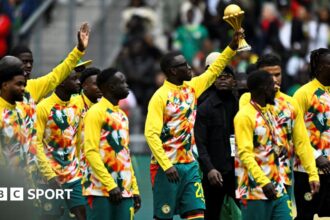
Senegal’s Defiant Stand: Lions of Teranga to Parade Afcon Trophy Amidst Title Stripping Controversy
In a stunning act of defiance that has sent shockwaves through the football world, Senegal is set to parade the Africa Cup of Nations trophy this Saturday in Paris, despite the Confederation of African Football (Caf) officially stripping them of the title last week. This bold move, announced during a fiery press conference by the Senegalese Football Federation (FSF), transforms a friendly match against Peru into a global stage for protest, signaling the start of a bitter legal and public relations battle for the soul of African football. The decision to overturn Senegal’s dramatic final victory over Morocco has ignited a firestorm, pitting administrative authority against the raw emotion of sporting triumph.
- A Parisian Press Conference: Declaring a “Crusade” for Justice
- Revisiting the Chaotic Final: What Actually Happened in Rabat?
- Expert Analysis: The Stakes and Precedents in a High-Profile Appeal
- Predictions and Ramifications: What Comes Next for African Football?
- Conclusion: More Than a Trophy, A Battle for Legacy
A Parisian Press Conference: Declaring a “Crusade” for Justice
The stage for this unprecedented conflict was set in Paris, far from Caf’s headquarters in Cairo. Surrounded by a determined legal team, FSF president Abdoulaye Fall did not mince words. His media conference was less a plea and more a declaration of war. Fall framed Senegal’s fight not as a mere appeal but as a “crusade” against a decision he labeled as fundamentally unjust and procedurally flawed. This choice of language underscores the depth of feeling in Senegal, where the 2025 Afcon victory was seen as a hard-earned pinnacle for a golden generation led by icons like Sadio Mané and Kalidou Koulibaly.
The federation’s strategy is clear: fight on every front. Legally, they have formally appealed to the Court of Arbitration for Sport (Cas), sport’s highest judicial body. In the court of public opinion, the trophy parade is a masterstroke—a visceral, symbolic rejection of Caf’s ruling. “We will show the world our champions, because that is what they are,” Fall asserted, framing the parade as an act of celebrating the players’ undeniable effort on the pitch, irrespective of the bureaucratic aftermath.
Revisiting the Chaotic Final: What Actually Happened in Rabat?
To understand the fury, one must revisit the chaotic night of January 18th in Rabat. After 120 minutes of grueling, goalless football against hosts Morocco, Senegal’s Lions of Teranga were on the cusp of victory. In the dying moments of extra time, a controversial penalty was awarded to Morocco. What followed was bedlam. The Senegalese squad, in an unprecedented move for a final, walked off the pitch in protest. After a significant delay, they returned, the penalty was missed, and the match proceeded to a shootout, which Senegal won.
Caf’s subsequent ruling, however, focused on the walk-off. Citing regulations that mandate a team’s presence on the field for a match to conclude, they deemed Senegal to have forfeited the match. The result was overturned to a 3-0 victory for Morocco. This technical application of the rules has clashed violently with the narrative of sporting contest.
- The Sporting Argument: Senegal’s supporters argue the players returned, the penalty was taken (and missed), and the match was concluded fairly on the field. The walk-off, while punishable, should not erase the subsequent shootout victory.
- The Regulatory Argument: Caf maintains that the rules are clear. Leaving the pitch constitutes a forfeit, and the events after the unauthorized departure are irrelevant.
This clash is at the heart of the impending Cas appeal: a test of whether strict regulatory adherence can nullify the tangible outcome of a sporting contest.
Expert Analysis: The Stakes and Precedents in a High-Profile Appeal
The appeal to the Court of Arbitration for Sport is now the central battleground. Legal experts are divided. Cas is known for upholding governing bodies’ regulations, but it also considers principles of proportionality and fairness. Senegal’s legal team, likely, will not just challenge the application of the forfeit rule but may also question the disciplinary process itself and the severity of the punishment.
“This is one of the most politically charged cases Cas has seen in African football,” notes a seasoned sports lawyer familiar with Caf proceedings. “The decision will set a massive precedent. Does walking off for ten minutes in protest, before returning to complete the match, warrant the ultimate sanction—the stripping of a continental title? Cas must balance deterrence for future conduct with the catastrophic sporting consequence for these players.”
Furthermore, the very public defiance of Senegal complicates matters. The trophy parade is a powerful symbol that could be seen as putting public and political pressure on the judicial process. However, it also galvanizes domestic support and ensures the world is watching, potentially making any compromise by Cas more difficult.
Predictions and Ramifications: What Comes Next for African Football?
The fallout from this controversy will reverberate long after Cas delivers its verdict. Several scenarios and consequences are now in play:
Scenario 1: Cas Upholds Caf’s Decision
Should Cas rule in favor of Caf, Senegal’s defiance will turn to profound disillusionment. The trophy would be physically transferred to Morocco, but the legitimacy of the title in the eyes of many fans would be forever tarnished. Trust in Caf’s leadership would likely hit a new low, potentially sparking calls for structural reform. The Senegalese federation could face further sanctions for its inflammatory rhetoric and the unsanctioned trophy parade.
Scenario 2: Cas Overturns or Modifies the Decision
A ruling in Senegal’s favor would be a seismic humiliation for Caf’s executive committee. It could reinstate Senegal as champions or, perhaps more likely, order a replay of the final—a logistically nightmarish prospect. This outcome would be celebrated as a victory for sporting spirit over bureaucracy but would critically weaken Caf’s authority to enforce its own regulations.
Beyond the verdict, the damage to the Africa Cup of Nations brand is tangible. The prestige of the continent’s premier tournament is built on the unassailable legitimacy of its champion. That foundation is now cracked. Future disputes may see federations more willing to pursue confrontational, public appeals, following Senegal’s template.
Conclusion: More Than a Trophy, A Battle for Legacy
When Senegal’s players carry that trophy onto the pitch at a Parisian stadium this Saturday, they will be carrying the hopes, anger, and pride of a nation. This is no longer just about a football match. It is a battle for legacy, for the right of athletes to have their on-field achievements stand, and for the soul of how African football is governed. The Senegalese Football Federation, under Abdoulaye Fall, has chosen a path of radical, public confrontation, betting that the court of public opinion can influence the court of arbitration.
Whether this “crusade” succeeds or fails, it has already exposed deep fissures. The image of a champion parading a trophy they have officially been stripped of is a powerful metaphor for the disconnect between administrators and the essence of sport. The Cas ruling will deliver a legal conclusion, but the emotional and political scars from this confrontation will define African football for years to come. The world will be watching, not just the parade, but the profound struggle it represents.
Source: Based on news from BBC Sport.