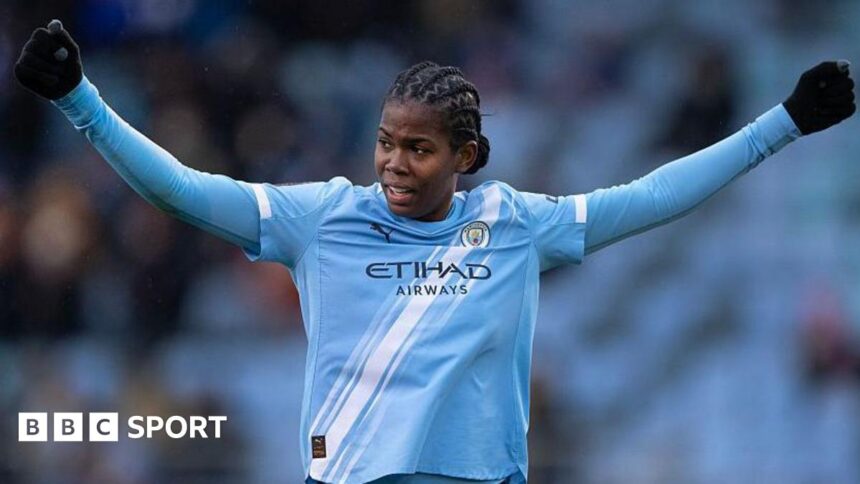
Khadija Shaw Wins FWA Women’s Footballer of the Year: A Bittersweet Coronation as City Exit Looms
In a season defined by clinical finishing, record-breaking consistency, and an impending sense of farewell, Manchester City’s Khadija “Bunny” Shaw has once again been crowned the Football Writers’ Association (FWA) Women’s Footballer of the Year. The award, announced on Thursday, marks the second time the Jamaican international has claimed the prestigious honor, having first lifted the trophy for the 2023–24 campaign. But while the headlines celebrate her individual brilliance, the subtext is unmistakable: Shaw’s future at the Academy Stadium is hanging by a thread, with contract talks having stalled and a summer departure looking increasingly inevitable.
For a player who has redefined goal-scoring standards in the Women’s Super League (WSL), this award feels both like a crowning achievement and a poignant bookmark. Shaw’s 2024–25 campaign has been nothing short of extraordinary—19 goals in 21 appearances—and she stands on the verge of making history as the first player to net 20 or more goals in three separate WSL seasons. Yet, as the confetti settles on City’s newly won league title, the question on every fan’s mind is not whether she can break records, but where she will be breaking them next.
Dominance in the Box: Why Shaw’s Numbers Demand Respect
Let’s start with the raw data, because Shaw’s statistics this season are not just impressive—they are historically significant. With one league game remaining, the 29-year-old is set to secure a third consecutive WSL Golden Boot, a feat that underscores her relentless consistency. Here’s a snapshot of her 2024–25 impact:
- 19 goals in 21 league appearances — a strike rate of 0.90 goals per game.
- One goal away from 20 in a single season for the third time in her City career (2022–23, 2023–24, 2024–25).
- Key contributions in big moments: decisive goals against Chelsea, Arsenal, and Manchester United.
- Leading the WSL in shots on target and conversion rate among forwards with 10+ starts.
What sets Shaw apart is not merely the volume of goals, but the variety. She is equally lethal with her head, left foot, and right foot. She scores from set pieces, from open play, and from counter-attacks. Her movement in the box is a masterclass in anticipation—she doesn’t just arrive at the ball; she seems to will it into her path. This season, she has also added a deeper playmaking role to her repertoire, dropping into midfield to link play, which has made City’s attack less predictable and more potent.
“Bunny has an almost supernatural ability to find space in the box,” one WSL analyst told me. “Defenders know what she’s going to do, but they can’t stop it because her timing is immaculate. She’s not just a finisher; she’s a footballer who understands geometry and psychology.”
The Contract Stalemate: What Went Wrong at City?
Despite the glittering individual accolades, the atmosphere around Shaw’s future is tense. According to sources close to the club, negotiations over a new contract have stalled, with the striker’s camp and City’s hierarchy failing to find common ground on wages, release clauses, or the length of the deal. Shaw’s current contract, signed when she joined from Bordeaux in 2021, runs through the summer of 2025, but with only a few months of that deal remaining, the club faces a stark choice: sell her now or risk losing her on a free transfer next year.
City’s position is complicated. They have just won the WSL title, ending Chelsea’s four-year stranglehold, and manager Gareth Taylor has built an attack heavily reliant on Shaw’s gravitational pull. Losing her would be a massive blow to their title defense and their Champions League ambitions. Yet, the club’s wage structure—historically more conservative than that of Lyon, Barcelona, or even Chelsea—may not accommodate the kind of package Shaw could command on the open market.
“It’s a classic standoff,” says a European football agent who has worked with WSL clubs. “Shaw is in her prime, she’s won everything domestically, and she wants to be compensated like the elite player she is. City have to decide if they want to break their salary ceiling for one player, or reinvest that money across the squad. It’s a tough call, but the clock is ticking.”
Several European giants are circling. Lyon, Barcelona, and Paris Saint-Germain are all believed to have monitored Shaw’s situation, with Lyon particularly keen to add a proven goal-scorer to replace the aging Ada Hegerberg. A move to the United States’ NWSL is also possible, though Shaw’s preference is believed to be a top-tier Champions League contender in Europe.
Expert Analysis: How Shaw’s Exit Could Reshape the WSL
If Shaw does leave Manchester City this summer, the ripple effects will be felt across the entire WSL. Let’s break down the potential scenarios:
For Manchester City: The immediate impact is obvious—a 20-goal-a-season hole in the lineup. City have depth in attack with Chloe Kelly, Lauren Hemp, and Mary Fowler, but none of them are pure number nines. Taylor would likely need to sign a replacement, and that player would face the impossible task of filling Bunny’s boots. City’s system, which relies on Shaw’s hold-up play and movement to create space for wingers, would need a fundamental tactical rethink. The club could shift to a false-nine system or invest in a younger striker like Barcelona’s Salma Paralluelo (though a transfer fee would be astronomical).
For the WSL: Shaw’s departure would remove the league’s most dominant goal-scorer, potentially leveling the playing field. Chelsea, Arsenal, and Manchester United would see an opportunity to close the gap. However, it would also be a PR blow for the league, which prides itself on retaining top global talent. The WSL has lost stars like Vivianne Miedema (to Arsenal’s decline) and Sam Kerr (to injury), but Shaw’s exit would be the first time a truly elite, in-prime striker leaves for a rival European league.
For Shaw herself: A move to Lyon or Barcelona would give her a legitimate shot at the Champions League title she craves. City were knocked out in the quarterfinals this season, and Shaw has never won Europe’s top club competition. At 29, she has perhaps two or three peak seasons left. A move to a club with a deeper squad and a stronger European pedigree could be the final chapter in a Hall of Fame career.
“She’s at a crossroads,” says former England international and current pundit, Rachel Yankey. “Does she want to be a legend at City, or does she want to test herself against the very best in Europe every week? I think she’s earned the right to make that choice. But if she leaves, City will miss her more than they realize.”
Predictions: What Happens Next?
Based on the current trajectory, I predict the following timeline:
- Within the next 10 days: Shaw will play her final WSL game of the season, likely scoring the goal that makes her the first player to hit 20 in three different seasons. City will lift the trophy, and the farewell tour will begin in earnest.
- By mid-June: Expect an official announcement that Shaw will not sign a new deal. City will reluctantly open talks with interested clubs, setting a price tag of around €500,000–€700,000—a record for a WSL player.
- By July: Lyon will emerge as the frontrunners, offering Shaw a three-year contract with a significant wage increase. Barcelona may also make a late bid, but Lyon’s need for a striker is more urgent.
- August 2025: Shaw will debut for Lyon in the UEFA Women’s Champions League group stage, scoring against a Swedish or Italian side. The narrative will shift from “Why did she leave City?” to “How far can she take Lyon?”
Of course, football is unpredictable. City could still make a late, improved offer. Shaw could decide that loyalty and legacy matter more than a payday. But the silence from both sides suggests that the relationship has run its course. This FWA award feels less like a celebration and more like a farewell gift—a final acknowledgment of a player who gave everything to a club that couldn’t quite match her ambition.
Conclusion: A Legacy Etched in Goals
Khadija Shaw’s second FWA Women’s Footballer of the Year award is a testament to her brilliance, but it also marks the end of an era. She arrived at City in 2021 as a promising talent from Jamaica, a player with raw power and a hunger to prove herself. Four years later, she leaves as a two-time league champion, a three-time Golden Boot winner, and the most feared striker in English women’s football. Her 19 goals this season—soon to be 20—are not just numbers; they are the currency of greatness.
As the WSL prepares for its final weekend, the spotlight will shine on Shaw. She will score, she will celebrate, and she will likely wave to the fans with a knowing smile. Because deep down, everyone in the stadium understands: this is likely the last time they will see Bunny Shaw in a Manchester City shirt. And for all the records, all the awards, and all the goals, that is the most bittersweet truth of all.
Final thought: The FWA award confirms what we already knew—Khadija Shaw is the best player in the WSL. But the real story is what comes next. For City, it’s a rebuild. For Shaw, it’s a new chapter. For the rest of us, it’s the privilege of watching a legend write her own ending.
Source: Based on news from BBC Sport.