Shedeur Sanders’ Fiery Defense: A Rookie’s Audible on Leadership and the Noise Outside the Huddle
The transition from college superstar to NFL starting quarterback is a gauntlet of physical pressure and relentless scrutiny. For Cleveland Browns rookie Shedeur Sanders, the latest test didn’t come from a blitzing linebacker, but from a post-game press conference. Following a gut-wrenching 20-17 home loss to the Buffalo Bills, a game defined by critical late-game coaching decisions, Sanders delivered a message that was less about Xs and Os and more about locker room sovereignty. His pointed pushback—”Come on, man”—wasn’t just a dismissal of a question; it was a declaration of where his allegiance lies and a fascinating moment in the evolution of a franchise quarterback.
The Crucible of Cleveland: From Tumult to Tenacity
Shedeur Sanders’ arrival in Cleveland was met with the typical fanfare of a first-round pick, but his early career was anything but typical. Inheriting a team in flux, Sanders’ rookie season began with significant growing pains, including a shaky offensive line and the inevitable mistakes that plague young quarterbacks. However, as noted by Browns legend and Hall of Famer Joe Thomas, what sets Sanders apart is his preternatural calm. “The moment has never been too big for him,” Thomas recently stated on his podcast. “You see the processing speed, the poise in the pocket. The early struggles were about the system coalescing, not about his confidence.”
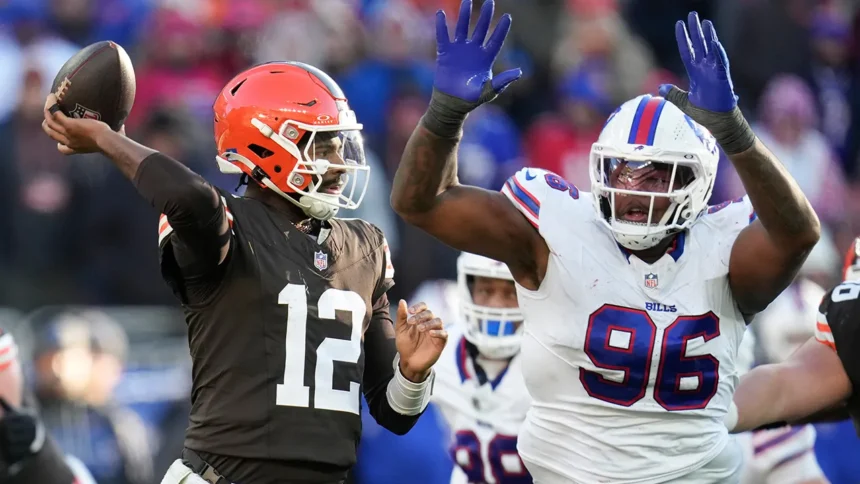
That coalescence was on full display against a formidable Bills defense. Sanders, facing constant pressure, made several breathtaking throws and showcased the improvisational magic that made him a Heisman contender. The stat line—24-of-38 for 278 yards and two touchdowns—was solid, but the game’s narrative was ultimately defined by two pivotal sequences in the final minutes, both with the Browns trailing by just a field goal.
- 4th & 3 at the BUF 42, 5:08 remaining: The Browns, after a timeout, run a play that results in an incomplete pass. Turnover on downs.
- 4th & 10 at the CLE 25, 1:55 remaining: Following a defensive stop, the Browns’ coaching staff elects to punt the ball back to Josh Allen, trusting their defense one final time.
Both conservative decisions, particularly the punt from deep in their own territory, became instant fodder for second-guessing. It was the inevitable question about these calls that sparked Sanders’ now-viral moment.
“Come On, Man”: Decoding Shedeur’s Defensive Stand
When the post-game inquiry came about the late-game strategy, Sanders’ reaction was immediate and visceral. He shook his head, offered a weary smile, and cut off the line of questioning with a firm, “Come on, man. We’re not doing that.” He then elaborated, framing his response not as defiance but as unity. “We believe in our coaches. We believe in the plan. Every call is a call we practice, a call we own. We had our chances on the field, and we win and lose as a team. Period.”
This was more than a cliché. In the high-stakes, hyper-analytic world of the modern NFL, where every decision is dissected on social media within seconds, Sanders’ stance is a powerful leadership maneuver. He effectively erected a shield around his coaching staff and redirected the focus to player execution. The message to the media was clear: don’t look to create division here. The message to his teammates and coaches was even clearer: I have your back, publicly and without hesitation.
This instinct to protect the institution is a trait often found in veteran leaders, not rookies navigating their first dose of NFL adversity. It reveals a maturity that transcends physical talent. Sanders understands that the ecosystem of a winning team is fragile, and public doubt, especially from within the huddle, is a corrosive force. By shutting down the narrative of “coaching error,” he is actively building the resilient, us-against-the-world culture that winning franchises require.
Expert Analysis: The Calculated Risk of Backing Your Staff
From a tactical standpoint, analysts will debate Head Coach Kevin Stefanski’s decisions for days. The analytics community was likely split on the 4th & 10 punt, weighing the odds of a conversion against the risk of giving Allen a short field. However, from a team-building perspective, Sanders’ response is unimpeachable.
“What you’re seeing is the birth of a true franchise quarterback,” says Dr. Elena Martinez, a sports psychologist who consults with NFL teams. “He is consciously assuming the role of the buffer. He’s absorbing the external pressure and refusing to let it seep into the meeting rooms. That ‘Come on, man’ wasn’t frustration with the reporter; it was frustration with the very idea of blaming the outcome on a single decision. He’s teaching everyone how he expects the team to respond to adversity.”
This dynamic also strengthens Sanders’ relationship with Stefanski. A coach can demand respect, but it is far more powerful when it is freely given and publicly championed by the team’s most important player. It creates a powerful coach-quarterback symbiosis that can withstand the inevitable storms of a long season. Joe Thomas’s confidence in Sanders seems to extend beyond the field, hinting at this very intangible quality: “He’s got the ‘it’ factor. And part of that is knowing what to say, when to say it, and who to protect.”
Predictions: How This Moment Fuels the Browns’ Future
The immediate aftermath of a close loss is about pain, but the long-term trajectory of the Browns may have been subtly accelerated by this exchange. Sanders has drawn a line in the turf.
- Locker Room Capital: Sanders’ stock with veterans and rookies alike will soar. Players fight for a quarterback who fights for them and their coaches.
- Media Relations Blueprint: Sanders has established his press conference demeanor—respectful but fiercely protective of the team’s internal process. The media now knows the boundaries.
- Front Office Confidence: The organization’s investment in Sanders is validated not just by his arm, but by his shoulders—his ability to carry the weight of leadership.
Looking ahead, this moment will be referenced as a turning point if the Browns evolve into a consistent contender. The close losses of today, borne with collective responsibility, forge the resilience needed for the clutch wins of tomorrow. The poise under pressure Shedeur Sanders showed in the pocket against the Bills was mirrored by his poise at the podium. Both are essential skills for the job.
Conclusion: More Than a Soundbite, A Statement of Purpose
Shedeur Sanders’ “Come on, man” will be clipped and shared, perhaps as a meme or a soundbite of a frustrated athlete. But to dismiss it as such would be to miss its profound significance. In a few short words, the rookie quarterback did what leaders do: he defined reality for his team. The reality he defined is one of unity, shared accountability, and unwavering belief in the process.
The loss to the Bills stings in the standings, but the Browns may have gained something more valuable than a single win: the unequivocal voice of their leader. The physical tools were never in question. Now, the intangible architecture of leadership is being constructed, brick by brick, in the public eye. Shedeur Sanders isn’t just answering questions about play calls; he’s calling the play for the culture of the Cleveland Browns. And his audibles, both on and off the field, suggest this franchise is in more than capable hands.
Source: Based on news from Fox Sports.