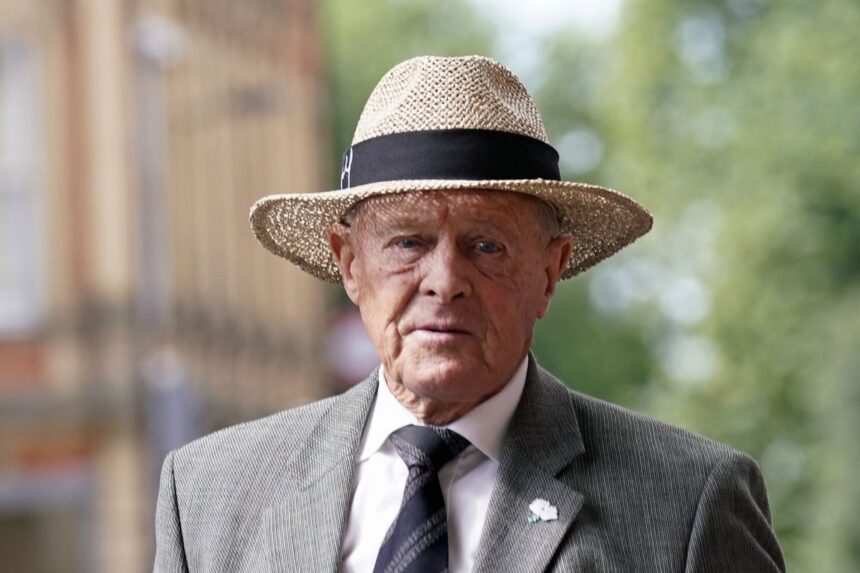
Sir Geoffrey Boycott Demands Axe for Brendon McCullum as Ashes Dream Crumbles
The dust has barely settled on the Adelaide Oval, where Australia clinically sealed the Ashes urn, but in England, the inquest has begun with a characteristically blunt instrument. Sir Geoffrey Boycott, the legendary opener and never one to mince his words, has launched a scathing broadside at the heart of England’s leadership, calling for the head of coach Brendon McCullum and issuing a stark ultimatum to captain Ben Stokes. This is not a gentle critique; it is a full-throated demand for regime change from one of English cricket’s most iconic voices, arguing that the ‘Bazball’ revolution has hit a brick wall built of Australian grit.
The Boycott Broadside: A Call for Radical Change
In his column for the Daily Telegraph, Boycott dispensed with pleasantries and went straight for the jugular. His central thesis is damning: the current leadership’s approach has become an exercise in stubborn folly. “Stokes and McCullum are like men digging a hole to nowhere,” Boycott wrote. “If what you are doing isn’t working then stop digging.” For Boycott, the 3-0 series deficit is not merely a result of being outplayed by a better side; it is a direct indictment of a philosophy he has long questioned. He perceives a dangerous and unchecked hubris that has replaced pragmatic cricket sense, a charge that cuts to the very core of the McCullum-Stokes ethos.
Boycott’s solution is unequivocal. Addressing England managing director Rob Key directly, he stated: “What would I do? Change the coach. We are tired of this duo talking a good game but not delivering against the best teams so Rob Key, it is time for you to assert yourself.” This is a significant moment. It moves the criticism from the realm of punditry into a direct challenge to the ECB’s hierarchy, pressuring Key to choose between backing his high-profile appointments or heeding a cricketing knight’s call for a scalp.
Bazball Under the Microscope: Revolution or Recklessness?
Boycott’s fury is the culmination of a long-standing scepticism towards Bazball—the hyper-aggressive, risk-embracing philosophy imported by Brendon McCullum. While it initially breathed exhilarating life into a moribund Test team, yielding a string of historic run-chases against lesser opponents, its efficacy against the world’s best bowling attack has been exposed. Boycott’s critique centres on the lack of situational adaptability. The key failures he highlights include:
- Poor First-Innings Batting: Consistently failing to build commanding first-innings totals, leaving the bowlers with nothing to defend.
- Shot Selection Under Pressure: Reckless dismissals at critical moments, mistaking aggression for intelligence.
- Ignoring Match Context: A perceived refusal to temper the approach when the game situation—or the quality of the opposition—demands it.
- Psychological Defeat: Allowing Australia to manipulate the tempo, turning England’s own aggressive intent against them.
“Change is absolutely necessary to step up to the next level,” Boycott insists. The implication is clear: Bazball, in its current unadulterated form, is a ceiling, not a foundation, for world domination.
The Stokes Conundrum: Captaincy Under Fire
Significantly, Boycott does not let Ben Stokes escape his wrath. While acknowledging his heroic qualities, Boycott suggests the all-rounder’s captaincy is part of the problem. The ultimatum is clear: learn tough lessons or face the axe. This raises profound questions about the duality of Stokes’s role. Can the same instinctive, momentum-seeking warrior who thrives on personal inspiration also be the cold, calculating strategist required to outmanoeuvre a side like Australia over five Tests?
Boycott’s argument suggests that Stokes’s unwavering commitment to the ‘entertainment’ mantra has clouded his judgment. The captain’s declarations, field placements, and batting orders have all been scrutinised, with critics arguing they have often played into Australian hands. The burden of leadership, combined with his vital role with bat and ball, appears immense. Should England persist with a captain whose style may be intrinsically linked to a failing method, or is a new, more pragmatic voice needed to harness the undeniable talent within the squad?
What Happens Next? Predictions for a Crossroads Summer
The final two Tests are now a battle for pride and, potentially, careers. Boycott’s intervention has raised the stakes from a simple post-mortem to a live referendum on English Test cricket’s direction. Several scenarios now loom:
- Stubborn Persistence: The most likely outcome is that the ECB, through Rob Key, publicly backs McCullum and Stokes, citing long-term vision and the transformative effect prior to this series. They will demand a response in the remaining Tests.
- Philosophical Evolution: Pressure may force a subtle but crucial shift. We may see a more nuanced ‘Bazball 2.0’—retaining positive intent but with smarter game management and shot selection, particularly in the first innings.
- The Boycott Scenario: A 5-0 whitewash could make Boycott’s call irresistible. If the final scoreline is catastrophic, Key may be forced to act, potentially sacrificing McCullum to preserve Stokes as captain and initiate a search for a coach who can add tactical nous to the existing aggression.
- Player Revolt (Silent or Otherwise): The dressing room’s mood is key. If senior players begin to privately question the method after another heavy defeat, the ground beneath McCullum’s feet will become dangerously unstable.
Conclusion: More Than Just a Column, A Line in the Sand
Sir Geoffrey Boycott’s column is more than just the rant of a former player. It is a crystallisation of a growing unease within a segment of English cricket’s faithful. It asks the uncomfortable question: is this brave new world actually a cul-de-sac? The romance of Bazball has crashed against the rocks of Australian excellence, and the bill for that collision is now being presented.
For Brendon McCullum and Ben Stokes, the remaining matches are no longer dead rubbers. They are auditions for their continued tenure. They must prove that their philosophy contains the seeds of its own adaptation, that it can learn, pivot, and ultimately conquer. For Rob Key, the man who appointed them, the coming weeks are a severe test of his own judgment. He must decide whether to ride out the storm with his chosen men or wield the axe to placate a legend and a disillusioned public. The Ashes may be gone, but the battle for the soul of English Test cricket has just been reignited, with Sir Geoffrey Boycott throwing the first, unmissable punch.
Source: Based on news from Yahoo Sports.