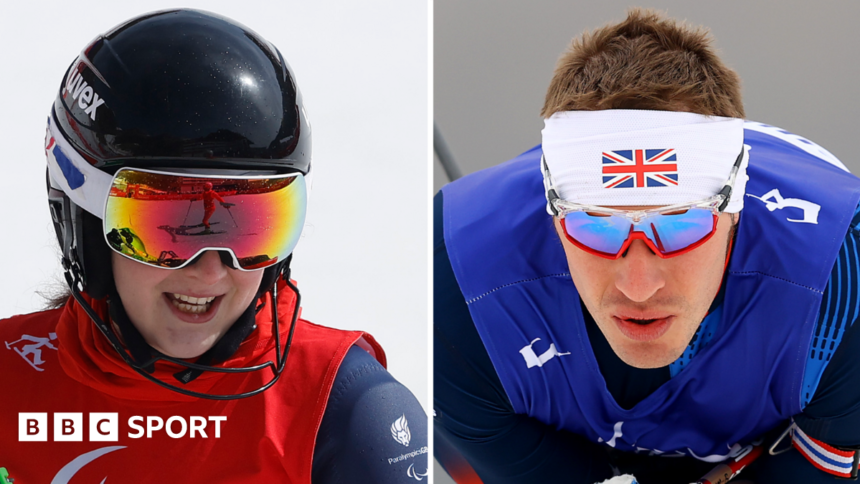
Fitzpatrick and Meenagh: A Tale of Resilience and Leadership as GB’s Paralympic Flagbearers
As the winter sun sets over the snow-dusted peaks of the host region, a powerful symbol of British sporting spirit will emerge at the head of the procession. The honour of carrying the Union Jack into the Opening Ceremony of the Winter Paralympics has been bestowed upon two athletes whose journeys encapsulate the very essence of Paralympic endeavour: resilience, excellence, and unwavering determination. Para-alpine skier Menna Fitzpatrick and para-Nordic skier Scott Meenagh, both embarking on their third Games, have been named as Great Britain’s flagbearers, a decision that resonates with profound meaning for the entire delegation.
This pairing is not merely ceremonial; it is a narrative-rich choice. Fitzpatrick, Britain’s most decorated Winter Paralympian, defies a recent and severe injury to compete. Meenagh, a pioneer in his discipline, represents the relentless pursuit of progress in a traditionally challenging field for British athletes. Together, they form a duo whose stories will inspire long before the starting gate opens. Their shared leadership role marks a poignant moment for British Paralympic sport, signalling a blend of historic achievement and gritty perseverance.
Profiles in Courage: The Flagbearers’ Journeys
The paths of Menna Fitzpatrick and Scott Meenagh, while distinct in their sporting specifics, run parallel in their demonstration of elite athletic fortitude. Their selection as joint flagbearers celebrates two remarkable careers reaching a pivotal zenith.
Menna Fitzpatrick, the 27-year-old from Wales, is a titan of British winter sport. With a haul of six medals—including one gold, two silvers, and three bronzes—from PyeongChang 2018 and Beijing 2022, her legacy is already secure. Guided by her sighted guide, Katie Guest, Fitzpatrick’s technical mastery and fearless speed in the visually impaired alpine events have made her a consistent podium threat. However, her journey to these Games is her most formidable yet. Just three months prior to competition, she sustained a significant knee injury—a potentially devastating blow for any skier, let alone one at the pinnacle of her career. Her very presence on the snow, let alone as flagbearer, is a testament to a monumental rehabilitation effort and a mindset that refuses to yield.
Scott Meenagh, a 33-year-old former paratrooper from Scotland, embodies the spirit of exploration and endurance. As a Para-Nordic skier, he competes in the gruelling disciplines of cross-country skiing and biathlon, terrains where British medals have been historically scarce. His role is that of a trailblazer. Meenagh’s appearances at PyeongChang 2018 and Beijing 2022 were landmark achievements in themselves, focused on breaking into the top tiers of a deeply competitive field. His progression—from finishing races to now targeting competitive placements—charts the growth of an entire programme. His selection as flagbearer recognises not just his personal athletic rigour, but his role in laying the tracks for future British Nordic skiers to follow.
Expert Analysis: The Significance of the Selection
The choice of Fitzpatrick and Meenagh is a masterstroke in narrative and symbolism, speaking volumes about the current state and values of ParalympicsGB. Analysts see this decision as multi-layered:
- Balancing Achievement and Grit: Fitzpatrick represents the pinnacle of proven Paralympic success. Her medal tally brings a aura of winning expectation. Meenagh, conversely, symbolises the courageous, long-term campaign in a development sport. Together, they honour both the podium stars and the pathfinders.
- A Message of Resilience: Fitzpatrick’s recent injury is a stark reality of high-performance sport. By placing her at the forefront, ParalympicsGB is broadcasting a powerful message about overcoming adversity. It tells every athlete facing their own challenges that resilience is celebrated as highly as victory.
- Unity Across Disciplines: Alpine and Nordic skiing are the two pillars of the winter programme. This joint honour fosters a sense of team unity and shared purpose across the entire delegation, from the speed-centric slopes to the endurance-testing tracks.
- Leadership for a New Cycle: As third-time Paralympians, both athletes provide experienced, steady leadership for a team blending veterans and newcomers. Their presence is a calming, inspiring force in the high-pressure Games environment.
Medal Prospects and Event Predictions
The flagbearer roles come with the immediate pivot to competition, where both athletes face compelling and contrasting narratives.
All eyes will be on Menna Fitzpatrick and guide Katie Guest. The key question is how her knee will hold up under the extreme forces of World Cup-level alpine skiing. Pre-Games training reports will be scrutinised. If she is near full capacity, Fitzpatrick remains a potent threat in every visually impaired event she enters, particularly the technical disciplines like slalom and giant slalom where her skill shines. The prediction here is one of heart over history: a medal would be a phenomenal triumph, but her true victory may be in courageous competition. Her performance will be a defining story of the Games, regardless of the result.
For Scott Meenagh, the metrics of success are different. The focus will be on his position in the results sheets, aiming to close the gap on the podium places. Look for him to potentially challenge for a top-10 finish in his strongest events, a result that would constitute a major step forward for British Nordic skiing. His biathlon shooting accuracy could be the decisive factor in breaking into new territory. His races are less about immediate medal contention and more about demonstrating tangible, performance-based progress that justifies the long-term investment in the sport.
Beyond the flagbearers, the British team will look to stars like Neil Simpson (guided by his brother Andrew) and others in the para-alpine squad to add to the medal tally. The overall expectation is for a compact, focused team to deliver a handful of podium moments, with Fitzpatrick’s events carrying the heaviest anticipation.
A Legacy in Motion: Carrying the Flag Forward
When Menna Fitzpatrick and Scott Meenagh grasp the flag on Friday, they will be carrying more than fabric; they will be hoisting the collective hopes, struggles, and pride of a team. For Fitzpatrick, the ceremony is a triumphant step in a recovery journey, a moment to savour before the storm of competition. For Meenagh, it is recognition of a decade of lonely kilometres on the track, pushing the boundaries of what is possible for an athlete in his discipline.
Their shared duty marks the perfect opening chapter for these Winter Paralympics. It reminds us that the Paralympic movement is as much about the character of the journey as the destination. Fitzpatrick’s story teaches us that champions are defined by how they respond to being knocked down. Meenagh’s story teaches us that progress is often measured in incremental gains, and that paving the way is an honourable pursuit.
As they lead the British team into the stadium, they embody a powerful duality: the brilliance of medals won and the quiet dignity of challenges relentlessly pursued. This is the essence of Paralympic sport. Their leadership begins not with a starter’s gun, but with the unfurling of a flag—a signal that for these athletes, and for the team they lead, the real work, and the real inspiration, is just about to begin.
Source: Based on news from BBC Sport.