Snicko Needs to Be Sacked: The Ashes Technology Controversy Engulfing Cricket
The Ashes is cricket’s grandest stage, a theater where legends are forged and narratives are etched in history. Yet, in the 2025-26 series, a subplot of technological farce is threatening to overshadow the sport itself. The controversy centers on the Snickometer, or ‘Snicko’, the audio-based detection system designed to be the arbiter of fine edges. What was meant to be a pillar of certainty has become a source of profound confusion, with calls growing for its immediate removal from the Decision Review System (DRS) suite. The third Test in Adelaide has laid bare a crisis of confidence, proving that when technology fails, it doesn’t just ruin a dismissal—it risks undermining the integrity of the entire contest.
A Tale of Two Balls: Adelaide’s Double Snicko Debacle
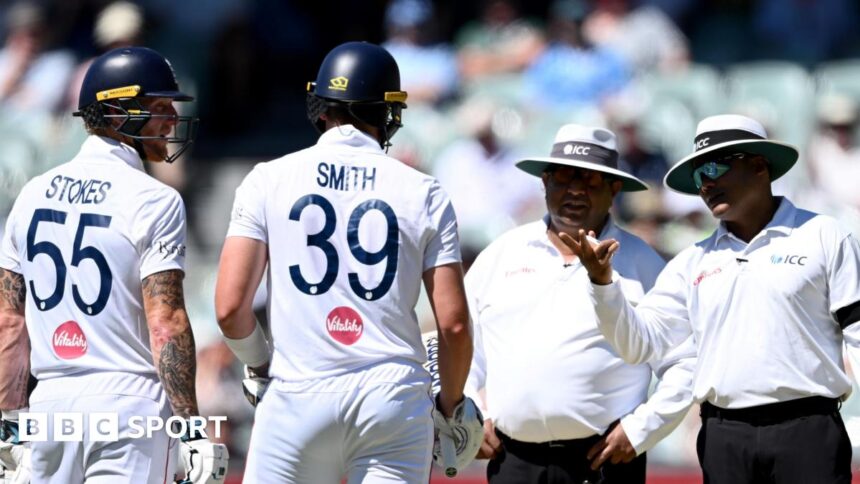
If day one’s reprieve for Australia’s Alex Carey—a result of a confirmed operator error—was a warning shot, days two and three were a full-blown bombardment on logic. England’s Jamie Smith found himself at the eye of a storm that perfectly illustrated the system’s alarming inconsistencies.
Facing a fiery spell, Smith appeared to feather a glance down the leg side. Australia went up in unison, the on-field umpire remained unmoved, and Pat Cummins instantly signaled for a review. The subsequent process was a masterclass in ambiguity. Real-time Snicko showed a faint, flatline disturbance as the ball passed the bat. However, the crucial UltraEdge graphic, which synchronizes the audio spike with video frames, was inconclusive at best. The third umpire, drowning in a sea of uncertain data, upheld the on-field ‘not out’ call. The Australians were furious, convinced justice had been denied by a flawed tool.
Just innings later, the script flipped with cruel irony. Smith, again, faced a similar delivery. This time, the on-field umpire raised his finger for a caught behind. Smith reviewed immediately, hopeful the technology would save him. The replay showed a clear gap between bat and ball. But the audio told a different, and now familiar, story: a faint murmur on Snicko. Despite the visual evidence, the third umpire felt compelled to follow the audio trace and upheld the decision. Smith was gone, a victim of the very system that had spared him hours before.
The sequence was damning:
- Inconsistent Application: Similar events yielded diametrically opposed outcomes.
- Operator & Interpretation Reliance: The human element in reading the tech became the deciding factor, introducing error and bias.
- Erosion of Trust: Players and fans were left bewildered, unsure what constituted conclusive evidence.
Expert Analysis: Why Snicko is Fundamentally Flawed
The problem with Snicko is not its intention, but its execution and place within the DRS. As a former international umpire and now leading analyst, Michael Gough, explained to me, “The system is too sensitive. It picks up everything—the bat brushing the pad, a hand leaving the handle, even external noises from the crowd or the mics themselves. When you isolate that audio and pair it with a graphic, it creates an illusion of certainty where none may exist.”
This sensitivity turns the review process into a forensic audio investigation for which umpires are not trained. They are asked to distinguish between the decibel level of an edge and the decibel level of incidental noise, a near-impossible task without clear visual correlation. The UltraEdge synchronization, which uses the stump mic’s audio for its spike, is meant to be the definitive check, but as seen in Adelaide, it can be murky on the faintest of contacts.
Furthermore, the technology operates in a vacuum. It ignores the context of the game—the sound of the shot, the bowler’s reaction, the keeper’s take. These traditional cues, honed over centuries, are dismissed in favor of a wavy line on a screen. The ‘umpire’s call’ margin for LBW has an accepted statistical tolerance. For edges, we have entered a realm of microscopic audio analysis that the sport was never meant to inhabit, creating more controversies than it resolves.
The Path Forward: Predictions for the DRS’s Future
This Ashes flashpoint is not an anomaly; it is a culmination. The pressure for the International Cricket Council (ICC) to act is now immense. Here are the most likely outcomes and necessary reforms:
1. The Immediate Demotion of Snicko: The most urgent prediction is that Snicko will be stripped of its decision-making power. It may remain as a broadcast tool for entertainment, but its input into the third umpire’s decision must be removed. The DRS should rely solely on high-frame-rate video (Hawk-Eye) and the synchronized UltraEdge graphic from the stump mic, with a higher threshold for what constitutes a definitive spike.
2. The Return to ‘Soft Signal’ with Tech as Aid: There is a growing argument for reinstating the on-field umpire’s soft signal for catches. The technology would then be used explicitly to overturn a clear and obvious error, not to go searching for evidence. This puts the cricket decision back in the hands of the officials on the field, with tech as a powerful assistant, not an infallible overlord.
3. Investment in Next-Gen Technology: The long-term solution lies in innovation. Research into thermal imaging or pressure-sensitive strips in bats could provide the unambiguous, visual data the sport desperately needs. Until such technology is proven and affordable, the DRS must simplify its protocols to avoid the Adelaide farce.
A Strong Conclusion: Saving the Spirit from the Machine
The Ashes is being decided by the players’ skill, courage, and resilience. It cannot be allowed to be remembered for the erratic behavior of a microphone. The Snicko controversy in Adelaide is a watershed moment. It has exposed a critical weakness in cricket’s pursuit of perfect justice: the belief that more data always leads to better decisions.
Cricket’s soul lies in its human drama—the bowler’s duel with the batter, the umpire’s judgment under pressure. Technology was brought in to correct the howlers, not to dissect the game into pixels and soundwaves until its essence is lost. The DRS system must be a framework that supports the human element of the game, not one that contradicts and confuses it.
For the sake of the players walking out at the MCG, for the umpires trying to do their job, and for the millions of fans whose passion fuels the sport, the ICC must act. It is time to sack Snicko from the decision-making process, restore clarity to the review system, and ensure that the defining moments of this Ashes, and all those to come, are made by cricketers, not by a controversial and unreliable audio graph.
Source: Based on news from BBC Sport.