So Close to a ‘World First’: Agonising Fourth for Mia Brookes Caps Frustrating Day for Team GB
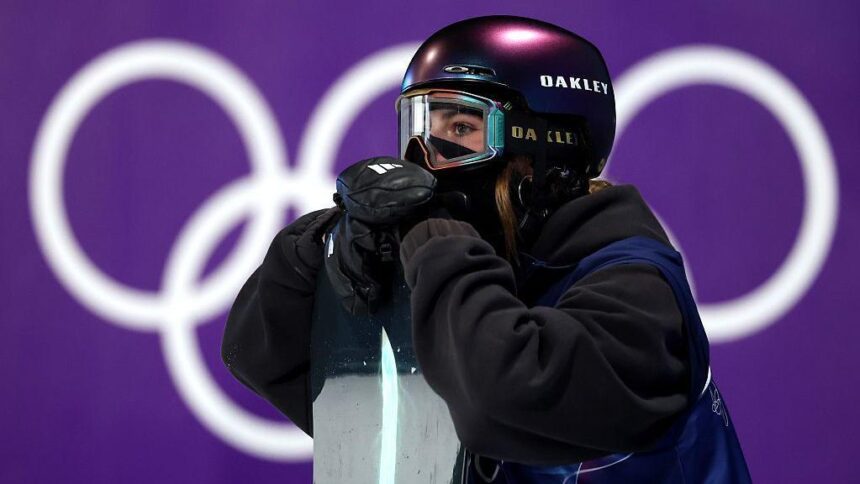
In the thin, crisp air of the mountains, where history is measured in hundredths of a point and the line between legend and ‘what if’ is as fine as a snowboard’s edge, Team GB endured a day of excruciating near-misses. What was anticipated as a potential golden Monday dissolved into a muted symphony of fourth-place finishes, each one carrying its own unique sting. At the heart of the frustration was a moment of breathtaking audacity from snowboarding prodigy Mia Brookes, who came within a heartbeat of landing a trick never before seen in competition, only to see a guaranteed gold medal slip through her fingers in the cruelest fashion.
A Trilogy of Near Misses: From Slopes to Sheets
The day’s pattern was set early under grey skies. Kirsty Muir, with her trademark composure, soared through the slopestyle course, her technical prowess on full display. Yet, in a field where amplitude and flair are king, her clean, precise runs couldn’t quite match the towering height of the podium finishers. Her fourth place was a testament to world-class consistency but left a lingering sense of an opportunity not fully seized.
On the curling sheet, the narrative was one of momentum brutally halted. The mixed doubles pairing of Bruce Mouat and Jen Dodds, a model of synergy and tactical intelligence throughout the round-robin, found their rhythm disrupted at the worst possible moment. A guaranteed medal vanished in a flurry of uncharacteristic errors and relentless pressure from their opponents, ending their campaign abruptly in the playoff rounds. The silence that followed their final stone spoke volumes.
This sandwich of disappointment—Muir’s near-podium and Mouat and Dodds’ missed guarantee—framed the central drama of the day: the big air final and the breathtaking gamble of a 17-year-old from Cheshire.
Brookes’ Bold Gamble: The Cab 1620 That Almost Rewrote History
Mia Brookes, already a slopestyle world champion, stepped into the big air final not to compete, but to conquer. Sitting in medal contention after two solid runs, she faced a simple, terrifying equation: play it safe for a possible bronze or silver, or unleash the trick she had been honing in secret—the Cab 1620. This manoeuvre, a switch backside spin with four and a half full rotations (1620 degrees), is the holy grail of women’s snowboarding, a world first in competition that would instantly elevate the sport.
Her drop-in was pure commitment. The take-off, powerful. The four-and-a-half rotations in the air, a blur of controlled chaos against the sky. As she came around for the final half-turn, the entire snow sports world held its breath. “That was a gold,” exclaimed BBC commentator Ed Leigh, his voice a mix of awe and instant realisation.
And for a moment, it was. Brookes landed the jump. The board made contact with the snow. The historic milestone was, technically, achieved. But in big air, the landing is everything. A slight over-rotation, a fraction too much weight on her heels, and her edge caught in the snow. She tumbled forward, the score plummeting with her. The gasp from the crowd was audible. The agonising fourth-place finish was confirmed, but the message was sent: Brookes had the courage to attempt the impossible and came closer than anyone ever has.
- The Trick: Cab 1620 (Four and a half rotations, switch stance).
- The Stakes: A certain gold medal and a permanent place in snowboarding history.
- The Moment: A clean landing before the over-rotation caused a hand drag.
- The Verdict: Unquestionable proof that the progression of women’s snowboarding is in hyperdrive, led by Brookes’ fearlessness.
Expert Analysis: The Fine Line Between Legend and Heartbreak
From a technical standpoint, Brookes’ attempt was a monumental leap forward. “What we witnessed wasn’t a failure; it was a preview,” says a former Olympic snowboard coach. “Completing the rotations is 90% of the battle. She proved the trick is competition-ready. The landing will come. The fact she even attempted it in a medal-deciding run tells you everything about her mentality. She’s not here for participation; she’s here to evolve the sport.”
The psychological impact on Team GB is twofold. Firstly, there is the collective gut-punch of three fourth-place finishes in one day—a statistical anomaly that underscores the razor-thin margins at this level. However, secondly and more importantly, Brookes’ run establishes a new benchmark for British winter sports ambition. It moves the goalposts from hoping to medal to pushing the boundaries of what is physically possible. This ethos, while painful in the short term, is what creates lasting legacies.
For Bruce Mouat and Jen Dodds, the analysis is more tactical. Curling is a game of inches and psychology. Their earlier dominance suggests a team capable of gold, but the pressure of the knockout stage exposed a slight fragility that top-tier opponents will ruthlessly exploit. The coming days for Mouat in the men’s team event will be a fascinating study in resilience.
Looking Ahead: Predictions for Team GB’s Response
This frustrating day is not an end, but a catalyst. The reaction in the coming days will define Team GB’s entire Games.
For Mia Brookes: The slopestyle event now becomes a must-watch. Armed with the knowledge that her biggest trick is nearly competition-perfect, and with a fire lit by today’s heartbreak, she will be a formidable force. Expect her to be even more aggressive. Prediction: A podium finish in slopestyle is highly likely, with gold a very real possibility if she lands the 1620 cleanly.
For Kirsty Muir: Her consistency is her strength. The big air event remains, offering immediate redemption. She possesses the amplitude and style to medal if she can add a degree of difficulty to match her flawless execution.
For Bruce Mouat: The mixed doubles disappointment will either weigh heavily or be channelled into ferocious focus for the men’s team event. His leadership will be critical. Expect a determined, sharpened team to emerge, using this setback as fuel.
The broader prediction for Team GB is one of a resilient bounce-back. History shows that British winter athletes often thrive as underdogs with a point to prove. The narrative has now shifted from expectation to determination.
Conclusion: The Pain of Progression
Monday was a masterclass in sporting agony. Three fourth-place finishes, each a story of what might have been. Yet, to view it purely as a day of failure is to miss the profound significance of Mia Brookes’ cab 1620 attempt. In that air, in that rotation, was the future of her sport. She didn’t just attempt to win a gold medal; she attempted to redefine her discipline.
While the curling result was a straightforward missed opportunity, and Muir’s a case of needing that extra spark, Brookes’ fourth place was of a different breed. It was the fourth place of a pioneer. The frustration felt across Team GB is valid, but it is the frustration that comes from touching greatness, not from falling short of it. The message from the mountains is clear: Team GB is no longer just participating; they are pushing on the ceiling of possibility. And sometimes, the sound of progress is the agonising scrape of a snowboard edge, so close to making history, yet reminding us that glory, in its purest form, is always just one clean landing away.
Source: Based on news from Yahoo Sports.