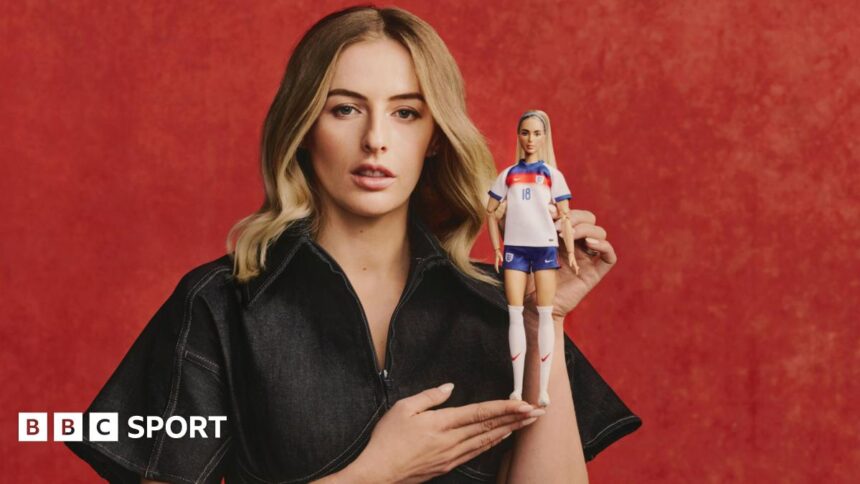
So Special: Chloe Kelly Immortalised as a Barbie ‘Dream Team’ Role Model
In the 65th year of an iconic brand, a new kind of footballing honour has been awarded. It doesn’t sit in a trophy cabinet, but on a shelf, inspiring a generation. Arsenal and England forward Chloe Kelly, the woman whose extra-time winner at Wembley cemented the Lionesses’ legacy, has been transformed into a one-of-a-kind Barbie doll. This unique accolade is part of Mattel’s groundbreaking “Barbie Dream Team,” a collection honouring global female pioneers to mark International Women’s Day. For Kelly, a hero whose journey from the cages of West London to the pinnacle of European football is the stuff of legend, this moment represents a profound cultural victory—a recognition that her impact now transcends the touchlines of the pitch.
More Than a Doll: The Cultural Weight of the Barbie Role Model
The phrase “Barbie doll” often conjures a specific, often debated, image. But Mattel’s Role Model programme, active for over 15 years, has systematically worked to shatter that monolithic perception. By creating dolls in the likeness of real-world trailblazers—from NASA scientists to filmmakers and now elite athletes—the brand is actively participating in reshaping the narratives available to young girls. Kelly’s inclusion is a strategic and powerful move. She joins an elite sporting cadre within the Dream Team that includes the indomitable 23-time Grand Slam champion Serena Williams and Indian cricket superstar Smriti Mandhana.
This isn’t mere merchandise; it’s a cultural artifact. “To be a Barbie role model is so special,” Kelly said, her statement radiating a genuine awe. “To have my very own one-of-a-kind doll – I’m very proud of that.” Her reflection on the achievement cuts to the heart of its significance: “You don’t really believe these things could happen. You always look for the trophies and the wins on the pitch but, off the pitch, this is a massive win.” This distinction underscores a vital evolution in athlete recognition. Where once legacy was solely measured in silverware, today’s icons understand their influence is also measured in representation, in the ability to become a tangible symbol of possibility in a child’s hands.
Analysing the ‘Dream Team’: Why Kelly Embodies the Modern Sporting Icon
From a sports journalism perspective, the curation of this inaugural Dream Team is a masterclass in selecting athletes who represent more than athletic excellence. Each woman embodies resilience, shattered ceilings, and a unique brand of leadership.
- Serena Williams: The archetype of relentless power and longevity, who redefined an entire sport while battling systemic inequalities.
- Smriti Mandhana: A symbol of explosive talent in the world’s second-most populous nation, inspiring a cricket-mad country to rally behind its women’s game.
- Chloe Kelly: The personification of a new, fearless era in English football. Her story—overcoming a devastating ACL injury to score the most iconic goal in English women’s football history—is a narrative of pure resilience.
Kelly’s doll, reportedly featuring her signature celebratory style—likely reminiscent of that unforgettable shirt-swirling moment at Wembley—captures more than her likeness. It captures an emotion and a moment of national euphoria. She represents the accessible hero; her passion is visceral, her joy uncontainable. This makes her the perfect bridge between the historic legacy of a Williams and the burgeoning stardom of athletes like Mandhana. She is a champion of the social media age, whose triumph was instantly iconic and whose personality continues to resonate.
The Ripple Effect: Predictions for Legacy and Inspiration
The long-term impact of such honourifics is profound. We can predict several key outcomes from this initiative:
1. Normalisation of Female Sporting Idols: When a young girl can play with a Chloe Kelly Barbie as easily as she can a generic doll, it normalises the idea of women as elite athletes and primary heroes in play narratives. This subtly shifts childhood paradigms.
2. Commercial and Cultural Validation: This move further elevates the commercial appeal and cultural stock of women’s football. It signals to other mega-brands that these athletes have reach and resonance that extends far beyond traditional sports marketing.
3. The “Off-Pitch Win” as Metric: As Kelly astutely noted, this is an “off-pitch win.” We predict future athletes will increasingly value and seek out these cultural milestones as key components of their legacy, alongside medals and titles. It represents a holistic measure of impact.
4. Expansion of the Dream Team: The success of this launch will inevitably lead to an expanded Dream Team in coming years. Athletes from underrepresented sports and regions—think UFC champions, Paralympic legends, or basketball stars—will likely join this growing pantheon, further diversifying the faces of aspiration.
A Lasting Legacy in Plastic and Purpose
Chloe Kelly’s Barbie doll is far more than a collectible. It is a landmark in her career and a significant moment for women’s sport. It crystallises her journey from a football-obsessed kid to a national icon whose image now serves as a direct source of inspiration. It tells every child, boy or girl, that the heroes of Wembley are worthy of immortalisation, that their joy is worth replicating, and that their sport matters.
The true victory lies not in the plastic mould, but in the message it carries. When Kelly lifted the European Championship trophy, she lifted the profile of her sport. Now, as a Barbie Role Model, she helps to mould its future audience. This honour confirms that the Lionesses’ legacy is not a fleeting moment of summer glory, but a deep, enduring cultural shift. The goals, the trophies, and the sold-out stadiums were the foundation. Now, with a one-of-a-kind doll on the shelf, Chloe Kelly has helped build a new, tangible layer of that legacy—one that will inspire the next dream team, long before they ever set foot on a pitch.
Source: Based on news from BBC Sport.