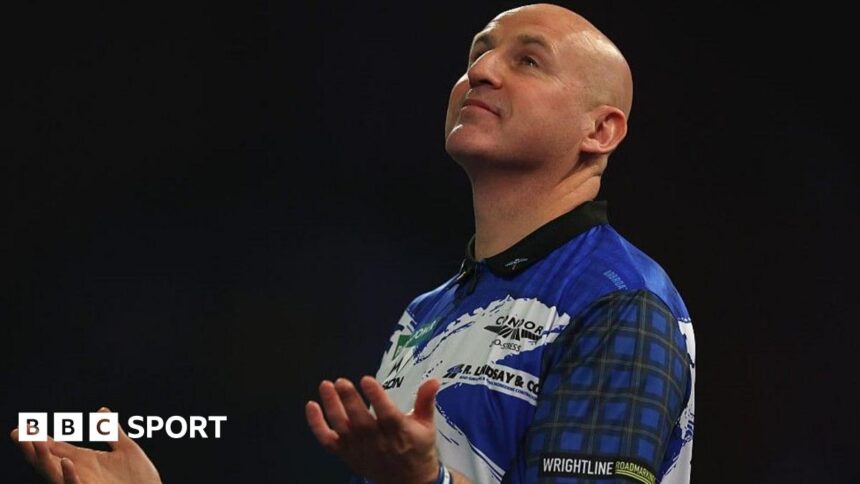
Alan Soutar Survives 15-Match Dart Agony in World Championship Epic
The PDC World Darts Championship is built on moments of high drama, but rarely does it produce a spectacle of such excruciating tension and raw, unfiltered nerve as the one witnessed between Alan Soutar and Teemu Harju. In a staggering first-round encounter that twisted and turned for nearly 90 minutes, Scotland’s Soutar somehow emerged victorious after an almost incomprehensible collapse, missing a staggering 15 match darts before finally sealing victory in a sudden-death leg. It was a match that defied logic, tested the resolve of both men, and instantly etched itself into Ally Pally folklore.
From Flawless Start to Unraveling Nerves
The opening act of this drama gave no hint of the chaos to come. Alan Soutar, a firefighter by trade and a man known for his steely resolve on the big stage, began in blistering form. He stormed into a two-set lead without conceding a single leg, his darts flying with pinpoint accuracy. At this stage, his three-dart average was a phenomenal 107.36 and he was clinical on the doubles, converting six of his first eight attempts. The narrative seemed straightforward: the experienced Scot, a two-time last-16 finisher at this event, was comfortably dispatching the Finnish debutant.
However, the unique pressure cooker of the World Championship stage has a way of rewriting scripts. As Soutar’s relentless pace slightly dipped, Teemu Harju, a 33-year-old qualifier, began to find his rhythm. Harju maintained a steady, unspectacular level, but crucially, he held his nerve. Soutar’s game, by contrast, began to show fractures. His overall average plummeted towards 90, and the first signs of doubt crept in on the doubles. What had been a procession was suddenly a contest.
- Blistering Start: Soutar wins first two sets 3-0, averaging 107+.
- Clinical Finishing: Nails six of his first eight double attempts.
- Momentum Shift: Harju’s consistency meets Soutar’s declining average.
- Pressure Mounts: The finish line feels further away with every missed opportunity.
The Agonizing Parade of Missed Match Darts
The final set descended into a psychological thriller, a masterclass in sporting tension that left the Alexandra Palace crowd in a state of disbelieving gasps. Soutar created chance after chance to win the match. He had darts at double 16, double 8, double 4, double 2, and double 1. Each one slipped by, each miss amplifying the pressure exponentially. The 15 match darts came in clusters, a torturous cycle of setting up the shot and failing to convert.
Incredibly, Harju was handed his own shot at glory. In the sixth leg of the deciding set, with the score locked, the Finn engineered four match darts of his own to cause a monumental upset. He, too, couldn’t find the target. The drama reached its peak when the set went to a sudden-death leg, where the player who wins the bullseye throws first. The tension was palpable; one mistake would spell the end.
Soutar’s nerve, so famously reliable, had been stretched to its absolute limit. Yet, in the moment of greatest pressure, with the echoes of 15 previous misses surely ringing in his ears, he found a way. When his chance finally came, he took it, collapsing to the floor in a mixture of utter exhaustion and overwhelming relief more than joy. It was a victory snatched not from the jaws of defeat, but from a seemingly endless series of missed opportunities.
Expert Analysis: What This Means for Soutar’s Campaign
From a technical standpoint, this match presents a profound paradox for Alan Soutar and his coaching team. The positives are undeniable: when he is on, he can average 107 and blow opponents away. His scoring power in the early sets was world-class. However, the collapse on doubles raises serious questions about his mental stamina in this specific environment. Surviving such an ordeal can be a double-edged sword.
On one hand, it could forge an unbreakable spirit. “Getting the win is all that matters” will be the mantra, and the sheer relief of surviving may unshackle him for the next round. He has proven he can win ugly, a vital trait in a long format tournament. On the other hand, the psychological scar of such a public struggle could resurface the next time he steps up to a finish. The key for Soutar will be to completely compartmentalize this performance.
For Teemu Harju, the defeat is heartbreaking but his reputation is immensely enhanced. To debut on the World Stage, fight back from a two-set deficit, and have darts to win against an established player is a phenomenal achievement. He demonstrated a temperament that suggests he will be back, and his performance will earn him many new fans.
Predictions: A Springboard or an Anchor?
Soutar now advances to face a potentially formidable opponent in the second round. His immediate future in the tournament hinges entirely on which version of himself turns up. The question is whether this epic escape acts as a springboard or an anchor.
- If he focuses on the first two sets: He can draw confidence from his elite scoring and use the win as a “get out of jail free” card that frees him up to play his natural game.
- If he dwells on the missed doubles: Doubt could become a constant companion, making every checkout a mental battle. Opponents will know this and try to prolong the game to test his nerve.
- The Verdict: Soutar’s career is built on resilience. His profession as a firefighter demands calm under pressure. It is likely he will use this harrowing experience as a catalyst, but his next match must start with a strong statement on the doubles board to quiet the inevitable external noise.
Conclusion: A Win Forged in Fire
Alan Soutar’s victory over Teemu Harju will not be remembered for its quality, but for its almost Shakespearean drama and sheer, unadulterated will to win. In missing 15 match darts, Soutar stared into the abyss of one of the most chastening defeats in World Championship history. In surviving, he authored a story of perseverance that encapsulates the brutal, beautiful unpredictability of sport.
This was more than a first-round darts match; it was a psychological war of attrition. For the fans, it was a breathtaking spectacle. For Teemu Harju, it was a heartbreaking lesson in fine margins. For Alan Soutar, it was a firewalk. He emerged scorched, shaken, but ultimately triumphant. Whether this epic proves to be the making or breaking of his 2024 campaign remains to be seen, but for one night in London, he demonstrated a kind of gritty, imperfect survival that sometimes defines a champion more than a flawless performance ever could.
Source: Based on news from BBC Sport.