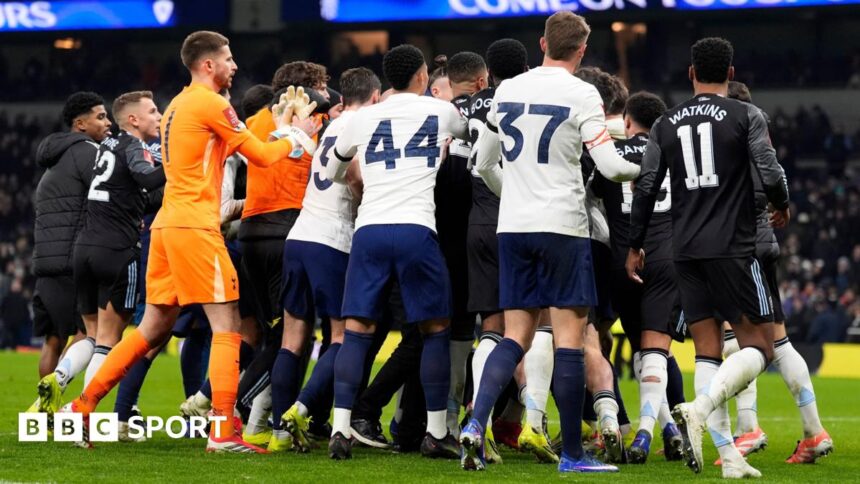
Spurs and Villa Face FA Wrath: The Anatomy of a Post-Final Whistle Melee
The beautiful game is often defined by moments of high drama, but sometimes that drama spills over from the pitch into the tunnel and headlines. The FA Cup, with its unique blend of passion and prestige, is a frequent breeding ground for such incidents. In the wake of Aston Villa’s hard-fought 2-1 victory over Tottenham Hotspur in the third round, the Football Association has swiftly intervened, charging both clubs with misconduct following a post-match melee that marred an otherwise compelling contest. This isn’t just a minor scuffle; it’s a significant event that exposes the raw nerves, high stakes, and disciplinary tightrope walked by modern football clubs.
A Flashpoint in North London: Unpacking the Incident
As the final whistle confirmed Villa’s passage to the fourth round, the immediate aftermath at the Tottenham Hotspur Stadium turned from celebration to confrontation. While specific triggers are often obscured in the chaos of pushing and shouting, the context is crucial. Tottenham, a team with trophy aspirations, had just been eliminated from a major competition at home. The frustration was palpable. For Villa, this was a statement win, proving their credentials against a top-tier rival. This potent cocktail of elation and exasperation created a volatile atmosphere.
Reports and footage indicate players from both sides became embroiled in physical altercations and heated exchanges near the tunnel area. The FA’s charge is deliberately broad, accusing each club of failing “to ensure their players and/or officials did not behave in an improper and/or provocative way.” This language is significant. It places the onus not just on individual players, but on the clubs’ collective responsibility to control their personnel. The fact that the incident occurred after the final whistle is a key aggravating factor for the governing body, as it falls outside the referee’s in-game jurisdiction and represents a breakdown of basic post-match protocol.
Expert Analysis: The Ripple Effects of On-Field Disorder
From a tactical and psychological standpoint, these incidents are rarely spontaneous. They are often the culmination of 90 minutes of simmering tension—hard tackles, verbal sparring, and perceived injustices. “What we see at the final whistle is usually just the eruption,” notes a former Premier League manager. “The real issue is the series of smaller flashpoints that weren’t managed during the game itself. Both the referee’s match control and the leadership within each team’s dressing room are called into question.”
The consequences extend far beyond a simple fine. We must consider the broader implications for club discipline and reputation.
- Financial Penalties: While fines are likely, they are often seen as a cost of doing business for wealthy Premier League clubs. The FA may seek a more impactful sanction.
- Individual Suspensions: If specific players are identified as primary aggressors, they could face separate charges and bans, weakening their teams for crucial league fixtures.
- Cultural Stain: For managers like Ange Postecoglou and Unai Emery, who pride themselves on a certain culture, such public displays of ill-discipline are a setback. It projects an image of a team losing its cool under pressure.
- Fan Behavior: There is a documented trickle-down effect where on-pitch melees can embolden negative behavior in the stands, a concern for safety officials.
This incident also highlights the intense competitive rivalry that has developed between these two clubs, both vying for a top-four finish. The FA Cup clash was a microcosm of that larger battle, adding fuel to the fire.
Predictions and Potential Outcomes: What Happens Next?
With both clubs having until Friday to respond to the charge, the immediate future involves legal and procedural maneuvering. Tottenham and Aston Villa will likely review all available footage, interview their players, and formulate a defense. Common strategies include accepting the charge but pleading for leniency, or contesting the severity of the FA’s characterization.
Based on precedent, we can forecast several potential outcomes:
- Accepted Charges and Standard Fines: The most common result. Both clubs accept responsibility, receive a fine likely in the region of £20,000-£40,000, and are warned as to future conduct.
- Points Deduction (Unlikely but Not Unprecedented): While extremely rare for Premier League clubs in such cases, the FA retains the power to impose a points deduction in extreme circumstances of mass misconduct. This remains a distant possibility but serves as the nuclear option to deter future incidents.
- Stadium Bans or Closed-Door Game Orders: A more severe punishment could involve forcing a future fixture to be played behind closed doors, though this is typically reserved for fan-related issues.
- Individual Charge Escalation: The FA could use this club charge as a springboard to identify and punish specific players, leading to personal fines and suspensions.
Given the high-profile nature of the clubs and the relatively contained (though unacceptable) nature of the melee, the most probable scenario is a significant financial penalty and a strong public reprimand. The FA will want to be seen as taking firm action without destabilizing the competition.
Conclusion: More Than Just a Scrap – A Lesson in Control
The post-match melee between Tottenham Hotspur and Aston Villa is a stark reminder that in football, the final whistle does not always signify an end to hostilities. While the passion and rivalry are integral to the sport’s appeal, they must be contained within the boundaries of respect and regulation. The FA’s charge is a necessary intervention, a line in the sand reminding clubs of their fundamental duty of care and control.
For Spurs and Villa, the cost will be financial, but the greater price is reputational. In an era where every moment is captured and amplified, losing composure is a luxury elite clubs cannot afford. As both teams continue their pursuit of Champions League football and, in Villa’s case, further FA Cup glory, this incident will serve as an unwelcome footnote—a lesson that the most important battles are sometimes fought not for goals, but for grace under pressure. How they respond to this charge, and how they conduct themselves in their next highly-charged encounter, will truly define their maturity as competing forces at the top of the English game.
Source: Based on news from BBC Sport.