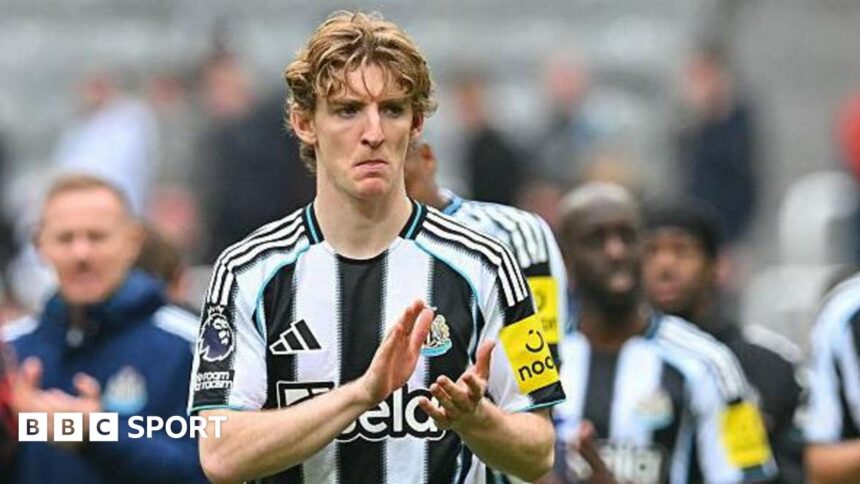
Gordon’s Derby Truth Bomb: A Stark Reality Check for Newcastle’s Pride
The Tyne-Wear derby is back, and it has brought with it a seismic shock to the foundations of football in the North East. For the first time in eight years, Sunderland faced Newcastle United, and for the first time in over a century, they completed a league double over their historic rivals. In the smoldering aftermath of Sunderland’s 2-1 victory at St James’ Park, it was not the scoreline but a post-match assessment from a Newcastle star that cut to the very bone of the Magpies’ current crisis. Anthony Gordon, fresh from his England call-up, delivered a verdict that was as brutally honest as it was damning: losing to Sunderland is “not good enough” because they are “not very good” compared with Newcastle. This statement is more than just sour grapes; it is a glaring spotlight on the chasm between expectation and reality at a club in turmoil.
A Historical Humiliation and a Painful Admission
Let’s first contextualize the magnitude of this result. Sunderland’s victory at St James’ Park wasn’t just another three points. It extended Newcastle’s winless run in this fixture to an astonishing 11 consecutive league meetings, the longest such streak for either side in the derby’s 132-year history. The Black Cats, under the relatively new management of a progressive coach, executed a perfect away-day performance: resilient, opportunistic, and ruthlessly clinical. Chemsdine Talbi’s equalizer and Brian Brobbey’s late winner were daggers to a disbelieving Gallowgate End.
Yet, the most telling moment came after the final whistle. Anthony Gordon, who had given Newcastle a first-half lead with a moment of individual quality, faced the media. His frustration was palpable. “It’s a derby, we know what it means, but let’s be honest—we are levels above them,” Gordon stated. “They’re not very good compared to us. To lose to them, especially here, is not good enough. It’s embarrassing for a club with our ambitions.” This admission, while highlighting the perceived quality gap, inadvertently exposes a far more concerning truth for Newcastle: talent on paper means nothing without heart, organization, and tactical discipline on the pitch.
Expert Analysis: The Chasm Between Perception and Performance
Gordon’s comments, though inflammatory, frame the central paradox at the heart of modern Newcastle United. On one side, you have the perception: a club backed by sovereign wealth, boasting a squad of internationals, competing in Europe last season, and spearheaded by a forward just selected for the England squad by Thomas Tuchel. On the other, you have the performance: a team that has now been tactically outmaneuvered twice in one season by a newly-promoted rival with a fraction of the budget.
This analysis reveals several critical failures:
- Tactical Naivety: Eddie Howe’s commitment to an attacking, high-press system is well-documented. However, against a well-drilled and counter-attacking Sunderland, it looked one-dimensional and vulnerable. The Magpies were picked apart, a recurring theme this season.
- Psychological Fragility: Gordon’s words suggest a squad that perhaps believed its own hype, that saw the derby as a formality. Sunderland played with the hunger of underdogs; Newcastle played with the anxiety of a side terrified of the consequence of defeat.
- Squad Imbalance: For all its star power, Newcastle’s squad lacks depth and specific profiles. The injury crisis has been a factor, but the failure to address a durable defensive midfielder and consistent full-back cover has left the team exposed.
The brutal reality is that Sunderland, in these two fixtures, were the better-coached, more unified, and more effective team. Gordon’s assessment of their quality is irrelevant in the face of the results. In derbies, passion and plan often trump pure talent, and Sunderland mastered both.
The Ripple Effect: What This Means for Newcastle’s Season
This defeat is not an isolated incident. It is a symptom of a season that is rapidly unraveling. The derby double represents a catastrophic blow to morale, fan confidence, and the club’s internal and external perception. The immediate fallout will be severe:
- Pressure on Eddie Howe: The manager’s position, once unassailable, is now under intense scrutiny. The nature of these defeats—tactically similar and psychologically damning—raises serious questions about his ability to reset the team’s mentality.
- Dressing Room Doubt: When a player like Gordon publicly questions the acceptability of a result, it hints at deeper fractures. The challenge for Howe is to channel that anger into a positive reaction, but the risk of the squad losing faith in the project is real.
- Recruitment Reckoning: The summer transfer window now looms as the most critical in the Saudi-era. The club must move beyond marquee names and recruit for character, tactical flexibility, and mental toughness. Players who can win a derby are as important as those who can charm the Champions League anthem.
Predictions: A Fork in the Road for the Magpies
The trajectory of Newcastle’s season now hinges on their response to this profound humiliation. Two paths lie ahead:
Path 1: The Spiral. The derby defeat becomes the defining moment of a campaign that peters out into a mid-table finish. The pressure overwhelms Howe, leading to a managerial change in the summer. The “project” is reset, but with significant lost momentum and a fractured relationship with the fanbase. The “not very good” jibe from their own player becomes a millstone.
Path 2: The Reckoning. The club uses this embarrassment as a brutal catalyst. Howe simplifies the approach, prioritizes defensive solidity, and rebuilds the team’s spirit from the ground up. The anger in Gordon’s voice is mirrored on the pitch in a relentless, backs-to-the-wall finish to the season that secures European football. The summer then brings a clear-eyed, strategic rebuild focused on leaders and warriors.
The smart prediction leans toward a messy middle, but the immediate future is fraught with pressure. The next few fixtures will reveal whether this squad has the character to atone for this historic failure.
Conclusion: More Than Just a Game, A Mirror Held Up
Anthony Gordon intended his words to defend his club’s stature. Instead, they performed the opposite function. By stating that losing to Sunderland is “not good enough,” he explicitly confirmed that Newcastle United are currently failing to meet their most basic obligations: pride, passion, and local supremacy. The Tyne-Wear derby has always been a mirror, reflecting the soul of each club. Right now, for Sunderland, it reflects a bright, cohesive, and upwardly-mobile future. For Newcastle, it reflects a disjointed, anxious, and entitled outfit that has lost its way.
The 11-game winless streak is no longer a quirky statistic; it is an era of dominance for Sunderland and an era of shame for Newcastle. Gordon is correct about one thing: it is not good enough. But the solution isn’t to talk about levels. It’s to rediscover the very fundamentals that make derbies winnable—fundamentals that their “not very good” rivals displayed in abundance. For Newcastle, the long road back to credibility starts not with grand statements, but with the humble acceptance that, on the evidence of this historic double, they have been thoroughly and deservedly surpassed by their oldest foes.
Source: Based on news from BBC Sport.