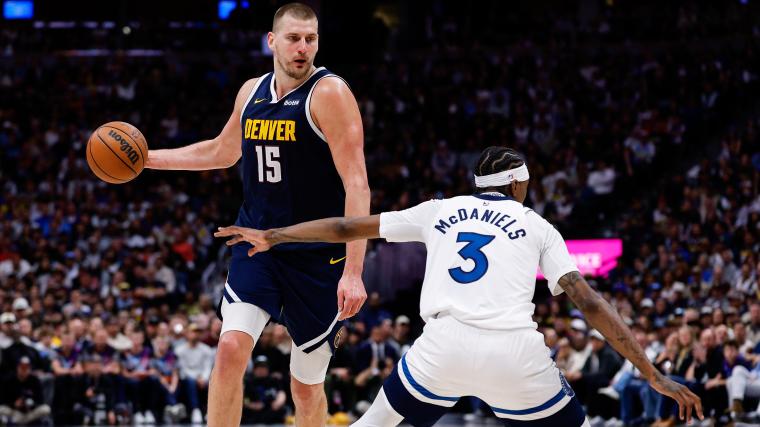
T-Wolves Crush Nuggets in Six, Advance to Face Spurs in NBA Playoffs
The Minnesota Timberwolves have done what few thought possible: they have unseated the defending champion Denver Nuggets in a brutal, six-game series. For a team that has often been defined by its playoff heartbreaks, this victory feels different. It was not a lucky bounce or a fluke shooting night. It was a systematic dismantling of a dynasty in waiting, a declaration that the Western Conference now belongs to the young and the hungry. The T-Wolves crush Nuggets in six, and in doing so, they have booked a ticket to face the San Antonio Spurs in a second-round matchup that suddenly feels like a coronation waiting to happen—or a trap door.
This series was never supposed to be this easy. The Nuggets, led by two-time MVP Nikola Jokic, were the hunted. But from the opening tip of Game 6, Minnesota played like the team with something to prove. The final score—a 112-98 blowout—does not fully capture the suffocating nature of the Timberwolves’ performance. Denver did not lead after the 6:10 mark of the second quarter. From that point forward, it was all Timberwolves. This series marks the earliest playoff exit for the Denver Nuggets since the 2017-18 season, when they missed the playoffs entirely. For a franchise that just won its first championship, this is a seismic wake-up call.
How Minnesota’s Aggression Overwhelmed Denver’s Offense
The game plan from Timberwolves head coach Chris Finch was simple: attack, attack, attack. And nobody embodied that ethos more than Jaden McDaniels and Terrence Shannon Jr. McDaniels, often known for his defensive prowess, exploded for 32 points. Shannon Jr., a playoff revelation, added 24 points. Together, they became a two-headed monster that Denver simply could not tame.
- Jaden McDaniels: 32 points, 8 rebounds, 3 blocks
- Terrence Shannon Jr.: 24 points, 6 assists, 4 steals
- Combined three-point shooting: 2-for-11
Here is the most telling stat: neither player shot the three-pointer well. They combined to go just 2-for-11 from beyond the arc. Yet they still dominated. Why? Because they refused to settle. Every time Denver’s defense sagged, McDaniels and Shannon drove straight into the paint, drawing fouls, finishing through contact, and collapsing the Nuggets’ thin interior defense. Without Aaron Gordon in the lineup—he missed the game with a calf strain—Denver had no answer for Minnesota’s relentless downhill pressure. The Nuggets’ usual paint protection, anchored by Jokic, was exposed repeatedly. Minnesota built its largest lead, 22 points, with only a minute remaining in the game. It was a statement.
The Timberwolves led almost every major team statistic. They dominated in rebounds (48-37), assists (28-19), second-chance points (18-6), and points in the paint (56-40). However, there were two glaring exceptions: field goal percentage and free throw percentage. Denver actually shot better from the floor (47% to 44%) and from the line (85% to 72%). But those advantages were rendered meaningless by the sheer volume of opportunities Minnesota created. The T-Wolves attempted 18 more field goals than the Nuggets, a direct result of their 14 offensive rebounds and Denver’s 19 turnovers. It was a masterclass in controlling the game’s tempo without needing to shoot lights out.
The Turnover Battle: A Double-Edged Sword That Favored the Wolves
One of the more bizarre subplots of this series-clinching win was the turnover disparity. Minnesota committed nearly double the turnovers as Denver—17 to 9. On paper, that should be a recipe for disaster. But the Timberwolves turned their own mistakes into a weapon. How? By converting Denver’s live-ball turnovers into instant transition buckets. While the Nuggets were careful with the ball in the half-court, they were sloppy in the open floor. Minnesota’s defense, led by the long arms of McDaniels and the quick hands of Shannon, forced 12 steals. Those steals led to 23 fast-break points.
This is where the Nuggets’ lack of depth truly hurt them. Without Gordon, Denver’s bench unit—specifically Reggie Jackson and Christian Braun—could not handle Minnesota’s pressure. Jokic, despite a triple-double of 28 points, 14 rebounds, and 11 assists, was forced to play 41 minutes. He was visibly exhausted in the fourth quarter, his shots falling short, his defensive rotations a step slow. The Timberwolves, by contrast, rotated 10 players with fresh legs. They ran the Nuggets into the ground. By the time the fourth quarter began, Denver had no gas left in the tank. Their final lead in the game came at the six-minute mark of the second quarter. After that, it was all Minnesota.
For the Nuggets, this series loss will sting for years. They entered the playoffs as the No. 1 seed, with home-court advantage and the best player on the planet. But they were out-hustled, out-muscled, and out-coached. The absence of Gordon was critical, but it does not explain why Jamal Murray shot just 38% from the field for the series. It does not explain why Michael Porter Jr. disappeared in Games 5 and 6. Denver’s championship window is still open, but this loss proves that the rest of the West has caught up—and in some cases, surpassed them.
Can the Timberwolves Survive Without Anthony Edwards?
Now, the focus shifts to the next challenge: a second-round series against the San Antonio Spurs. And here lies the biggest concern for Minnesota. They will need Anthony Edwards back in the lineup if they want to make a series of it against the Spurs. Edwards missed Game 6 with a nagging knee issue, and while his absence was not felt against a depleted Nuggets team, San Antonio presents a completely different monster.
The Spurs, led by the transcendent Victor Wembanyama, swept their first-round series against the Dallas Mavericks. Wembanyama averaged 29 points, 12 rebounds, and 4 blocks in that series. He is playing at a level that borders on unfair. Without Edwards, Minnesota lacks a primary creator who can consistently break down San Antonio’s defense. McDaniels and Shannon were heroes against Denver, but they are not yet proven as go-to scorers against a top-tier defense. The Spurs have the length to bother McDaniels’ mid-range game and the discipline to contain Shannon’s drives.
Here is the good news for Minnesota: they have time. The series does not start for another four days. Edwards is reportedly day-to-day, and the Timberwolves’ medical staff is optimistic he will be ready for Game 1. If Edwards plays at even 80% health, this series becomes a toss-up. His ability to draw double-teams will open up the floor for Minnesota’s shooters—something they desperately lacked in Game 6, where they shot just 28% from three. The Timberwolves also have a defensive ace in Rudy Gobert, who can at least make Wembanyama work for his points. But Gobert cannot guard the perimeter, and San Antonio’s spacing—with Devin Vassell and Keldon Johnson—will test Minnesota’s rotations.
Expert Analysis: What the T-Wolves Must Do to Beat the Spurs
If Minnesota wants to continue their Cinderella run, they must follow a specific blueprint. First, they need to control the glass. The Spurs are a below-average rebounding team, ranking 22nd in the regular season. Minnesota dominated Denver on the boards, and they must do the same against San Antonio. Second, they must force Wembanyama into tough, contested mid-range jumpers. The rookie sensation is deadly at the rim and from three, but his efficiency dips significantly on long two-pointers. If the Timberwolves can run him off the three-point line and wall off the paint, they can limit his impact.
Third, and most importantly, Terrence Shannon Jr. cannot be a one-series wonder. He needs to replicate his aggressive, attacking style against a Spurs defense that struggles with athletic guards. If Shannon can get into the paint and draw fouls on Wembanyama, he could force the rookie into foul trouble—a scenario that would tilt the series heavily in Minnesota’s favor. The Timberwolves also need more from Karl-Anthony Towns, who was quiet in Game 6 (12 points, 6 rebounds). Towns must be a consistent scoring threat to prevent San Antonio from loading up on Edwards.
Prediction: This series will be a war of attrition. If Anthony Edwards is healthy, the Timberwolves have the depth and defensive versatility to push the Spurs to seven games. But if he is limited or out, San Antonio’s superior half-court offense and Wembanyama’s brilliance will be too much. I am leaning toward the Timberwolves in seven—but only if Edwards is at 100%. Without him, the Spurs win in six. The margin for error is razor-thin.
Conclusion: A New Era in the West
The T-Wolves crush Nuggets in six, and in doing so, they have sent a message to the entire league: the Western Conference is no longer Denver’s playground. This series was a coming-of-age moment for Minnesota. They showed grit, intelligence, and a ferocity that has been missing from their franchise for decades. But the job is not finished. The San Antonio Spurs await, led by a generational talent who is rewriting the rules of basketball. This next series will define whether the Timberwolves are a legitimate contender or just a team that caught a break against a wounded champion.
One thing is certain: the NBA playoffs are more exciting when the Timberwolves are playing with this kind of edge. The city of Minneapolis is buzzing. The target is now on their backs. And for the first time in a long time, they look ready to shoot for it. The road to the NBA Finals runs through San Antonio. Buckle up.
This article originally appeared on The Sporting News. Add The Sporting News as a Preferred Source by clicking here.
Source: Based on news from Yahoo Sports.