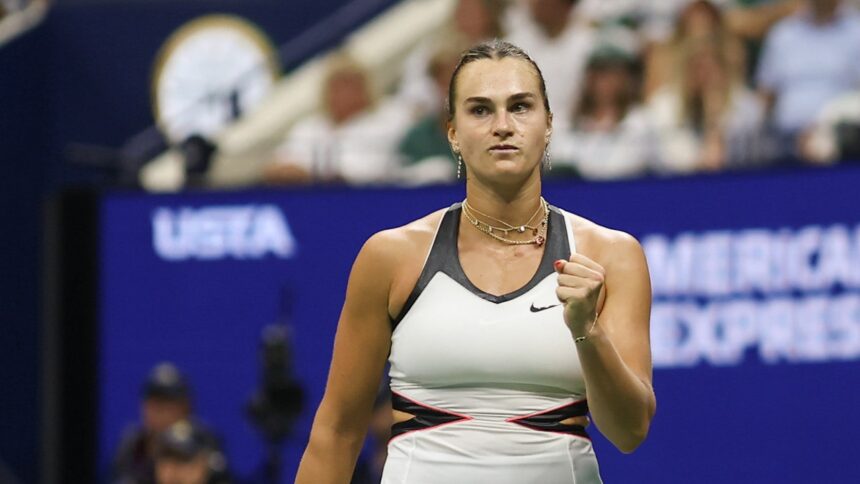
Aryna Sabalenka’s Serve on Trans Athletes in Women’s Sports: A Rally Cry for Fairness or Fault?
The world of professional tennis is no stranger to fierce debates, both on and off the court. As Australian maverick Nick Kyrgios and Belarusian powerhouse Aryna Sabalenka prepare for a unique “Battle of the Sexes” exhibition, their pre-match commentary has ignited a firestorm far beyond the baseline. In a striking alignment of views, both stars have asserted that transgender athletes, specifically biological males who have transitioned, should not compete against biological women in professional sports. For Sabalenka, the World No. 2 and a dominant force in the women’s game, the stance is rooted in a fundamental principle of athletic competition: fairness. “It’s just not fair to women,” she stated, framing the issue not as one of identity, but of immutable physical advantage.
The Exhibition’s Modifications: A Metaphor for the Debate
The upcoming exhibition match itself serves as a potent, if unintended, metaphor for the very issue Sabalenka and Kyrgios are highlighting. To level the playing field between the top-tier male and female athletes, organizers have instituted specific performance-balancing modifications. Kyrgios will be granted only one serve per point, not two, and will be required to hit toward a significantly smaller side of the court. These rules explicitly acknowledge the inherent physiological disparities in power, speed, and reach that exist between elite male and female competitors.
Sabalenka, whose first serve is one of the most feared weapons in women’s tennis, would be at a stark disadvantage facing the unbridled power and spin of a male professional’s serve in a real match. The exhibition’s format concedes this reality. It begs the question: if such structural accommodations are necessary for a one-off showcase, what does that imply for the integrity of year-round professional competition where no such modifications exist? Sabalenka’s comments suggest she sees the participation of transgender women in women’s sports as a permanent, unregulated version of this imbalance, where the “modifications” (hormone therapy) may not sufficiently negate the foundational athletic advantages of male puberty.
Dissecting the “Fair Play” Argument: Physiology vs. Inclusion
The core of Sabalenka’s argument, echoed by a growing number of female athletes across swimming, track and field, and cycling, rests on sport-specific physiology. Sports science consistently points to advantages in bone density, lung capacity, heart size, and lean muscle mass that are developed during male puberty and are largely retained even after hormone therapy. In a sport like tennis, where explosive movement, rotational power on serves and groundstrokes, and recovery speed are paramount, these advantages can be decisive at the elite level.
Proponents of inclusion argue that hormone replacement therapy (HRT) reduces testosterone to within a specified range, mitigating these advantages. However, critics and some researchers point to a lack of conclusive, long-term studies on whether HRT fully erases the benefits of male puberty for elite athletic performance. The debate creates a profound dilemma for governing bodies:
- Protecting the Female Category: The creation of a women’s category in sport was historically to ensure fair competition and opportunity for biological females. Many athletes argue this category must be protected to honor its original intent.
- Ensuring Dignity and Inclusion: Sports organizations also have a moral and often legal imperative to provide inclusive environments for all athletes, including transgender individuals.
- The Elite vs. Recreational Divide: Some suggest the conversation differs fundamentally between elite, record-seeking competition and recreational, community-level sports, where inclusion can be prioritized without the same stakes.
Sabalenka’s position places her firmly in the camp that believes the integrity of women’s sports is compromised when the physiological line is crossed, regardless of identity.
The Ripple Effect: Sponsors, Tours, and the Future of Women’s Tennis
When a star of Sabalenka’s magnitude speaks out, the ramifications extend beyond opinion pages. The WTA, ATP, and the International Tennis Federation (ITF) have so far navigated this issue with caution. The current ITF policy, similar to those of other federations, allows transgender women to compete in the female category under certain testosterone-level conditions. However, as high-profile athletes like Sabalenka and Kyrgios voice concerns, pressure on these organizations will mount.
We are likely to see:
- Increased Scrutiny on Policies: Governing bodies will face calls to review and potentially tighten eligibility rules, relying on ever-evolving (and often contested) science.
- Sponsorship Considerations: Brands aligned with women’s tennis may find themselves navigating a cultural minefield, forced to weigh support for inclusion against support for athletes advocating for the category’s protection.
- Player Association Advocacy: The WTA Player Council could become a more formal arena for this debate, as athletes seek a unified voice to lobby for the competitive future they envision.
The conversation, once relegated to fringe discussions, is now being served at the center of the sport’s biggest stages by its biggest names.
An Unforced Error or a Champion’s Defense?
Predicting the outcome of this cultural volley is as difficult as predicting a Kyrgios underarm serve on match point. However, several trajectories seem probable. In the short term, the polarization will intensify. Sabalenka’s comments will be hailed as courageous by some and condemned as transphobic by others, a reductive binary that often plagues the debate. The exhibition match will be analyzed not just for its entertainment, but as a symbolic event.
Long-term, the path forward is murky. Sports science may eventually provide more definitive answers, but the conflict is as much about philosophy as physiology. One potential evolution is the exploration of alternative competition categories based on physiological parameters rather than gender identity, though this presents massive logistical and cultural challenges. What is clear is that the era of silence from top female athletes is over. They are no longer willing to let this issue be decided solely by administrators, activists, or scientists in labs. They are stepping to the baseline, microphone in hand, ready to fight for what they believe is the essence of their sport’s fairness.
Aryna Sabalenka, a woman who has built her career on overwhelming force and uncompromising power, has now directed that force toward a defining issue of her era. Whether history judges her stance as an unforced error or a champion’s defense of her field may depend less on today’s headlines and more on the final ruling that sports governance—caught between the imperative of inclusion and the defense of the female category—is eventually forced to make. The match, both on and off the court, has only just begun.
Source: Based on news from Fox Sports.