Beyond the Frame: The Man and the Stories Behind Golf’s Iconic Images
In the silent galleries of memory, golf’s history is written not in words, but in frozen moments of unadulterated emotion. Seve’s defiant dance. Rory’s cathartic roar. Tiger’s primal fist pump. These are the hieroglyphs of our sport, images so powerful they transcend the game itself. For over five decades, I’ve had the profound privilege of holding the camera that translated these seismic human experiences into enduring icons. The journey from a split-second reaction at St. Andrews to a meticulously planned predawn vigil at Augusta reveals a truth often lost behind the lens: capturing legend is equal parts instinct, obsession, and sheer luck.
The Spontaneous Spark: Seve’s St. Andrews Samba
Every career has a defining ignition point. Mine was not a slow burn, but a flash of kinetic brilliance on the 18th green of the Old Course in 1984. Seve Ballesteros was a force of nature, a matador in a cable-knit sweater. As his winning putt dropped at The Open, he didn’t merely celebrate; he erupted in a spontaneous, full-bodied iconic celebration. The club went flying, the fist punched the Scottish sky, and his legs kicked out in that unforgettable, joyous jig.
My position was fortunate, but the shot was pure instinct. There was no time for technical calculation—only the visceral reaction to compress his unrestrained passion into a single frame. That photograph did more than capture a victory; it encapsulated Seve’s entire soul: passionate, artistic, and defiantly alive. It kickstarted my life’s work and set the standard. It taught me that the most powerful images are often unplanned gifts, where the photographer’s role is to be ready, emotionally and technically, to receive them.
The Anatomy of Anticipation: Planning for Perfection at Augusta
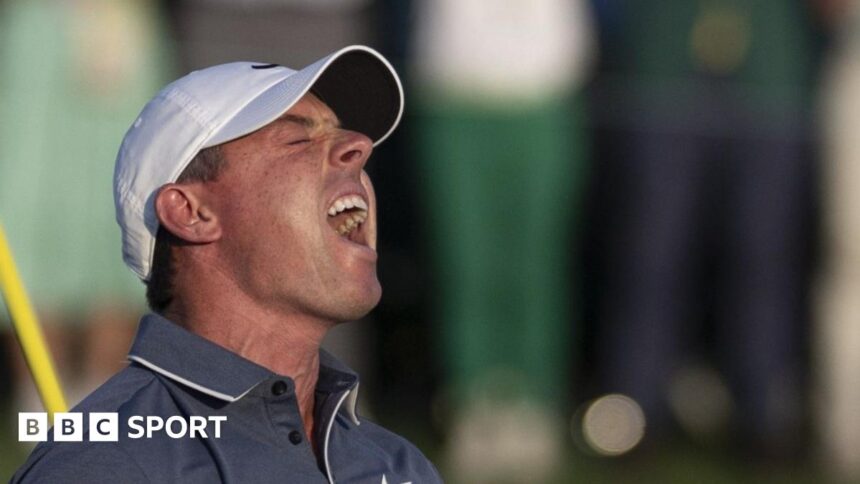
For every spontaneous moment, there is its opposite: the image born from relentless preparation. The victory of Rory McIlroy at the 2023 Masters, completing his career Grand Slam, was one such moment. Knowing the weight of history, I was at my spot by Amen Corner at 06:15, nearly twelve hours before the decisive putt would drop. Why so early? At Augusta National, securing the perfect vantage point is a battle in itself. I needed the angle that would give me Rory’s face as the realization hit, with the cathedral of pines and the iconic bridge in the frame, telling the full story of triumph at golf’s most hallowed ground.
This is the unseen 99% of sports photography. It involves:
- Scouting locations days in advance, studying the light’s path.
- Understanding the narrative arc of the tournament and the player’s likely emotional journey.
- Anticipating where history will physically manifest on the course.
When Rory’s final putt fell and he unleashed that guttural, tear-streaked roar, my camera was an extension of months of mental planning. The image wasn’t taken at 6:18 PM; it was taken at 6:15 AM, when the commitment to wait for magic was made.
The Tiger Project: A Masterpiece of Patience
I’ve documented all 15 of Tiger Woods’ major victories, each with its own chapter of awe. But one image stands apart for its logistical complexity. It wasn’t a putt or a punch. It was a portrait of power in motion, requiring months of negotiation and planning with tournament officials, course managers, and Tiger’s team. The goal was unprecedented access to capture his pre-shot routine from an angle never before seen, using specialized equipment to isolate his intensity against the chaos of a major championship backdrop.
The execution was a high-wire act. We had a three-minute window during a practice round. One chance. The result was an image that stripped away everything but Tiger’s legendary focus, a quiet moment of concentration that screamed louder than any fist pump. It reinforced that iconic photography isn’t just about the trophy lift; it’s about revealing the essence of the athlete, sometimes in the quiet before the storm.
The Future Frame: What Makes the Next Iconic Image?
As the game evolves, so too does the art of capturing it. The next generation of stars—the Rahms, Schefflers, and Koepkas—carry a different, more controlled intensity. The future of golf photography will lie in peeling back new layers.
I predict the next iconic images will come from:
- Ultra-High-Speed Detail: Isolating the micro-expressions of disappointment or determination invisible to the naked eye.
- Environmental Storytelling: Images that powerfully juxtapose player emotion with the escalating challenges of weather and climate at Open venues.
- The Veteran’s Last Stand: The poignant, powerful frame of an aging champion facing sunset, packed with narrative weight.
The technology will advance, but the core tenet remains: the photographer must be a historian with a heartbeat, predicting where the sport’s emotional ledger will be written.
Conclusion: The Unseen Heartbeat of History
These photographs are more than records; they are the emotional heartbeat of golf’s history. From the instinctual snap that caught Seve’s dance to the military operation that captured Tiger’s focus, each iconic image is a love letter to the game, written in light and shadow. They remind us that behind every legendary moment is a confluence of preparation and chance, and a photographer who, for a fraction of a second, breathes the same rarefied air as the legend making history. The dance, the roar, and the fist pump are theirs. But the memory, forever crystallized, belongs to all of us.
Source: Based on news from BBC Sport.