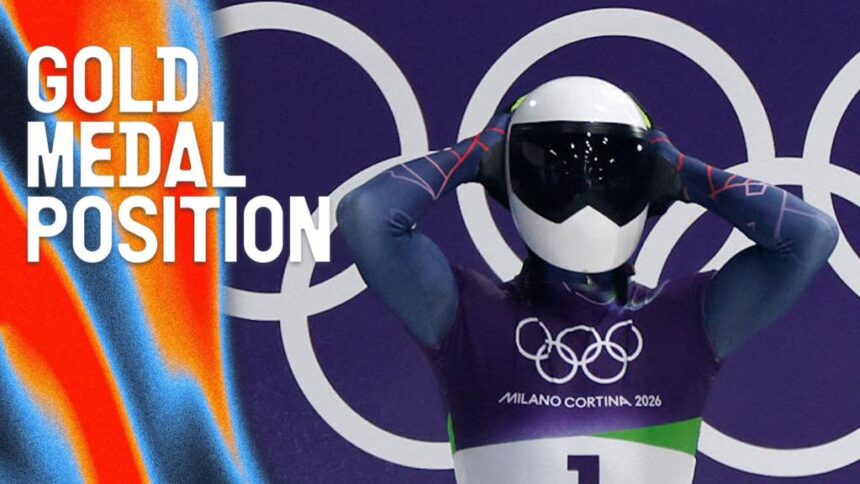
The Man to Beat: Matt Weston Shatters Skeleton Track Record at Winter Olympics 2026
In the high-stakes, whisper-quiet world of skeleton racing, where victory is measured in hundredths of a second and courage is tested at 80+ mph face-first, a new king has declared his reign. Team GB’s Matt Weston didn’t just take the lead at the Winter Olympics 2026; he issued a thunderous statement to the world. By shattering the existing track record in a blistering display of technical mastery and raw speed, Weston has transformed from contender to the undisputed “the man to beat” with just two runs standing between him and Olympic immortality.
A Run for the History Books: Deconstructing Weston’s Record Blitz
While specific timing data is closely guarded, the magnitude of Weston’s performance cannot be overstated. Skeleton records at this level are not merely broken; they are chipped away at over years. To demolish one on the sport’s grandest stage speaks to a near-perfect synthesis of athlete and ice.
Expert analysis points to several key factors in Weston’s historic run:
- Unmatched Start Power: A former competitive sprinter, Weston’s explosive push-off is widely considered the best in the world. Converting leg drive into immediate velocity is the skeleton’s foundation, and he laid a masterpiece.
- Precision Steering: The record-breaking run wasn’t about brute force down the straightaways, but surgical precision in the curves. His minimal sled movement and optimal line conserved every fraction of momentum the start provided.
- Mental Fortitude: Facing immense pressure, Weston showcased a champion’s psyche. His focus was palpable, treating the record attempt not as a gamble, but as the execution of a well-rehearsed plan.
This wasn’t a fluke or a “hot run.” It was the culmination of a four-year cycle focused solely on this moment, a testament to the high-performance program of Team GB that has consistently produced sliding stars.
The Chasing Pack: Who Can Answer Weston’s Challenge?
Weston’s monumental lead has cast a long shadow over the competition, but the final two heats promise a fierce battle for the podium. The psychological blow of his record run is significant, yet the world’s best sliders are now forced to throw caution to the frozen wind.
The primary challengers must now adopt an all-or-nothing strategy. Look for German veterans, with their storied sliding tradition, to make technical adjustments in search of more aggressive lines. The Latvians and Americans, known for their raw power, will be aiming to match Weston’s start intensity, knowing that even matching it might not be enough. The critical question is whether chasing Weston’s ghost in the ice will cause pursuers to over-drive, leading to costly mistakes on a track that punishes even the smallest error. The gold medal is now Weston’s to lose, but the silver and bronze are poised for a spectacular, multi-nation dogfight.
Predictions for the Final Showdown: Can Anyone Stop the Brit?
Based on the seismic shift of the track record, the prediction landscape has fundamentally altered. Here is how the final runs are likely to unfold:
- Matt Weston (GB): The strategy shifts from attack to controlled, intelligent dominance. He will aim for two clean, consistent runs, managing risk without becoming conservative. The gold medal is his if he simply replicates his earlier form. The pressure is now of a different kind—managing expectation.
- The Pursuers: We will see unprecedented aggression. The only chance to close the gap is to risk everything, potentially leading to either heroic climbs up the leaderboard or catastrophic errors. Podium positions will likely be decided by who best walks this tightrope.
- The X-Factor: Track conditions will evolve. As more sleds pass, the ice groove deepens, changing the dynamics slightly. Weston’s team has proven adept at sled adjustment; his ability to adapt mid-competition could be the final nail in the coffin for his rivals.
Barring a miraculous series of personal bests from the field or an uncharacteristic error from Weston, the narrative is set. The competition is now for silver.
Legacy in the Making: What This Means for GB Skeleton
Matt Weston’s performance is more than a personal triumph; it is the latest chapter in Britain’s unlikely and dominant skeleton dynasty. From the pioneering gold of Alex Coomber to the iconic victories of Lizzy Yarnold and the relentless consistency of Laura Deas, Team GB has turned skeleton into a conveyor belt of champions. Weston’s record blitz reinforces this legacy, proving the system’s ability to regenerate world-beating talent.
His success, should he seal it in the final runs, will inspire a new generation of British sliders and solidify the nation’s reputation as a cold-weather sports powerhouse, built on cutting-edge technology, physiological excellence, and nerves of steel. He is not just racing for gold; he is sliding on the shoulders of giants, aiming to become one himself.
The stage is set for a coronation. Matt Weston has done what all great champions do: he has redefined the possible on the Olympic stage. By smashing the track record, he has moved the goalposts and placed the weight of the world upon his competitors. As the final two runs approach, all eyes will be on the ice-clad chute, watching to see if the chasing pack can mount a challenge, or if they are merely witnesses to history. One thing is unequivocally clear: in the heart-pounding, ice-cool world of skeleton, Matt Weston is, without doubt, the man to beat.
Source: Based on news from BBC Sport.