


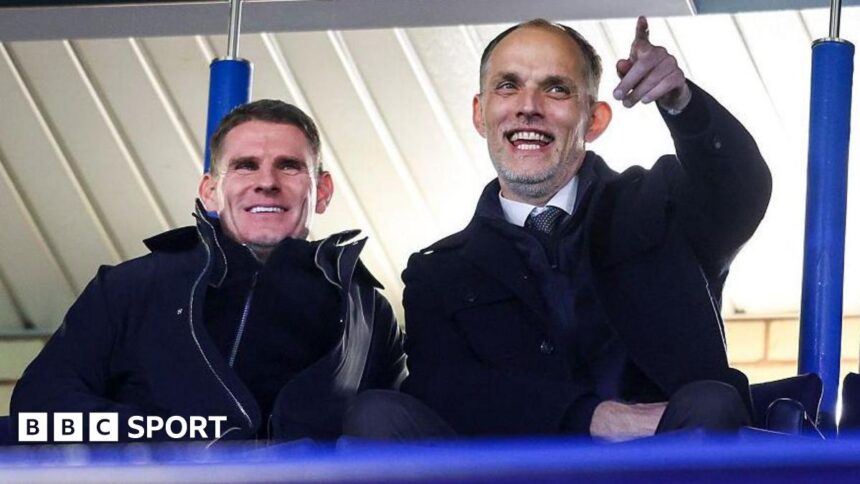
The Unlikely Meteoric Rise: Anthony Barry, The English Brain in Tuchel’s Inner Sanctum
In the rarefied air of elite football management, where super-agent connections and superstar pedigrees often open doors, the story of Anthony Barry stands apart. A decade ago, he was a journeyman midfielder grinding out fixtures in England’s lower leagues, his boots caked in the mud of Accrington and Fleetwood. Today, he is a trusted lieutenant to Thomas Tuchel, a coveted tactical brain whose insights shape the fortunes of footballing giants and national teams. From League Two to the Champions League, his ascent is not just remarkable—it is a masterclass in modern coaching evolution, proving that the sharpest football minds aren’t always found on the front of a trading card.
From Accrington’s Training Pitches to the Champions League Summit
The trajectory of Anthony Barry’s career defies conventional football logic. In 2017, while still a player at Wigan Athletic, he began his coaching education in earnest with a part-time role at Accrington Stanley. This dual life—playing by weekend, dissecting the game midweek—forged a unique perspective. He wasn’t a retired legend imparting wisdom; he was a contemporary translating complex theory into on-pitch reality for his peers. This practical, grounded beginning is the bedrock of his methodology. When his playing days ended, he didn’t linger in the lower leagues. His sharp intellect caught the eye of Chelsea, where he initially joined Frank Lampard’s staff in 2020. His survival and subsequent promotion under Thomas Tuchel is the pivotal chapter. While many staff were overhauled, Barry’s value was so apparent that Tuchel not only retained him but empowered him.
Barry’s specific remit became a secret weapon. He was entrusted with set-piece strategy and defensive shape, areas where games at the highest level are won and lost. Under his guidance, Chelsea transformed into a dead-ball terror, scoring crucial goals and exhibiting immaculate defensive organization—a key component in their 2021 Champions League triumph. His work was so impactful that when Tuchel moved to Bayern Munich, Barry was one of his first calls, a testament to the indispensable role he plays. As Barry himself succinctly put it regarding his partnership with Tuchel: “I’m the yin to his yang.” This speaks to a complementary relationship where Barry’s detailed, analytical preparation balances Tuchel’s intense pitch-side orchestration.
The CV That Defies His Age: A Global Coaching Nomad
For a 39-year-old coach, Anthony Barry’s resume is nothing short of astonishing. It reads like that of a seasoned veteran twice his age, spanning club football’s most pressurized environments and the international stage’s tactical chessboard.
- Chelsea FC: Integral to Champions League and UEFA Super Cup glory, revolutionizing their set-piece approach.
- Bayern Munich: Followed Tuchel to the German behemoth, applying his principles in the Bundesliga and Europe.
- Portugal National Team: In a stunning move, he was recruited by Roberto Martínez to join the Portuguese coaching staff for Euro 2024 qualification, a clear recognition of his tactical acumen.
- Belgium National Team: Simultaneously, he performed a similar role for Martínez’s Belgium, a unique dual-national-team responsibility highlighting his specialist reputation.
This portfolio is unprecedented for an English coach of his generation. While his peers may be managing in the Championship or leading Premier League academies, Barry operates in a transnational stratosphere. He is a tactical consultant to the stars, a fixer for specific, high-leverage problems. His ability to seamlessly integrate into diverse football cultures—German, Portuguese, Belgian—while maintaining his core identity showcases a rare adaptive intelligence and soft skills often overlooked in coaching.
Analysis: What Makes Barry the Modern Coach Prototype?
Anthony Barry’s rise signals a shift in what top-level clubs and federations value. He embodies the specialist coach—a figure less defined by their name as a player and more by their output as an analyst and teacher.
First, his expertise is data-informed but not data-dominated. His set-piece work is legendary, merging video analysis, opponent tendency reports, and inventive rehearsals on the training ground. He translates spreadsheets into player movements, making analytical insights accessible and executable.
Second, he possesses elite communication skills. Surviving and thriving under strong personalities like Tuchel and Martínez, while commanding the respect of global superstars at Chelsea, Bayern, and international camps, requires immense emotional intelligence. He is a conduit between the manager’s philosophy and the player’s understanding.
Finally, his lack of a superstar playing career is arguably a strength. It has fostered a work ethic built on curiosity and proof of concept, not on assumed authority. He is a career coach, not a career player who moved into coaching. His path mirrors the rise of specialists in American sports, where detailed, compartmentalized knowledge is prized above all else.
The Future: England’s Next Managerial Export?
The natural question now surrounds Anthony Barry’s endgame. He is on a path that few English coaches have ever walked. Predictions for his future are compelling:
- Short-Term: Continued success as a elite assistant and specialist, likely following Tuchel or another top-tier manager to a new project, while maintaining his international consultancy roles. His stock in the game has never been higher.
- Medium-Term: The lure of a top managerial job will grow. His apprenticeship under Tuchel and Martínez, coupled with his hands-on experience in multiple leagues, makes him a fascinating prospect for a forward-thinking club seeking a detailed, modern tactician.
- Long-Term: Could he be a future England manager? The FA has historically favored big-name former players, but Barry’s experience with multiple national teams and his cutting-edge approach make him a formidable candidate should the governing body decide to break its own mold.
The key will be timing and opportunity. Barry’s career suggests he values depth of learning over a swift jump to the top seat. When he does take the helm, he will do so with a preparation and tactical library unmatched by most of his contemporaries.
Conclusion: A Blueprint for the Thinking Coach
Anthony Barry’s journey from the lower leagues to the apex of world football is more than a feel-good story. It is a validation of expertise, humility, and specialized skill. In an industry obsessed with celebrity, he has carved a niche as the indispensable background genius. He represents a new avenue for aspiring coaches, proving that a deep understanding of the game’s intricacies can be a more powerful currency than a famous playing past. As the only English coach in Tuchel’s core team, he is not just a token presence; he is a pivotal strategist, the yin to Tuchel’s yang. His remarkable rise underscores a fundamental truth in modern football: the game is won in the minds of players, and the most important person in shaping those minds might just be the unassuming figure with the laptop and the plan, who remembers what it’s like to play on a rainy Tuesday night in Accrington, but now prepares for World Cups and Champions League finals.
Source: Based on news from BBC Sport.
