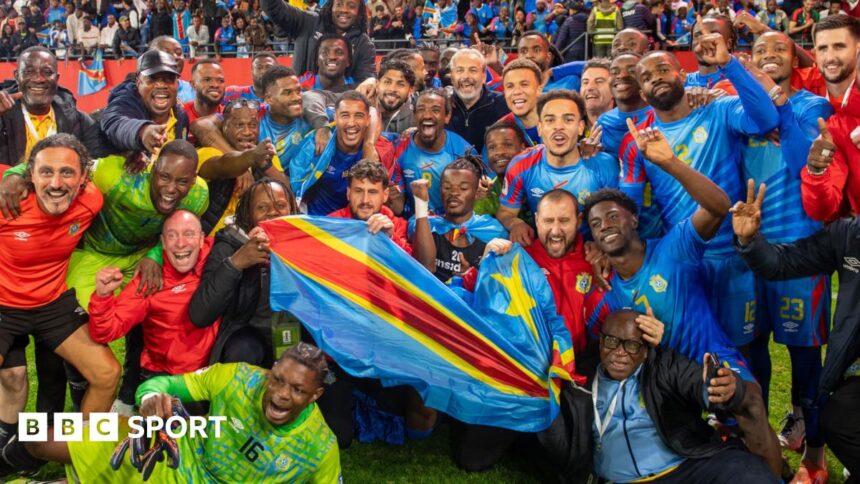
This is Bigger Than Football: DR Congo’s Historic Bid to End a 52-Year World Cup Wait
The air in Kinshasa crackles with a potent mix of hope, history, and collective yearning. For the Democratic Republic of Congo’s national football team, the Leopards, a single match against Jamaica on Tuesday transcends sport. It is a portal to the past and a gateway to the future—a chance to heal the lingering sting of a 52-year-old memory and finally, gloriously, return to the world’s stage. This isn’t just a play-off; it’s a national exorcism.
The Ghost of 1974: A World Cup Campaign Frozen in Time
To understand the magnitude of this moment, you must journey back to 1974. The world was a different place. Richard Nixon resigned, the Rubik’s Cube was invented, and in Kinshasa, Muhammad Ali performed his “Rope-a-Dope” to reclaim his crown from George Foreman in the “Rumble in the Jungle.” In that same tumultuous year, the nation then known as Zaire made its solitary, fateful World Cup appearance in West Germany.
The campaign, however, became a footnote of futility. Zaire lost all three group matches, culminating in a 3-0 defeat to the reigning champions, Brazil. The imagery was harsh: a team out of its depth, symbolizing a gap between African football and the global elite. That tournament created a narrative the nation has been desperate to rewrite for over half a century. For the fans, players, and a country of nearly 100 million, Tuesday’s match is about far more than a ticket to Canada, Mexico, and the USA. It’s about redemption.
Why does 1974 still haunt Congolese football?
- Unfulfilled Promise: It was a pioneering moment that ended in disappointment, leaving a sense of what could have been.
- Symbolic Struggle: The performance was wrongly used by some to diminish African football, a stereotype the continent has spent decades shattering.
- Generational Divide: Most Congolese alive today have never seen their nation at a World Cup. It exists as family lore, not living memory.
The Stakes: A Nation’s Dream on the Shoulders of the Leopards
The intercontinental play-off against Jamaica is the final, formidable hurdle. Victory does not just end the longest active World Cup drought for any African nation; it guarantees Africa a historic 10th representative at the expanded 2026 tournament. The pressure is immense, but the Leopards are not the team of 1974.
This is a squad brimming with talent from Europe’s top leagues, led by experienced campaigners who understand the moment. Burnley defender Axel Tuanzebe captured the sentiment perfectly: “I’d definitely consider it as the biggest game in my football career.” His words are echoed by the bedrock of the modern Congolese game, former captain Gabriel Zakuani, who labels the play-off “the biggest game in our history.”
This sense of history is the team’s fuel and its burden. Manager Sébastien Desabre must harness the raw emotion of a nation and channel it into 90 minutes of focused, tactical football. The Leopards are not just playing for points; they are playing for pride, for legacy, and for the chance to inspire a generation in a country where football is a universal language of hope.
Expert Analysis: Keys to Unlocking History
Breaking down this high-stakes clash reveals several critical battlegrounds. Jamaica, the “Reggae Boyz,” are athletic, physically imposing, and on a mission of their own, having never qualified for a Women’s or Men’s World Cup through a conventional play-off path. They will be no pushovers.
For DR Congo to succeed, three elements are non-negotiable:
1. Emotional Control: The atmosphere will be electric, bordering on frenzied. The Leopards must use the energy of the crowd without being overwhelmed by the occasion. Early composure is key to settling nerves and imposing their game plan.
2. Defensive Solidity: With Axel Tuanzebe likely marshaling the back line, organization is paramount. Jamaica’s threat comes from pace and power in transition. Disciplined positioning and avoiding individual errors will provide the platform for victory.
3. Attacking Fluency: The creative burden will fall on players like Gaël Kakuta and Yoane Wissa. They must find spaces between Jamaica’s lines, provide service to the dangerous Cédric Bakambu, and be clinical with any chances that come. This game may be won by a single moment of quality.
The tactical duel between Desabre and Jamaica’s Heimir Hallgrímsson will be fascinating. Does Congo press for an early goal to satisfy the crowd, or play a more patient, counter-attacking game against a Jamaican side that must also come out to win?
Prediction: A New Dawn for Congolese Football?
The weight of history is a formidable opponent. Yet, there is a feeling that this Congolese generation is uniquely equipped to carry it. They are more experienced, more exposed to high-level football, and acutely aware of the legacy they can reshape.
Playing at home in the cauldron of the Stade des Martyrs in Kinshasa provides an undeniable advantage. The connection between this team and its supporters is palpable, a symbiotic relationship where the players draw strength from the stands, and the fans live every pass through the athletes.
Our prediction: This will be a tense, physically demanding affair, likely decided by the finest of margins. Expect a low-scoring game, with moments of high anxiety for both sets of fans. However, the Leopards’ technical quality, combined with the overwhelming force of national will, should see them through. A 1-0 or 2-1 victory for DR Congo feels like a destiny waiting to be claimed.
Victory would trigger an eruption of joy unseen in the DRC since perhaps that famous night in 1974 when Ali triumphed. It would be a celebration not just of football, but of national identity and perseverance.
Conclusion: More Than a Game, It’s a Homecoming
When the whistle blows on Tuesday, 22 players will contest a football match. But for the Democratic Republic of Congo, they will be contesting history itself. This is about closing a 52-year-old chapter and writing a vibrant new one. It’s about honoring the pioneers of 1974 by forging a better legacy. It’s about proving that the Leopards of today are predators, not prey, on the global stage.
The phrase “this is bigger than football” is often overused. Here, it is a profound understatement. This is about national pride, generational dreams, and the unifying power of sport to redefine a country’s narrative. The wait has been long, the patience immense. Now, the Leopards stand one game away from bringing their nation home. The world is watching, and Congo is ready to roar.
Source: Based on news from BBC Sport.