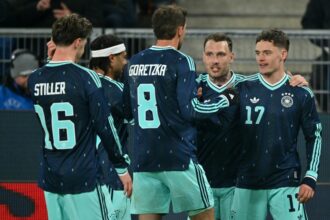
Germany’s Tactical Tango: Three Observations from a Thrilling 4-3 Win Over Switzerland
The beautiful game is often a battle between chaos and control. In Frankfurt, Germany and Switzerland staged a spectacular 90-minute argument on the subject, with the hosts emerging 4-3 victors in a Euro 2024 group stage finale that felt anything but final. The scoreline delivered pure entertainment, but the performance offered a fascinating, flawed blueprint for Julian Nagelsmann’s Germany. This was not a routine victory; it was a high-wire act performed over a tactical minefield. Here are three key observations from a match that proved Germany can thrill the world, but also that their greatest threat might be their own ingenuity.
The Nagelsmann Paradox: When Tactical Genius Becomes a Liability
Julian Nagelsmann, the wunderkind coach, considers himself a master tactician. Against Switzerland, he delivered a system that was, in equal parts, breathtakingly fluid and alarmingly fragile. The intent was clear: dominate the ball, disorient the opposition, and create overwhelming numerical superiority in attack. In practice, however, the tactics outgrew their purpose, transforming from a sharp tool into an overcomplicated, overwrought mess.
The base formation was a 4-2-3-1, but it was a shape-shifter. With possession, it morphed into a daring, almost reckless 2-1-3-5. Joshua Kimmich inverted from right-back into central midfield, while left-back David Raum pushed up to become a winger. This left only Antonio Rüdiger and, crucially, the error-prone Jonathan Tah as the last line. The front four was perfectly fluid: Kai Havertz dropped deep, Florian Wirtz drifted inside, Serge Gnabry floated, and Leroy Sané stretched the play. The result was a heavy overload on the right flank, designed to unlock a stubborn Swiss block.
Yet, this architectural marvel had a critical flaw: acres of space behind the midfield. Whenever Switzerland won the ball, they found vast green pastures on the flanks, particularly in the space Raum had vacated. Germany’s answer was a ferocious, high-intensity gegenpressing trigger. But against a disciplined, physical side like Switzerland, it wasn’t enough. The three conceded goals were not just individual errors; they were systemic failures—the direct cost of a structure that prioritized offensive complexity over defensive stability.
System Overload: The Joshua Kimmich Conundrum and Defensive Disarray
To understand Germany’s tactical gamble, one must focus on Joshua Kimmich. In Nagelsmann’s system, Kimmich was asked to be a one-man tactical nexus, essentially playing three different positions at the same time.
- Nominal Right-Back: Starting position in the defensive phase.
- Inverted Playmaker: Drifting centrally to form a midfield trio and dictate tempo.
- Overload Creator: His movement opened the right half-space for Gnabry and Sané.
While this showcased Kimmich’s phenomenal intelligence, it placed an unsustainable burden on his teammates. The defensive structure left a lot to be desired. The pivot of Robert Andrich and İlkay Gündoğan was often bypassed with one pass, exposing the center-backs. The first Swiss goal, a simple cross from that vulnerable left side, was a warning. The second, where Jonathan Tah was easily outmuscled by Dan Ndoye, highlighted the pressure on isolated defenders.
Individual performances compounded the systemic issues. Kai Havertz was uncharacteristically loose in possession. Leroy Sané’s decision-making was frantic. Substitute goalkeeper Oliver Baumann, in for the rested Manuel Neuer, couldn’t make a single save. Yet, to blame the individuals alone is to miss the point. Nagelsmann had concocted a beastly system with so many offensive modes and tiny moving parts that it seemed to confuse his own players as much as the opponent. The defensive work was an afterthought, a bet that the sheer force of their attack would negate the need for a coherent plan without the ball.
The Saving Grace: Resilience, Subs, and a Glimpse of Unlocked Potential
For all its flaws, this system also contains Germany’s salvation. The very complexity that creates defensive holes also manufactures moments of unstoppable offensive magic. After going behind, Germany’s response was a testament to their talent and resilience. Nagelsmann’s substitutions were bold and impactful. Niclas Füllkrug, the archetypal target man, provided a direct, physical focal point that the clever Havertz could not. His towering header for the 92nd-minute equalizer was a triumph of classic football over modern overcomplication.
Then came the winner, a moment of sublime simplicity: a direct ball, a clever touch from Jamal Musiala, and a ruthless finish. It was a goal that came not from a pre-programmed pattern, but from individual brilliance within a framework that, for all its faults, encourages players to seek the killer blow. This is the Nagelsmann bargain. He has built a team with so many offensive modes that they can win a game in a multitude of ways, from intricate build-up to a striker’s duel in the air.
The victory secured top spot in Group A, but the lessons are more valuable than the points. The match revealed a team capable of breathtaking attacking football and a stubborn fighting spirit. It also exposed a tactical vanity that could be their undoing against more clinical opponents in the knockout rounds.
Road to Berlin: Predictions and the Necessary Evolution
Germany marches on as tournament hosts and one of the most compelling sides to watch. However, the Swiss expose a clear roadmap for future opponents: stay compact, weather the early tactical storm, and exploit the transition. For Nagelsmann, the path forward requires evolution, not revolution.
First, a recalibration of risk is non-negotiable. The full-backs cannot both be auxiliary wingers simultaneously against elite sides. A more conservative balance, perhaps with Kimmich returning to a permanent midfield role, would solidify the spine. Second, the gegenpressing must be more coordinated; it cannot be a panacea for a broken shape. Finally, the luxury of Manuel Neuer’s sweeping and command will return, masking some of the defensive disorganization.
Germany’s ceiling is a European Championship title. Their floor is a spectacular, self-inflicted knockout defeat. The difference will be Nagelsmann’s willingness to temper his tactical ambitions with pragmatic safeguards. The win over Switzerland was a thriller, a warning, and a showcase all in one. They have proven they can outscore anyone. To win it all, they must remember that sometimes, the cleverest move is to also be solid.
In the end, the Frankfurt fireworks displayed the full Nagelsmann experience: a brilliant, chaotic, and ultimately victorious vision of football. For the fans, it’s a dream. For the coach, it’s a vivid lesson that in the quest for perfection, simplicity is not the enemy of genius, but its necessary companion.
Source: Based on news from Yahoo Sports.