Tiger Woods Crash: Trump’s Reaction and the Unraveling of a Legend
The world of sports and celebrity collided once again this weekend, as news broke of golf icon Tiger Woods’ serious single-car accident in Jupiter Island, Florida. The incident, which resulted in a DUI charge, sent shockwaves through the global community. Amidst the public concern and media frenzy, a notable voice weighed in: former President Donald Trump. His comments, layered with personal connection and vague allusion to “difficulty,” have added a complex political and social dimension to an already troubling sports story. This article delves beyond the headlines to explore the crash, the reaction from Trump, and what this moment signifies for the embattled legacy of Tiger Woods.
The Crash and The Charges: A Timeline of Events
In the early hours of Friday, March 27, authorities in Jupiter Island responded to a rollover accident involving a single vehicle. The driver was identified as Eldrick “Tiger” Woods. While initial reports focused on the dramatic nature of the crash—the vehicle sustaining significant damage—the subsequent police report revealed a more serious underlying issue. Woods was not seriously injured in the rollover itself, but law enforcement officials administered a field sobriety test at the scene.
The results led to his arrest and transport to a local police station. He was later charged with Driving Under the Influence (DUI). It is crucial to note the specifics: according to the police affidavit, Woods’ breathalyzer test did not register alcohol. However, officers noted he exhibited signs of impairment and subsequently performed poorly on field sobriety tests. This points toward potential impairment from prescription medication, a detail that shifts the narrative from one of reckless drinking to a potentially more nuanced and medically complicated situation.
- Event: Single-vehicle rollover accident in Jupiter Island, FL.
- Time: Early morning, Friday, March 27.
- Driver: Tiger Woods.
- Key Charge: DUI (with no alcohol detected, indicating possible prescription drug impairment).
- Outcome: Woods was booked and later released on his own recognizance.
“A Very Close Friend”: Donald Trump’s Personal Reaction
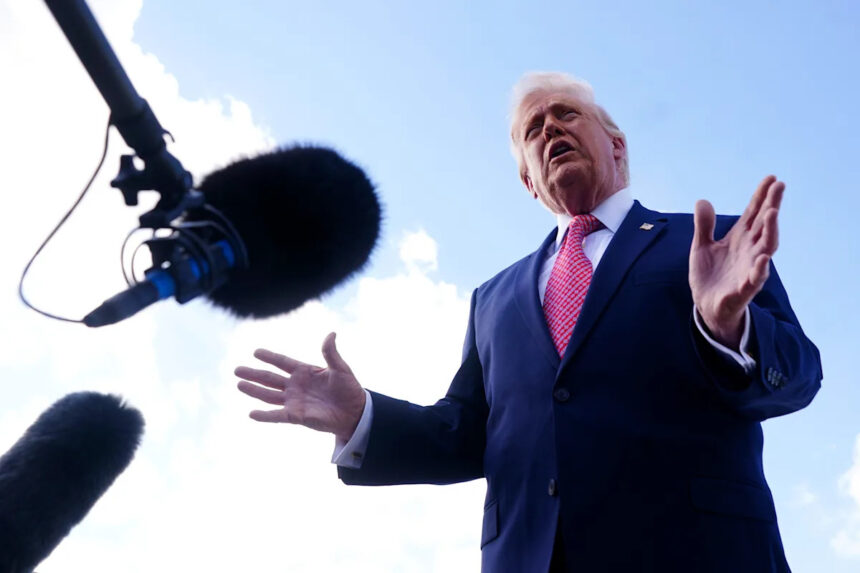
As the story dominated news cycles, former President Donald Trump landed in Miami for a scheduled speaking engagement. Upon deplaning, he was immediately asked about the incident involving Woods. His response was notably personal and emotional, a departure from typical political commentary on celebrity news.
“I feel so badly, his, uh, he’s got some difficulty,” Trump stated. “There was an accident, and that’s all I know. Very close friend of mine. An amazing person, amazing man … but some difficulty.” The phrasing, particularly the repeated mention of “difficulty,” sparked immediate analysis. Was Trump alluding to the immediate legal trouble, or to the broader, well-documented personal and physical struggles Woods has faced over the past decade? The personal connection between Trump and Woods is well-established, rooted in a shared history as icons in their respective fields and a mutual appreciation for golf. Woods has played at Trump courses, and Trump has frequently praised Woods’ talent and comeback attempts.
This connection is further complicated by a familial link: Tiger Woods is currently dating Vanessa Trump, the former daughter-in-law of Donald Trump, who was previously married to his son, Don Jr. This intertwining of personal relationships adds a layer of genuine concern to Trump’s public remarks, positioning his statement not as a political figure’s soundbite, but as a friend’s worried reaction to a crisis.
Expert Analysis: Navigating Legacy, Law, and Public Perception
To understand the full weight of this incident, one must view it through multiple lenses: legal, athletic, and reputational. From a legal standpoint, a DUI charge, even without an alcohol violation, carries severe consequences in Florida, including potential license suspension, fines, and mandatory substance abuse education. For Woods, this marks a stark departure from his 2017 arrest for impaired driving related to prescription drugs, which he addressed as part of his “self-medicating” for back pain.
From a sports journalism perspective, this crash is another devastating blow to a comeback narrative that has defined Woods’ later career. His triumphant 2019 Masters victory was hailed as one of the greatest comebacks in sports history, a redemption arc that seemed to transcend his past personal scandals and debilitating injuries. This incident threatens to unravel that narrative, shifting the public focus back to his personal struggles rather than his athletic genius.
The public perception battle is now paramount. Woods’ team must navigate the legal process while managing a media storm that now includes commentary from figures like Donald Trump. The “difficulty” Trump referenced is the core of the challenge: is this a one-time error in judgment regarding medication, or a sign of deeper, ongoing issues? How Woods and his representatives handle communication in the coming weeks will be critical in shaping the next chapter of his story.
Predictions and the Road Ahead for Tiger Woods
The immediate future for Tiger Woods is fraught with uncertainty, but several outcomes seem probable. Legally, he will likely enter a plea deal that involves diversion programs and close monitoring, avoiding jail time but requiring him to fulfill strict court-mandated conditions. This process will be intensely scrutinized, with every court appearance making headlines.
Professionally, the impact on his golf career could be significant. While his physical recovery from the crash itself appears minimal, the psychological and reputational damage may affect his focus and sponsorship portfolio. Major corporate partners will be watching the legal proceedings closely. Furthermore, his ability to compete at the highest level, already a question due to his past spinal fusion surgery, may now be compounded by this off-course distraction.
Perhaps the most significant prediction concerns his legacy. Tiger Woods exists in a rarefied space as a transcultural athletic icon. This incident forces a recalibration of his story. The narrative is no longer a simple “fall and rise.” It is now a more complex, ongoing human struggle marked by unparalleled peaks and profound valleys. The public’s capacity for empathy will be tested, as will Woods’ own resilience.
Conclusion: Beyond the Headlines
The Tiger Woods crash is more than a celebrity DUI story. It is a multifaceted event that intersects sports, law, celebrity culture, and even politics through Donald Trump’s personal reaction. Trump’s somber, off-the-cuff remarks highlight the very human dimension of this tragedy, reminding us that behind the global brand of “Tiger Woods” is an individual navigating profound challenges.
For Woods, the path forward requires more than legal maneuvering or a return to the PGA Tour. It necessitates a genuine and transparent addressing of the “difficulty” that has now twice placed him and others in danger. His legacy as the greatest golfer of his generation is secure in the record books. But his legacy as a man is still being written. The world, including friends in high places, is watching to see if the champion’s mentality that defined him on the golf course can guide him through this latest, and perhaps most precarious, hazard.
Source: Based on news from Yahoo Sports.