Tiger Woods’ DUI Arrest: Bodycam Reveals Surprising “President” Call Amidst Crash Aftermath
The narrative surrounding Tiger Woods’ 2017 arrest for Driving Under the Influence was already a stark chapter in the legendary golfer’s tumultuous comeback story. However, newly surfaced bodycam footage has added a bizarre and poignant layer, revealing a disoriented Woods telling a police officer he was just “talking to the president” in the immediate aftermath of his single-vehicle crash. This detail, more than just a tabloid headline, opens a window into the immense pressures, powerful connections, and profound personal struggles of an athlete navigating life in a relentless spotlight.
The Crash and the Confusing Aftermath: A Bodycam Timeline
In the early hours of May 29, 2017, Tiger Woods’ Mercedes-Benz was found crashed and rolled over on a road near his home in Jupiter Island, Florida. He was alone in the vehicle. The newly obtained footage from the Martin County Sheriff’s Office paints a scene far removed from the controlled intensity of a Masters Sunday.
Officers found Woods not in the car, but standing nearby, visibly dazed. The footage shows him pacing slowly, phone in hand, seemingly disconnected from the flashing lights and urgent questions. In a critical sequence, an officer approaches as Woods ends a call. When asked who he was speaking with, Woods slurs his response: “The president. Talking to the president.” This moment, fleeting yet loaded, became the incident’s most unexpected footnote.
- Disoriented State: Woods is seen struggling with basic coordination, unable to follow simple instructions to drop a small object he was holding.
- Failed Field Sobriety: The footage corroborates previous reports that Woods performed poorly on standard field sobriety tests, unable to maintain balance or complete an eye-tracking test.
- Chemical Revelation: It is crucial to recall that Woods later stated he had an unexpected reaction to a mix of prescription medications—including painkillers for his surgically repaired back—not alcohol. A breathalyzer test showed a 0.00 BAC.
Decoding “The President”: Symbolism vs. Reality
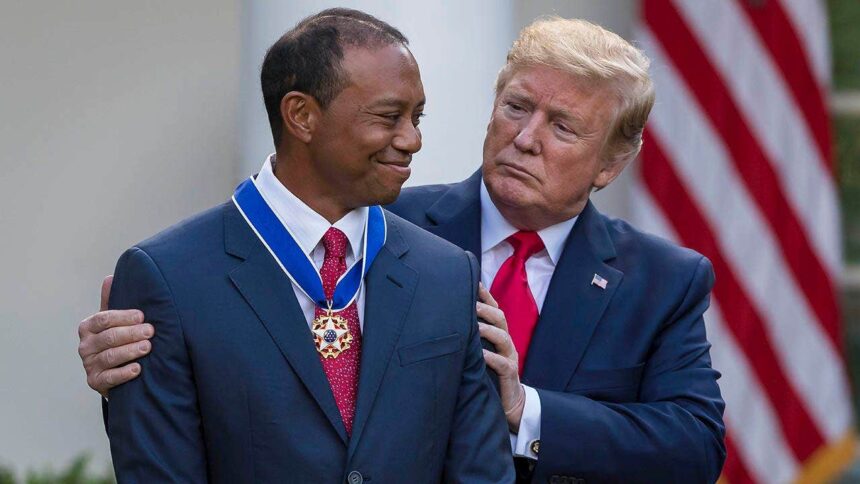
Woods’ statement about “the president” ignited immediate speculation. Which president? The sitting U.S. President at the time was Donald Trump, a known friend and golfing partner of Woods. The two had played together at Trump’s golf courses, and Woods had publicly praised Trump’s presidency. The simpler explanation is that he was indeed on the phone with a friend offering support in a moment of crisis.
However, viewing this through a broader lens reveals a deeper symbolism. For Tiger Woods, “the president” represents the pinnacle of a network of power, fame, and expectation that has surrounded him since adolescence. The call, whether literal or a confused misstatement, underscores a central theme in Woods’ life: in his most vulnerable, humiliating moment—stranded on a public street after a crash—his instinctive reference point was one of the most powerful offices in the world. It highlights the rarefied air he breathes and the immense pressure that comes with being a global icon. This incident wasn’t just a DUI; it was a collision between the private man battling pain and medication and the public figure forever linked with the highest echelons of influence.
The public persona of Tiger Woods has always been one of unflappable, machine-like focus. The bodycam footage violently dismantles that image, showing a human being in profound distress. The mention of “the president,” in this context, acts as a jarring bridge between these two realities—a reminder that even in his lowest moment, the weight of his stature was present.
Expert Analysis: The Psychology of Crisis and Comeback
Sports psychologists and media analysts see this episode as a critical case study in athlete trauma and public perception. “This footage is a raw look at cognitive impairment, but also at the instinct to grasp for a lifeline to normalcy or authority,” notes Dr. Elena Martinez, a specialist in sports-related trauma. “Whether he was actually speaking to President Trump or not, citing that connection could be a subconscious attempt to reassert control and identity in a situation where he had utterly lost both.”
Furthermore, this event must be re-examined within the continuum of Woods’ legendary competitive resilience. The 2017 arrest came after multiple spinal surgeries and during a period of professional uncertainty. His body was failing him, and his career was in question. The DUI was a rock-bottom moment that, paradoxically, may have cleared the path for his next, and perhaps greatest, comeback. It led to a necessary reckoning with his pain management regimen. The public humiliation, captured on bodycam, stripped away any remaining illusions and forced a singular focus: health and golf, in that order.
This analysis reframes the incident not as a salacious scandal, but as a painful, public step in a longer rehabilitation journey—both physical and personal. The Tiger Woods comeback narrative is built on overcoming impossible odds, and this DUI became one of the most daunting obstacles of all.
Predictions: Legacy Impact and the Road Ahead
How does this newly emphasized detail affect the legacy of Tiger Woods? In the immediate sense, it adds a humanizing, albeit tragic, chapter to his story. For a generation that only knows the post-scandal, injury-plagued Woods, it underscores the depth of his struggles beyond the golf course.
Looking ahead, several predictions can be made:
- Legacy Resilience: Woods’ legacy as the golfer who changed the sport is unassailable. This incident will remain a footnote, albeit a vivid one, overshadowed by his 2019 Masters victory—a triumph of will that directly followed this dark period.
- Increased Scrutiny on Pain Management: The episode continues to serve as a cautionary tale within professional sports about the complex and dangerous interplay between surgical recovery, pain management, and public life.
- Fuel for the Final Act: As Woods transitions into a part-time competitive role, his story gains even more profound dimensions of mortality, pain, and perseverance. This moment from 2017 will be revisited as the bleak precursor to one of sport’s most inspirational resurgences.
The ultimate prediction is that the “talking to the president” line will be remembered not for its political connotations, but for what it represented: a lost and hurting individual, momentarily clinging to an identity of power while at his most powerless.
Conclusion: A Stark Portrait in the Flashing Lights
The bodycam footage from Tiger Woods’ 2017 DUI arrest is more than just a police record; it is a stark, unvarnished portrait of a fallen idol in crisis. The revelation that he told an officer he was “talking to the president” is the haunting centerpiece of this portrait—a symbol of the dizzying heights from which he fell and the complex life he navigates. It reminds us that the journey of Tiger Woods has never been a simple arc of athletic domination, but a deeply human saga of unparalleled talent, catastrophic personal failures, debilitating physical pain, and a resilience that seems to defy all logic. This incident, now viewed with the clarity of hindsight, was not an end. It was the dark, necessary prelude to a comeback that would further cement his legend, proving that even from the deepest rough, Tiger Woods could still find a way back to the green.
Source: Based on news from Fox Sports.