Trump’s Touchdown? The Political Punt to Rename American Football Ignites Culture War
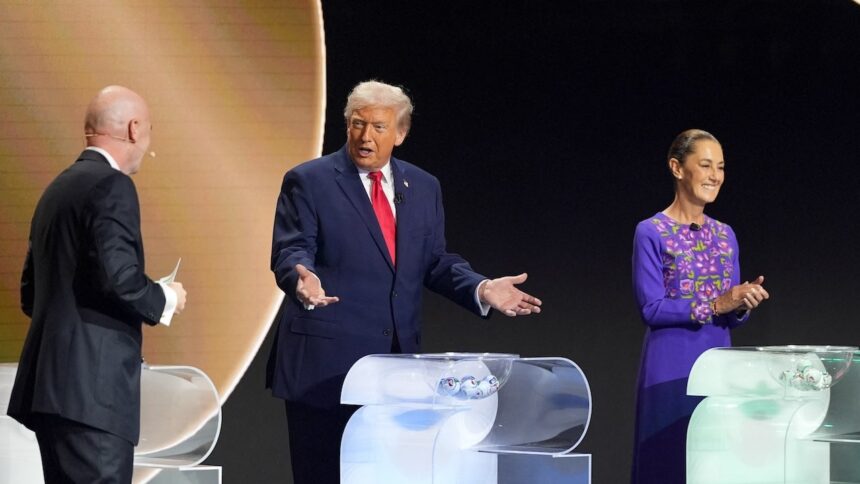
In a moment that only the confluence of global sports diplomacy and American politics could produce, former President Donald Trump has lobbed a verbal hand grenade into the heart of American sports culture. While accepting a surprise FIFA Peace Prize in Washington, D.C., Trump suggested a seismic shift: American football should change its name to clear the way for soccer—the world’s football—to claim its linguistic birthright in the United States. The proposal, made during the high-profile backdrop of a World Cup draw, is less a practical policy suggestion and more a provocative cultural talking point, instantly dividing fans, linguists, and patriots. It touches on deep-seated notions of American exceptionalism, the globalizing force of sport, and the ever-present theater of a Trump headline.
The FIFA Stage and a Presidential Proposal
The setting was as significant as the statement. FIFA President Gianni Infantino’s decision to award Trump the FIFA Peace Prize—citing his administration’s role in brokering the Abraham Accords—already raised eyebrows in the international sports community. But Trump, never one to shy from the spotlight, used the platform to pivot to a perennial American sports quandary. “We need to come up with another name for the NFL stuff,” he declared, framing the global term ‘football’ as the obvious, logical choice for soccer. This wasn’t a casual aside; it was a pointed commentary delivered on a world stage, ensuring maximum impact and guaranteed controversy back home. The World Cup draw in Washington, D.C. thus became the unlikely launchpad for a debate that stretches far beyond the pitch.
A Gridiron by Any Other Name? The History of a Linguistic Divide
To understand the weight of Trump’s suggestion, one must first understand the historical fork in the road. Both sports evolved from ancient ball games, but their codification in the 19th century took different paths.
- Association Football (Soccer): Codified in England in 1863, the term “soccer” is actually a British invention, derived from “association” (as in “assoc.”). It was a colloquial term used alongside “football.”
- American Football: Evolving from rugby and soccer in the late 1800s at elite American universities like Harvard and Yale, it was distinctly American from the start. The name “football” stuck, despite the sport’s evolution into a more hand-oriented game.
The critical divergence is this: while Britain largely abandoned “soccer” in the latter 20th century in favor of “football,” the United States, with its own dominant sport already bearing that name, retained “soccer” for the global game. This created the transatlantic sports naming conflict we know today. Trump’s argument hinges on global consensus, but it dismisses over a century of entrenched American tradition and cultural identity built around the term “football” meaning helmets, tailgates, and the NFL.
Expert Analysis: Why The Proposal is a Political Punt, Not a Practical Play
Sports historians, branding experts, and cultural commentators see Trump’s comment not as a genuine reform proposal but as a multifaceted political maneuver.
First, it’s a nod to globalism and the 2026 World Cup. By aligning himself with the global term, Trump positions himself as a statesman appreciating the world’s game, just as North America (the U.S., Canada, and Mexico) prepares to host the massive 2026 FIFA World Cup. It’s soft diplomacy, albeit with a characteristically disruptive edge.
Second, it ignites a culture war flashpoint. The comment is a classic Trumpian move: identifying a seemingly benign asymmetry and framing it as an illogical absurdity that “doesn’t make sense.” The reaction is predictably polarized. Supporters may see it as a bold, common-sense stance, while critics view it as an attack on a cherished American institution. It forces people to pick a side between American tradition and global conformity.
Third, it overshadows the award itself. The conversation is no longer about the complexities of the FIFA Peace Prize or Middle East politics; it’s about football vs. soccer—a far more digestible and engaging topic for the American public. This is strategic media redirection.
Branding experts are unanimous: the idea of the NFL rebranding its century-old identity is a non-starter. The financial, legal, and cultural capital tied to the words “National Football League” and “football” is incalculable. As one analyst put it, “You might as well suggest Apple change its name to Fruit.”
Predictions: The Lasting Impact of a Passing Comment
While the name of the NFL will remain untouched, Trump’s provocation will have ripple effects.
- Fuel for the “Soccer vs. Football” Purists: The debate will be reignited in bars, online forums, and media segments for weeks, giving American soccer advocates a high-profile moment to argue for linguistic alignment with the global community.
- Increased Scrutiny on FIFA-Trump Ties: The awarding of the peace prize and Trump’s subsequent platform will lead to deeper investigation into the political relationship between FIFA and U.S. political figures, especially with 2026 looming.
- A Boost for U.S. Soccer’s Profile: Ironically, by using the term “football” for soccer in his remarks, Trump inadvertently lends weight to the argument of U.S. soccer fans. Major League Soccer and the U.S. Soccer Federation may quietly welcome the spotlight, even if they distance themselves from the political source.
- Zero Chance of an NFL Name Change: This prediction is the safest of all. The NFL is a $100+ billion empire. The term “football” in America is synonymous with Thanksgiving, the Super Bowl, and a specific kind of athletic brutality. That identity is immutable.
Conclusion: A Culture Clash with No Winner
Donald Trump’s call to rename American football is ultimately a symbolic gesture, a political punt that lands squarely in the middle of America’s ongoing culture wars. It highlights the tension between America’s insular sporting traditions and its place in a globalizing world. While the proposal itself is a logistical and commercial fantasy, the conversation it sparks is very real. It forces a national reflection on why we call our sports what we do and what those names say about us. In the end, the American football naming controversy won’t be solved by a presidential decree, but by the slow, organic march of cultural change. For now, and for the foreseeable future, on American soil, football will mean pigskins and goalposts, while soccer will continue its meteoric rise under its own, distinctly American, moniker. The world may call it football, but in the U.S., the only end zone being discussed is in the NFL.
Source: Based on news from Fox Sports.
Image: Source – Original Article