Trump Signs Executive Order on College Sports, Aiming to Regain Control of NIL Landscape
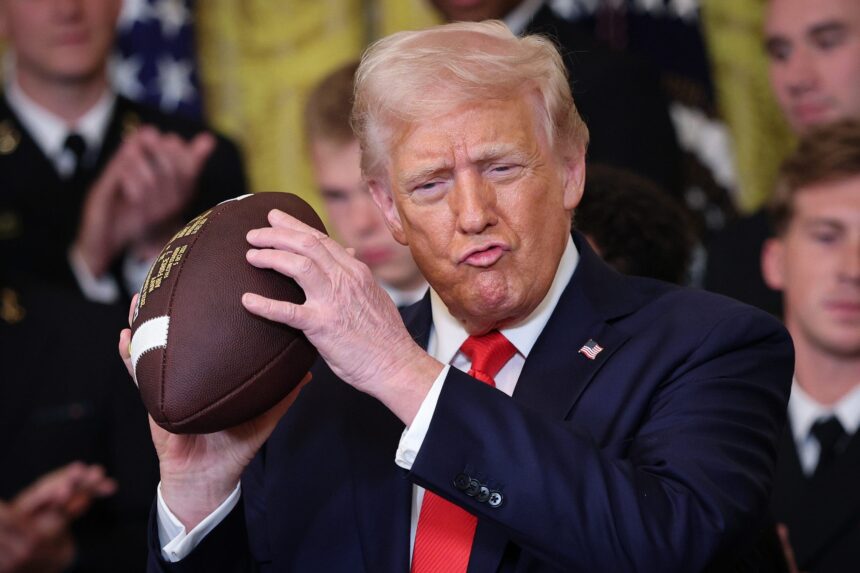
In a move that has sent shockwaves through the multibillion-dollar world of collegiate athletics, former President Donald Trump has signed an executive order designed to fundamentally reshape the governance of college sports. The order, titled “Preserving the Unique American Institution of College Athletics,” represents a direct federal intervention into the chaotic realm of Name, Image, and Likeness (NIL) and athlete transfer rules. Coming just weeks after a high-profile White House roundtable with sports luminaries, this action signals a bold attempt to impose a new order on what many have called the “Wild West” of student-athlete compensation.
The White House Roundtable: Setting the Stage for Federal Action
The executive order did not emerge in a vacuum. Last month, Trump convened a private discussion at the White House with a powerful coalition of sports figures. While the full guest list remains private, reports indicate it included prominent coaches, athletic directors, and advocates who have been vocal about the destabilizing effects of the current NIL and transfer portal systems. This roundtable served as a critical sounding board, highlighting the frustrations of traditional power brokers in college sports who feel the NCAA has lost control. The consensus from that meeting was clear: without a coherent national framework, the recruiting landscape has become a free-for-all, competitive balance is threatened, and athletes are vulnerable to exploitation by unscrupulous third-party collectives. The executive order is the direct policy response to those concerns, leveraging federal power to enforce a new vision of “order, fairness, and stability.”
The core mechanism of the order is a dramatic escalation of federal oversight. It moves the debate from conference boardrooms and NCAA committees directly to the desks of federal agency officials.
Decoding the Executive Order: A New Federal Enforcement Hammer
At its heart, the executive order is about attaching serious financial consequences to the violation of college sports rules. It directs federal agencies—most notably the Department of Education and others that administer grants and contracts—to undertake a sweeping evaluation. Their mandate is to determine whether a university’s failure to enforce key rules related to athlete eligibility, transfer regulations, and prohibitions on direct pay-for-play schemes should render that institution “unfit” to receive federal funds.
This represents a paradigm shift. The potential penalties are no longer just postseason bans or scholarship reductions; they now risk impacting a university’s core research, infrastructure, and aid funding. The order focuses on three pillars:
- NIL and Pay-for-Play: While NIL itself is protected, the order seeks to crack down on deals that are mere disguises for recruiting inducements or performance-based payments, which remain illegal under NCAA amateurism rules.
- Transfer Portal Rules: It aims to bolster existing transfer windows and eligibility requirements, potentially curtailing the trend of immediate, multi-time transfers without penalty.
- Institutional Control: It places the onus squarely on universities to police their boosters and collectives, making them federally accountable for the actions of third parties affiliated with their athletic programs.
In essence, the order attempts to use the federal treasury as a cudgel to force schools into aggressive self-policing, creating a uniform national standard where currently a patchwork of state laws exists.
Expert Analysis: Unintended Consequences and Legal Thunderdomes
Sports law and policy experts are already dissecting the monumental implications of this executive action. “This is the most significant governmental intrusion into college sports since Title IX,” notes Dr. Amanda Sterling, a professor of sports governance. “It bypasses Congress and the courts, attempting to create de facto federal regulations by threatening universities’ financial lifelines. The enforcement complexity will be staggering.”
The immediate legal challenges are inevitable. Critics argue the order may overreach federal authority and conflicts with state-level NIL laws that were passed to grant athletes more rights. Furthermore, the definition of what constitutes a violation rendering a school “unfit” for federal funding is legally nebulous. Boosters and collectives, often structured as separate legal entities, could operate in a gray area, forcing the government into difficult, protracted investigations.
Another significant concern is the potential chilling effect on athlete compensation. While the order states it aims to protect legitimate NIL, the fear among athlete advocates is that the threat of massive institutional penalties will cause schools to overly restrict their athletes’ market opportunities, rolling back the newfound earning potential many have embraced.
“This isn’t just about cleaning up recruiting,” argues former athletic director and analyst Marcus Thorne. “This is a power play to re-assert institutional control over the athlete economy. The message to athletes is: ‘You can have NIL, but only on our terms, under our watchful eye, or we all lose federal funding.’ It creates an unprecedented alliance between university presidents and the federal government against the forces of athlete empowerment and booster capitalism.”
The Future of College Athletics: Predictions in a New Era
The signing of this executive order marks the beginning of a new, volatile chapter for college sports, not its conclusion. Several predictions can be made about the coming landscape:
- Immediate Legal Onslaught: Expect lawsuits from athlete advocacy groups, states with progressive NIL laws, and potentially even collectives, arguing the order is an unconstitutional overreach that harms athletes.
- NCAA Empowerment or Irrelevance? The NCAA could be empowered as the de facto standard-setter for rules that now carry federal weight. Conversely, if the federal government takes over enforcement, the NCAA’s role could diminish to that of a rule-writing body without true power.
- A Two-Tiered System: Schools with massive, federally-funded research portfolios (e.g., major public universities in the Big Ten, SEC) may become hyper-vigilant. Smaller private schools less reliant on federal contracts might operate more freely, potentially altering competitive dynamics.
- Accelerated Push for an Employer-Employee Model: Faced with heavy federal regulation, some power conferences may finally decide that the only clear path forward is to formally employ athletes, moving completely outside the traditional amateur model and its associated rules.
Conclusion: A High-Stakes Gambit for Control
Donald Trump’s executive order on college sports is a high-stakes gambit to reclaim control of a system that has spun into perceived chaos since the dawn of the NIL era. By wielding the threat of lost federal funding, it seeks to impose a top-down stability that the NCAA has been unable to achieve. Its success hinges on surviving legal challenges, navigating a labyrinth of enforcement, and balancing the competing interests of institutions, athletes, and the free market.
Whether this action ultimately preserves the “unique American institution” as intended, or accelerates its transformation into a fully professionalized enterprise, remains to be seen. One outcome is certain: the playing field of college sports policy has been permanently altered. The debate is no longer confined to NCAA conventions or state legislatures; it is now firmly entrenched in the arena of federal power, with the financial viability of America’s universities hanging in the balance. The final whistle on this game is decades away.
Source: Based on news from Fox Sports.