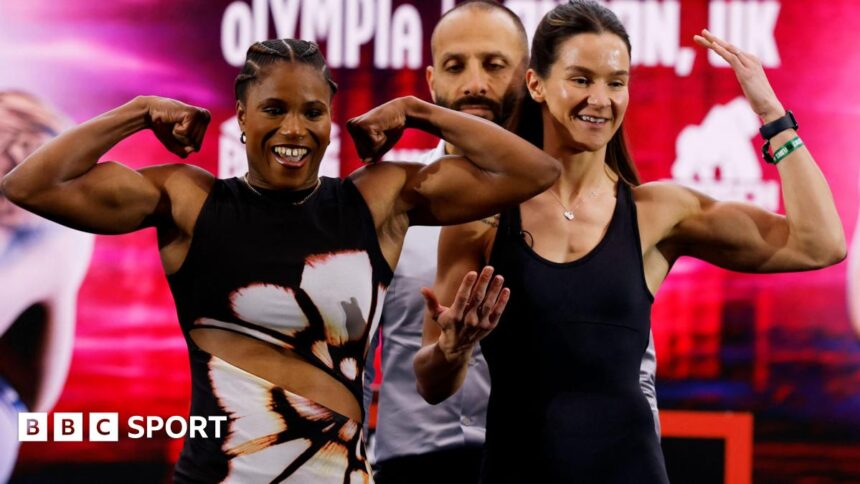
‘Turn Off My Mic’: Inside the Explosive Dubois vs Harper Rivalry
The art of the fight build-up is a delicate dance of intimidation and psychology. Rarely, however, does it escalate to the point of physical confrontation before the first bell. For British lightweight rivals Caroline Dubois and Terri Harper, the line between promotion and genuine animosity has not just been crossed—it’s been shoved aside. Days before their historic unified world title clash at Olympia London, a war of words has become a war of wills, punctuated by a shove that has the boxing world buzzing. This is more than a title fight; it’s a collision of two eras, two contrasting champions, and two fiercely proud athletes who have declared the respect chapter closed.
A Shove Heard ‘Round the Fight World
The flashpoint came during Wednesday’s face-off. As cameras flashed, a tense stare-down between the unbeaten phenom Caroline Dubois and the seasoned three-weight world champion Terri Harper boiled over. Harper placed a hand on Dubois’s shoulder and pushed. The reaction was instantaneous and telling. Dubois, cool yet clearly irked, didn’t flinch into retaliation but instead into rhetoric. At Friday’s final news conference, when pressed on the incident, Dubois’s frustration with the narrative peaked, leading to her demanding, “Turn off my mic.”
This moment was a microcosm of the entire build-up. Harper, the champion from Denaby Main, defended the push as part of the “mind games,” a physical assertion of her experience and territory. Dubois, from London, viewed it as a cheap shot, an attempt to rattle a composure she believes is unshakeable. “Talk is cheap,” both had insisted moments before, yet the talk—and now the physicality—has revealed a deep-seated tension that promises to fuel a ferocious contest.
Clash of Identities: The Prodigy vs. The Proven
To understand the venom, one must understand the stark contrast between the two fighters. Their careers represent two different paths to the summit of the sport.
- Caroline Dubois (9-0, 5 KOs): The anointed one. A stellar amateur pedigree that saw her dominate the youth scene and compete at the Olympics. As a professional, she has been fast-tracked, her technical brilliance and sharp boxing brain dissecting opponents. Her confidence borders on arrogance, a belief system built on an unblemished record. She questions the quality of Harper’s opposition, subtly undermining the champion’s resume to position herself as the true elite force.
- Terri Harper (14-1-2, 6 KOs): The self-made champion. Harper’s journey from working in a chip shop to winning world titles at super-featherweight, lightweight, and light-middleweight is the stuff of British boxing legend. Her three-weight world champion status is a testament to her grit, adaptability, and heart. She represents the school of hard knocks, and she perceives Dubois’s questioning of her achievements as the ultimate disrespect from a fighter who hasn’t yet been truly tested.
“I do not want or need her respect,” Harper stated bluntly. This is the core of the conflict. Dubois seeks to validate her hype by dethroning a celebrated champion, while Harper aims to expose the prodigy as a protected product, using her hard-earned experience as the ultimate weapon.
Expert Analysis: What Wins the Fight?
Beyond the drama, this is a compelling stylistic matchup. Dubois, the southpaw, is the superior pure boxer. Her jab, footwork, and ring IQ are her pillars. She will look to control distance, pick Harper apart from the outside, and accumulate rounds with clean, sharp punching. The key for Dubois is to use the ring, avoid getting drawn into a trench war, and make Harper’s aggression pay with counters.
Harper’s path to victory is rooted in pressure and proven resilience. She is the stronger, more physically mature fighter who has been in deep waters against punchers and come through. Her engine is relentless. She must cut the ring off, work to Dubois’s body to slow the movement, and turn the fight into a grueling, physical battle in the pocket. Her experience in championship fights—the ability to adjust mid-fight—is her intangible advantage.
The critical questions are:
Can Dubois’s chin and stamina hold up under Harper’s constant, heavy-pressure assault?
Can Harper, who has moved up and down in weight, cope with the speed, sharpness, and youthful energy of the naturally bigger lightweight?
Prediction: Fireworks at the Olympia
Predicting this fight is fraught with difficulty, which is what makes it a must-watch event. The pre-fight animosity guarantees a high-tempo start. Harper will come forward from the opening bell, looking to establish dominance and prove her point physically. Dubois will look to box and move, using her skills to silence the champion.
The early rounds will be crucial. If Dubois can establish her jab and make Harper miss, she can build a lead and force Harper into desperate, risky attacks. However, if Harper can successfully pressure, corner Dubois, and land her heavy shots to the body, she can drain the prodigy’s legs and take control in the second half of the fight.
This expert leans slightly toward the notion that professional experience in tough fights will be the deciding factor. Harper has faced adversity, been knocked down, and rallied. Dubois has yet to face anyone with Harper’s combination of strength, will, and championship pedigree. Expect a dramatic, back-and-forth battle that goes into the championship rounds, with Harper’s pressure and body work ultimately earning a close, and potentially controversial, decision victory. But one thing is certain: Caroline Dubois has the talent to make that prediction look foolish, and that is the beauty of this magnificent clash.
Conclusion: More Than a Belt at Stake
When Caroline Dubois and Terri Harper finally step between the ropes at Olympia London, they will be fighting for more than the unified lightweight world title. They will be fighting for validation. For Dubois, it is the chance to transform potential into undisputed reality and claim the respect she feels is her due. For Harper, it is an opportunity to defend her legacy, to prove that heart and experience can trump pure talent, and to teach the next generation a painful lesson.
The shove, the “turn off my mic” moment, the barbed words—these are not mere promotional tools. They are symptoms of a genuine rivalry born from contrasting journeys and a mutual understanding of what is at stake. On Sunday night, the talking stops, and the fists finally do the talking. In a fight fueled by genuine tension, the British boxing public is guaranteed a classic.
Source: Based on news from BBC Sport.