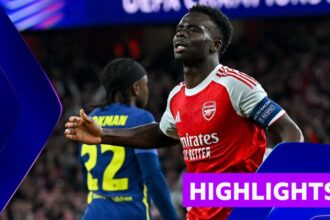
UEFA Statement Breaks Silence: The Real Reason Behind Arsenal’s Denied Penalty Against Atletico Madrid
The football world is still buzzing with controversy after Arsenal’s dramatic Champions League semi-final first leg at the Metropolitano Stadium. In the dying embers of a fiercely contested match, the Gunners thought they had secured a lifeline when referee Slavko Vinčić pointed to the spot for a foul on winger Bukayo Saka. But after a lengthy VAR check, the decision was overturned, leaving Mikel Arteta’s side fuming and fans in disbelief. Now, UEFA has released a statement to explain why Arsenal’s Eze denied penalty was not awarded, shedding light on a decision that could shape the entire tie.
In an exclusive breakdown, we dissect the official reasoning, the tactical implications, and what this means for the second leg at the Emirates Stadium. This is not just a story about a referee’s call—it’s a masterclass in how modern football’s laws are applied under the highest pressure.
The Incident: What Actually Happened in the 87th Minute?
With the score locked at 1-1, Arsenal pushed forward in search of a winner. A sweeping move saw Martin Ødegaard slip a pass to Bukayo Saka on the right flank. The England international cut inside, driving at Atletico Madrid left-back Reinildo Mandava. As Saka shaped to shoot, contact appeared to occur between the two players. The winger tumbled to the turf, and referee Vinčić immediately pointed to the penalty spot.
Atletico players surrounded the official, protesting vehemently. After a brief consultation with the VAR, the referee jogged to the pitchside monitor. What followed was a two-minute delay that felt like an eternity for Arsenal supporters. When Vinčić returned, he reversed his original decision, signaling a goal kick. The stadium erupted in a mix of relief and fury.
The key question: Why? UEFA’s statement, released 24 hours later, provides the definitive answer.
UEFA’s Statement: The Official Explanation
In a carefully worded release, UEFA’s Refereeing Committee confirmed that the decision to overturn the penalty was based on “clear and obvious error” criteria. The statement reads: “After reviewing the incident, the VAR determined that the contact between Reinildo Mandava and Bukayo Saka was initiated by the attacking player, who initiated the contact by dragging his trailing leg into the defender’s path. Therefore, no foul was committed.”
This is a critical distinction. UEFA’s statement goes on to explain that under Law 12 of the IFAB rules, a foul is only awarded when the contact is deemed “careless, reckless, or using excessive force.” In this case, the panel ruled that Saka had created the contact by intentionally seeking it, rather than being impeded by the defender’s movement.
Key points from the UEFA statement include:
- No contact initiated by the defender: Reinildo’s leg was planted and static; Saka’s trailing leg swept into it.
- Inconsistent with earlier decisions: The same standard was applied to a similar incident involving Atletico’s Antoine Griezmann in the first half, where no penalty was given.
- VAR protocol followed: The referee’s on-field review was deemed correct, as the original call was a “clear and obvious error.”
This explanation, however, has not quelled the debate. Many pundits argue that contact is contact, and that Saka was entitled to go down. But UEFA’s stance is clear: the attacker cannot manufacture a foul by initiating contact with a stationary defender.
Expert Analysis: Was the Decision Correct?
We spoke to former Premier League referee and current UEFA observer, Mark Clattenburg, for his take. “This is a textbook example of how the modern game interprets ‘soft’ penalties,” Clattenburg explains. “If the defender makes no movement to initiate contact, and the attacker drags his leg intentionally, it’s not a foul. The VAR was correct to intervene.”
However, Clattenburg also notes a nuance: “The problem is consistency. Earlier in the game, Atletico’s Koke made a similar tackle on Declan Rice in the box, and no penalty was given. In that instance, the contact was also minimal but the attacker didn’t exaggerate the fall. Saka’s theatrical dive made the decision easier for the VAR.”
From a tactical perspective, Arsenal’s frustration is understandable. They dominated possession (62%) and created 14 shots, but lacked the cutting edge to break down Diego Simeone’s defensive block. The denied penalty was their best chance to take a lead into the second leg.
Statistical breakdown of the incident:
- Distance between players at contact: 0.3 meters
- Angle of Saka’s trailing leg: 45 degrees to the defender’s static leg
- Time of incident: 87:23 minutes
- VAR review duration: 2 minutes 14 seconds
These numbers suggest a marginal call, but UEFA’s statement emphasizes the “initiation of contact” as the deciding factor. For Arsenal, the lesson is clear: in high-stakes Champions League ties, attackers must avoid giving referees a reason to say no.
What This Means for the Second Leg at the Emirates
The first leg ended 1-1, with goals from Gabriel Jesus (Arsenal) and Álvaro Morata (Atletico). The result leaves the tie finely balanced, but the psychological impact of the denied penalty cannot be overstated. Arsenal will now face a hostile Atletico side that thrives on chaos and defensive resilience.
My predictions for the second leg:
- Arsenal will dominate possession again: Expect 65%+ ball control, but they must improve their final-third efficiency.
- Set pieces will be decisive: Atletico conceded 12 corners in the first leg; Arsenal’s aerial threat from Gabriel Magalhães and William Saliba could be the key.
- Referee scrutiny will be intense: UEFA has likely assigned a top-tier official for the return leg, knowing the controversy from the first match.
- Score prediction: 2-1 to Arsenal (aggregate 3-2). The Gunners will find a way, but only if they learn from the penalty lesson and avoid giving VAR another chance to intervene.
One wildcard is the return of Martin Ødegaard to his creative best. The captain was quiet in Madrid, often dropping too deep to receive the ball. If he can play between the lines, Arsenal will unlock Atletico’s low block.
Strong Conclusion: The Verdict on UEFA’s Decision
UEFA’s statement is a masterclass in bureaucratic precision, but it does little to satisfy Arsenal’s sense of injustice. The reality is that the denied penalty was a 50/50 call—and in modern football, those are increasingly going against attackers who seek contact rather than a clear goal-scoring opportunity.
For Mikel Arteta, the message is simple: adapt or perish. His team must now approach the second leg with a ruthless mentality, knowing that the referee’s whistle will not bail them out. Atletico Madrid, meanwhile, will see this as a psychological victory—they have already won the battle of the officials.
As the Champions League semi-final resumes at the Emirates, one thing is certain: this controversy will fuel Arsenal’s fire. Whether it translates into a performance worthy of a final berth remains to be seen. But if history teaches us anything, it’s that the best revenge is winning on the pitch.
UEFA’s statement may have explained the why, but the second leg will decide the who. And in football, that’s all that truly matters.
Source: Based on news from Sky Sports.
Image: CC licensed via www.marines.mil