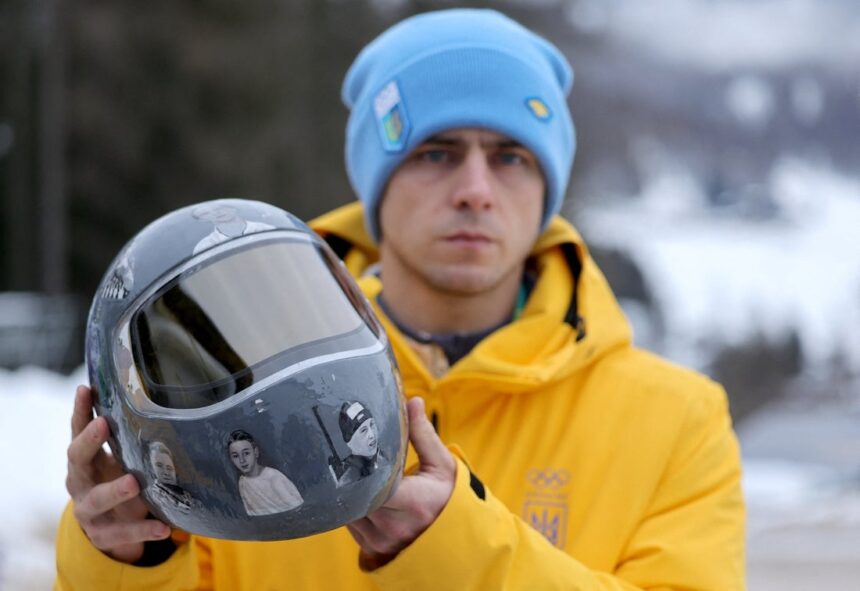
Helmet of Remembrance: Ukrainian Skeleton Athlete DQ’d, Sparking Olympic Principle Firestorm
The icy chute of the sliding track in Cortina d’Ampezzo was meant to be a stage for athletic triumph. Instead, it became the epicenter of a profound and painful clash between Olympic protocol and raw human remembrance. In a decision that has ignited global debate, Ukrainian skeleton racer Vladyslav Heraskevych was disqualified from competition minutes before his run over a helmet honoring two dozen Ukrainian athletes killed since Russia’s full-scale invasion. The incident, involving a last-minute personal appeal from a tearful IOC President, lays bare the agonizing tension between the Games’ cherished neutrality and a competitor’s need to bear witness to unimaginable loss.
A Last-Minute Disqualification and an Unprecedented Appeal
The drama unfolded with crushing abruptness. Heraskevych, 27, had been training openly in Italy with his custom-designed “helmet of remembrance,” a stark visual memorial featuring the faces and names of fallen Ukrainian sports figures. According to reports, officials informed him he was barred from competing and would have his accreditation stripped just before he was set to launch himself down the ice. The reason: a violation of Rule 50 of the Olympic Charter, which prohibits political, religious, or racial propaganda in Olympic venues.
What happened next was extraordinary. International Olympic Committee President Kirsty Coventry, a former athlete herself, personally intervened. Witnesses described her as emotional as she asked the IOC’s Disciplinary Commission to urgently reconsider the accreditation withdrawal. This high-stakes appeal resulted in a partial reversal: Heraskevych could keep his credentials and remain at the Milano Cortina Games, but his disqualification from the skeleton event stood firm. “I am disqualified from the race. I will not get my Olympic moment,” Heraskevych stated, his Olympic dream sacrificed on the altar of a principle he believes is being selectively applied.
Rule 50 Under the Microscope: Remembrance vs. Propaganda
This incident forces a brutal re-examination of the Olympic Charter’s political neutrality in an era of geopolitical conflict. The IOC’s Rule 50 exists to protect the sporting field from becoming a platform for divisive statements, ensuring the focus remains on athletic achievement. However, Heraskevych’s helmet presents a complex edge case. Is honoring specific war dead—individuals, not abstract symbols—a political act, or a fundamental human act of mourning?
Expert analysis suggests the IOC’s dilemma is acute. Allowing the helmet could be seen as taking a side in an active, brutal war. Disqualifying the athlete, however, is perceived by many as a cold bureaucratic silencing of a victim’s testimony. Heraskevych’s poignant words cut to the heart of this perception: “They were killed, but their voice is so loud that the IOC is afraid of them.” The decision highlights the inherent tension in apolitical ideals when confronted with a reality where an athlete’s very presence at the Games is a consequence of a geopolitical catastrophe.
- Historical Context: The IOC has historically cracked down on overt political gestures, from the Black Power salute in 1968 to more recent demonstrations. However, memorials for tragedy, like moments of silence for lost Olympians, are often incorporated.
- The Athlete’s Perspective: For Heraskevych, the helmet was not a generic protest but a specific, personal tribute to colleagues and friends, blurring the line between private grief and public statement.
- The Precedent Problem: The IOC fears a “slippery slope” where any cause could be championed via athlete equipment, politicizing every venue. Yet, critics argue that failing to distinguish between aggression and commemoration moral equivocation.
Broader Implications for the Future of Athlete Expression
The Heraskevych disqualification is not an isolated case but a symptom of a growing pressure point within global sport. As conflicts rage and social consciousness rises, athletes increasingly view their platforms as integral to their identities. The evolving landscape of athlete activism, particularly on issues of human rights and justice, continues to test the traditional boundaries of sporting governance.
This event will undoubtedly influence future IOC policy reviews of Rule 50. We can predict several potential outcomes:
- Clarification of “Remembrance” Guidelines: The IOC may attempt to create a formal distinction between honoring specific victims of violence (potentially allowable) and making generalized political statements (not allowable).
- Increased Scrutiny of Pre-Approval Processes: Athletes may be forced into earlier, more secretive submissions of equipment for approval, potentially leading to more behind-the-scenes conflicts.
- Erosion of the “Field of Play” Concept: The starkness of this decision may fuel further athlete and public sentiment that the rules are out of touch, leading to more defiant acts and a potential crisis of legitimacy for the IOC’s neutrality stance.
The partial compromise—allowing Heraskevych to stay but not compete—feels like a quintessential bureaucratic solution, satisfying no one fully. It acknowledges the humanitarian dimension while upholding the letter of the law, a outcome that may become more common as these conflicts intensify.
A Conclusion Etched in Memory
Vladyslav Heraskevych did not get his Olympic moment on the track. Yet, in a tragic irony, his disqualification has amplified his message far beyond what a single skeleton run ever could. The “helmet of remembrance” controversy transcends a single ruling; it is a defining moment that questions the very soul of the modern Olympic movement. Can the Games truly be a sanctuary from the world’s troubles when those troubles have already destroyed the homes and lives of the competitors?
The IOC’s mandate to remain neutral is understandable, but neutrality in the face of a war of aggression and documented atrocities is interpreted by many as complicity. Heraskevych’s helmet was not a slogan; it was a cemetery. By ruling it a political statement, the IOC demonstrated the near-impossibility of separating the athlete from the context of their nation’s suffering. The final result is a loss for everyone: an athlete denied his competition, a memorial confined to the training slope, and an Olympic ideal looking increasingly fragile on the world’s icy, complicated stage. The names on that helmet were silenced once by war. The world is now left to debate whether they were silenced a second time by the rules of peace.
Source: Based on news from Deadspin.