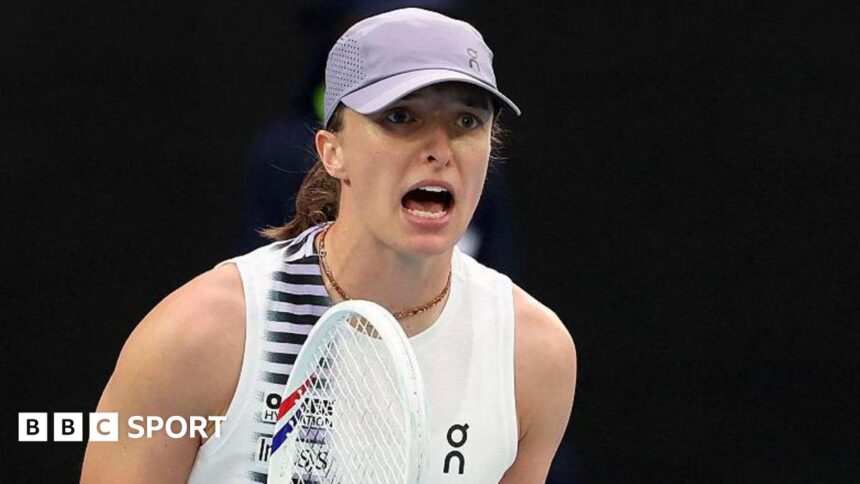
Swiatek’s Historic Quest Begins with a Gritty, Unpolished Victory
The path to immortality is rarely a stroll. For Iga Swiatek, whose mission at the 2025 Australian Open is to carve her name into the rarest air of tennis history, it began not with a thunderous declaration, but with a laborious, error-strewn grind. The world number two, needing only the Melbourne crown to complete the career Grand Slam, navigated a tense and unexpectedly complicated first hurdle, subduing Chinese qualifier Yuan Yue 7-6 (7-5), 6-3. The victory was a testament to her competitive grit, but the performance was a stark reminder that even the most dominant forces must sometimes wrestle with their own standards.
A Shaky Start on the Stage of Dreams
Rod Laver Arena, the very court where legends cement their status, witnessed an uncharacteristically vulnerable Swiatek. From the outset, her usually reliable serve was a source of frustration, lacking its typical pop and precision. Groundstrokes that normally paint the lines instead found the tape or sailed long. In total, a staggering 34 unforced errors flowed from her racquet, a number that would typically spell disaster against a higher-ranked opponent. Yuan Yue, the world number 130 playing with the nothing-to-lose freedom of a qualifier, capitalized brilliantly, matching Swiatek’s power from the baseline and exposing her early-match nerves.
The first set became a tense tug-of-war, with Swiatek unable to break free. It culminated in a tie-break where the Pole’s experience and clutch mentality finally surfaced. She edged it 7-5, but the sigh of relief was palpable. This was not the clinical best of the player who has ruthlessly dominated Roland-Garros and swept past fields at the US Open and Wimbledon. This was a champion solving a problem in real-time, her B-game just enough to avoid a catastrophic stumble.
Deconstructing the Struggle: What Went Wrong for Iga?
Expert analysis of Swiatek’s performance points to a confluence of factors. The weight of history, however often dismissed, is a tangible burden.
- Grand Slam Pressure: The “missing piece” narrative is powerful. While Swiatek is a seasoned champion, the quest to complete the set adds a unique layer of expectation, potentially manifesting in tight shoulders and rushed shots.
- Serve Mechanics: Her serve, a weapon she has steadily improved, abandoned her at key moments. The lack of free points put constant pressure on her rally game.
- Yuan’s Fearless Game Plan: Credit must go to Yuan Yue, who executed a perfect qualifier’s script: aggressive, deep returns and relentless baseline hitting that prevented Swiatek from settling into any rhythm.
- Early-Round Rust: Even the greats need matches to find their peak level. This was a classic case of shaking off competitive rust against an inspired opponent.
Ultimately, Swiatek’s victory was secured by her champion’s mentality. When her A-game was missing, she relied on her elite movement, fought for every point, and leveraged her superior physicality in the longer rallies as the match progressed. She found a way, which is the ultimate hallmark of greatness.
The Road Ahead: Predictions for a Smoother Path?
This shaky start, paradoxically, could be the best thing for Swiatek’s campaign. A straightforward win might have masked lingering issues. Now, with the tension of the first round dissipated, she and her team have a clear blueprint of what needs immediate repair. Expect a focused, intense practice session centered on first-serve percentage and reducing unforced errors.
The draw does not get easier, but Swiatek’s game typically elevates with each round. She will be a heavy favorite in her next match, and a more dominant performance would instantly reset the tournament narrative. The key takeaway is that she survived. In the grueling two-week format of a major, early tests can forge the necessary resilience for the battles that await in the second week. Opponents will see vulnerability, but they will also see a competitor who can win while playing poorly—a terrifying prospect.
Chasing History: The Stakes in Melbourne
The context of this first-round win cannot be overstated. Iga Swiatek is not just playing for another trophy; she is playing for a permanent place in the tennis pantheon. A win here would:
- Complete the career Grand Slam, joining an elite group of legends who have won all four majors.
- Mark her seventh Grand Slam trophy, further distancing herself from her contemporaries and solidifying her status as the defining player of her era.
- Achieve the rare feat of holding all four major titles at different points, a testament to her all-surface prowess.
This historical bid is what transformed a routine first-round match into a pressure cooker. Every shot, every game, is now measured against this ultimate objective. The Melbourne title is the final frontier, the only gap in a resume that already includes four French Open crowns, a US Open, and the Wimbledon championship she captured last year.
In conclusion, Iga Swiatek’s Australian Open began not with a bang, but with a battle. Her uneven victory over Yuan Yue was a reminder that the journey to history is a marathon of focus, adaptation, and sheer will. While the unforced errors and service struggles are concerns, her ability to navigate a dangerous opponent on an off-day is arguably more telling. The polish will come. The draw will open. The mission remains clear. For Swiatek, the first step on this historic path was shaky, but it was a step forward. The tennis world now watches to see if this was merely a stumble out of the blocks, or a preview of a harder-than-expected climb to the summit she so desperately seeks.
Source: Based on news from BBC Sport.