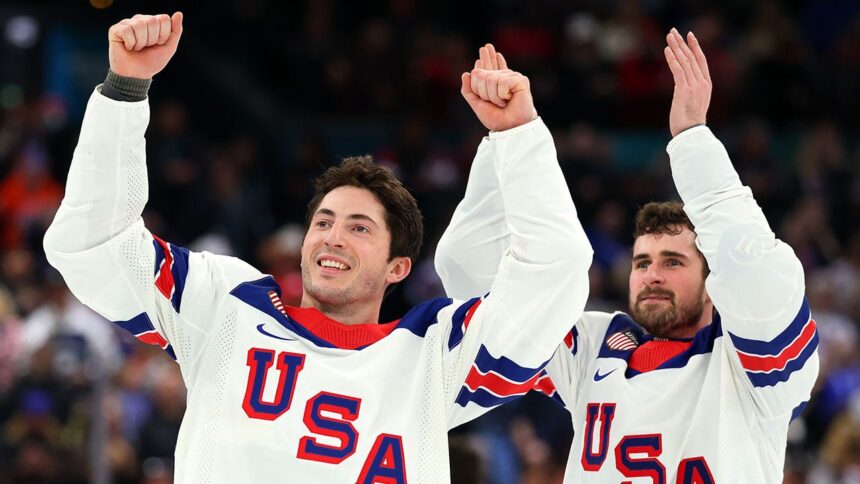
From Milan to the White House: US Hockey Stars Larkin and Werenski on the Weight of Gold and the Source of Their Pride
In the quiet hours after the storm of celebration, after the final buzzer had echoed through the Milan Santagiulia Ice Hockey Arena and the weight of Olympic gold settled around their necks, Dylan Larkin and Zach Werenski were left with a profound sense of clarity. The United States men’s hockey team had just achieved the monumental: a heart-stopping 2-1 overtime victory over archrival Canada, reclaiming the sport’s summit for the first time in over two decades. Yet, as they revealed in an exclusive interview on Fox News Channel’s “Fox & Friends,” the metal of the medal was inseparable from the fabric of the flag it represented—a symbol of a journey fueled by immense, deeply personal American pride.
- The Culmination of a Dream: Beating Canada on the World’s Biggest Stage
- More Than a Patch: The Heart-Wrenching Tribute to Johnny Gaudreau
- The Source of the Stripes: Where Does That American Pride Come From?
- A Presidential Invitation and the Lasting Impact of Gold
- Conclusion: A Legacy Forged in Pride and Purpose
The Culmination of a Dream: Beating Canada on the World’s Biggest Stage
For American hockey players, the narrative is inescapable. The shadow of Canada, the sport’s traditional powerhouse, looms large over every international competition. The 2026 gold medal game was a classic of the genre: tense, tactical, and brutally physical. Winning it, especially in dramatic overtime fashion, wasn’t just a victory; it was a statement.
Dylan Larkin, a veteran leader of the squad, described the moment as a tidal wave of emotion. “You spend your whole life imagining that scenario,” Larkin said. “But nothing—no NHL playoff game, no childhood daydream—prepares you for the actual feeling. Seeing that puck go in, looking over and seeing your teammates, every single one of them sacrificing everything for that jersey… it validates every early morning, every mile skated, every sacrifice.”
The win was a masterclass in resilience. After a tournament filled with dominant performances, the U.S. found itself in a brutal, defensive struggle against a desperate Canadian team. The victory required not just skill, but a collective will that Zach Werenski attributed directly to their identity. “That’s the American spirit, right there,” Werenski emphasized. “We’re not always the flashiest, but we’re never outworked. We have that grit, that belief that we can find a way. Beating Canada for gold is the ultimate test of that, and to pass it… it’s the pinnacle.”
More Than a Patch: The Heart-Wrenching Tribute to Johnny Gaudreau
Amidst the euphoria, a poignant thread of remembrance was woven into the team’s triumph. The players wore a subtle but powerful tribute to Johnny Gaudreau, the American hockey star whose life was tragically cut short in a 2024 car accident. Gaudreau, a beloved figure known for his electrifying play and humble demeanor, was a lock for the 2026 Olympic team and a source of inspiration for an entire generation of U.S. players.
Larkin and Werenski grew visibly reflective discussing their fallen compatriot. “That was for Johnny,” Larkin stated, his tone softening. “He was with us every step. We felt his presence. Wearing that tribute wasn’t a decision; it was an obligation. To honor his memory, his family, and the joy he brought to the game.”
Werenski detailed how Gaudreau’s spirit became a silent catalyst. “In the toughest moments, in the third period when your legs are gone, you’d look down at that patch or just think about him. It puts everything in perspective. We were playing for something bigger than a medal. We were playing for a brother we lost. That’s a powerful, heart-wrenching kind of motivation that I think truly united us in a way nothing else could.” This layer of emotion transformed the gold from a mere athletic achievement into a legacy piece, honoring the past while cementing the present.
The Source of the Stripes: Where Does That American Pride Come From?
When pressed on the origins of their palpable national pride, both athletes pointed not to grand political ideals, but to grassroots, personal foundations. Their American identity was forged in local rinks and community values.
- Dylan Larkin’s Hometown Roots: “For me, it’s Waterford, Michigan. It’s my family, my high school coaches, the guys I grew up playing with. It’s the blue-collar work ethic of Detroit. Representing the USA is the ultimate way to honor that community that built me. You’re carrying every kid dreaming on a frozen pond in Minnesota, in Massachusetts, in Michigan.”
- Zach Werenski’s Family Legacy: “My grandfather served. Talking to him about what the flag means, about sacrifice… it changes your view. Putting on the USA sweater is the greatest honor in my sport. It’s temporary—you give it back after the tournament—but what it stands for is permanent. It’s about excellence, about competing the right way, and about showing the world what American hockey is all about.”
This pride, they explained, manifests in the unique style of American hockey: fast, relentless, and team-oriented. “We might not have the single superstar every year,” Werenski noted, “but we have twenty guys who will skate through a wall for each other. That’s our identity.”
A Presidential Invitation and the Lasting Impact of Gold
The journey for Larkin, Werenski, and their teammates is far from over. Their historic win has earned them an invitation to a hallowed American event: the State of the Union address at the invitation of President Donald Trump. This tradition of honoring American heroes underscores the cultural resonance of their victory.
“It’s surreal,” Larkin admitted. “You go from battling on the ice in Milan to being recognized in the Capitol. It’s a reminder that this victory isn’t just ours; it’s for every fan who stayed up late to watch, for every young player who now believes it’s possible.” Werenski added, “To be in that room, representing our sport and our team… it’s a profound responsibility and an honor we’ll never forget.”
Expert Analysis: The Ripple Effect of 2026 Gold
This victory is a tectonic shift for USA Hockey. The 1980 “Miracle on Ice” was a geopolitical statement; the 1996 World Cup win announced American arrival; the 2026 Olympic gold cements a new era of sustained expectation. No longer are American victories considered miracles. They are the product of a deep, thriving hockey ecosystem from the NHL down to burgeoning youth programs in non-traditional markets. This win will supercharge participation, inspire the 2030 Olympic team, and alter the psychological landscape of the U.S.-Canada rivalry. The Americans are no longer chasing; they are the standard-bearers.
Conclusion: A Legacy Forged in Pride and Purpose
The gold medal won by Dylan Larkin, Zach Werenski, and Team USA in Milan is more than a championship trophy. It is a multifaceted symbol—of athletic excellence achieved against the ultimate rival, of heartfelt remembrance for a lost icon, and of a deep, authentic national pride rooted in community and family. As they prepare to take their seats at the State of the Union, their journey from the ice of Italy to the halls of American power completes a powerful narrative. They did not just win for themselves; they won for Johnny, for their hometowns, and for the enduring idea that American hockey, built on grit, speed, and collective will, is once again the gold standard. The victory in Milan was a historic endpoint, but the pride it instilled and the inspiration it provides is just the beginning of a new chapter for American hockey.
Source: Based on news from Fox Sports.