Maxim Naumov’s Olympic Tribute: Skating Through Grief for His Lost Legends
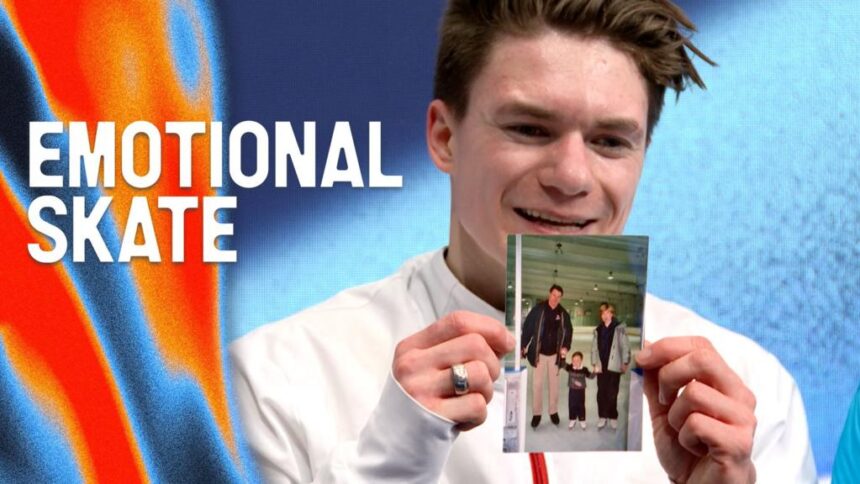
The air in the Olympic arena is always charged, a cocktail of nervous energy and soaring ambition. But sometimes, a performance transcends the points, the medals, and the technical scorecards. It becomes a vessel for something far deeper, a story written on ice with the blades of a broken heart. For American figure skater Maxim Naumov, his Olympic program was not merely a routine; it was a son’s eulogy, a public mourning, and a breathtaking act of remembrance for the two towering figures who should have been in the stands: his parents, world champion pair skaters Vadim Naumov and Evgenia Shishkova.
A Legacy Forged in Pairs and a Dream Passed Down
To understand the profound weight on Maxim Naumov’s shoulders, one must first know the legacy he carries. Vadim Naumov and Evgenia Shishkova were not just his parents; they were icons of the sport. Representing Russia, they captured the World Figure Skating Championships title in 1994, their names forever etched in the pantheon of great pair skaters. Theirs was a partnership of power, grace, and dramatic flair, qualities they would later nurture in their son, who chose the singular path of a men’s singles skater for the United States.
The tragic plane crash in January 2025 that claimed their lives sent shockwaves through the global skating community. For Maxim, the world collapsed just months before the pinnacle of his athletic life. The choice to compete, to channel unimaginable grief into his Olympic moment, was an act of staggering courage. His training became a sanctuary, the ice a place to feel connected to the two people who taught him everything.
- World Champion Pedigree: Direct lineage to skating royalty shaped his technical foundation and artistic sensibility.
- Dual Identity: Skating for the USA while honoring his Russian-born parents’ legacy created a powerful, unifying narrative.
- Pre-Olympic Trauma: The timing of the tragedy added an almost insurmountable psychological hurdle mere months before the Games.
Analysis: The Performance as a Emotional Catharsis
From the moment Maxim Naumov took his starting pose, a hush of understanding fell over the audience. This was not a standard Olympic skate. The music selection, likely a piece deeply meaningful to his family, was the first clue. Every element was infused with intention. His technical execution, while facing immense pressure, showcased the pristine technique his champion parents instilled—clean edges, tight rotations, and a disciplined posture.
But it was the artistic interpretation and raw emotion that transformed the performance. The choreography seemed to tell a story of love, loss, and searching. His jumps were not just feats of athleticism; they were leaps of faith. His spins were vortices of emotion. The step sequences conveyed a journey through memory. Expert analysts noted the subtle details: a gesture echoing his father’s signature move, an expression mirroring his mother’s famed grace. He didn’t just skate a program; he channeled their spirits, creating a poignant dialogue between past and present on the Olympic ice.
This was a masterclass in emotional athleticism. While other skaters aimed for flawless quad jumps, Naumov aimed for a flawless connection to his parents. The potential for errors was high, given the emotional burden, making every landed element a triumph of focus over sorrow. The performance redefined what “success” means at this level, prioritizing narrative and heart alongside technical merit.
Predictions: The Lasting Impact of a Legacy Performance
Regardless of the final placement on the leaderboard, Maxim Naumov’s Olympic moment is destined to be remembered as one of the most poignant in the sport’s history. Its impact will ripple far beyond these Games.
For Naumov’s Career: This performance will serve as a defining turning point. It could galvanize him, providing a profound sense of purpose that fuels the remainder of his competitive career. We may see him evolve into a skater known for unparalleled depth and storytelling, a torchbearer for his parents’ artistic legacy in the men’s field.
For the Sport’s Narrative: In an era often dominated by scoring controversies and technical arms races, Naumov reminded the world of figure skating’s original power: to tell human stories that resonate universally. It brings a raw, authentic humanity back to the forefront, a welcome shift that fans and federations alike will embrace.
For Olympic Lore: The Olympics cherish these stories of overcoming adversity. Naumov’s tribute will be enshrined in Olympic highlight reels for decades, mentioned alongside other legendary moments of personal triumph over tragedy. It elevates his parents’ legacy to a global audience, ensuring new generations learn the names Vadim Naumov and Evgenia Shishkova.
Conclusion: More Than a Medal, A Monument on Ice
As Maxim Naumov’s music faded and he struck his final pose, a moment of suspended silence was followed by a torrent of emotion—from the stands and from the skater himself. The tears he shed were not of relief or disappointment, but of release and communion. He did not just complete a program; he built a temporary monument on ice to his parents, visible to the world for those few, fleeting minutes.
His skate was the ultimate act of filial love and professional dedication, a fusion of personal mourning and public celebration. He carried the weight of a shattered world onto the Olympic stage and transformed it into something beautiful, powerful, and unforgettable. In doing so, Maxim Naumov achieved something far greater than an Olympic medal. He honored his parents’ legacy in the most profound way possible: by living their dream with the very heart they gave him, and by ensuring that their story, and their love for him, soared one more time on the world’s biggest stage. The champions in the heavens, undoubtedly, were watching.
Source: Based on news from BBC Sport.