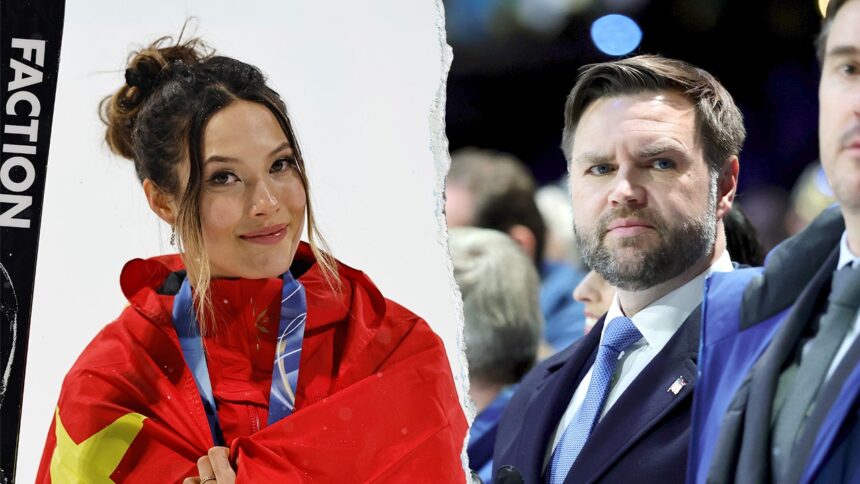
Vance Weighs In: The Eileen Gu Nationality Debate and the Politics of Olympic Allegiance
The intersection of global sports, national identity, and geopolitics rarely produces simple stories. The case of freestyle skier Eileen Gu—the San Francisco-born phenom who chose to compete for China at the 2022 Beijing Olympics—is a perfect storm. Her success, wrapped in questions of citizenship and motive, continues to reverberate, now finding a voice in the upper echelons of American politics. In a recent interview on Fox News, Vice President JD Vance addressed the controversy, offering a measured yet pointed perspective that underscores the complex feelings many Americans harbor about athletes representing rival nations on the world’s biggest stage.
Vance’s Cautious Take: A Political Tightrope on Olympic Soil
During a wide-ranging discussion on “The Story With Martha MacCallum,” Vice President Vance was asked to wade into the enduring debate surrounding Gu’s decision. His response was notably cautious, avoiding legal pronouncements while making a clear patriotic appeal. “I have no idea what her status should be, I think that’s ultimately up to the Olympics Committee, I won’t pretend to wade into that,” Vance stated. This deference to the International Olympic Committee’s (IOC) often-murky rules on nationality and representation is a pragmatic stance, acknowledging the unique and complicated governance of international sport.
However, Vance did not stop at procedural neutrality. He quickly pivoted to the heart of the emotional matter for many viewers: national pride and allegiance. The Vice President expressed a clear hope that American citizens would choose to wear the red, white, and blue. “I hope that American citizens would choose to compete for the U.S. on the world stage,” he said. This sentiment, while not a condemnation of Gu personally, frames the issue as one of civic expectation. It transforms the conversation from a bureaucratic discussion about Olympic eligibility into a broader dialogue about patriotism in global competition.
Deconstructing the Eileen Gu Phenomenon: Beyond the Podium
To understand the weight of Vance’s comments, one must revisit the unique contours of Eileen Gu’s story. A prodigy raised in the United States, Gu stunned the sports world by announcing in 2019 that she would compete for China, her mother’s homeland. Her reasoning was multifaceted:
- Inspiring Millions: She frequently stated a desire to promote skiing among Chinese youth, particularly girls, leveraging her platform for grassroots growth in a nascent market for winter sports.
- Cultural Bridge: Gu positioned herself as a figure who could connect her two cultures, stating, “I’m not trying to keep anybody happy… I’m an 18-year-old girl out here living my best life.”
- Strategic Ambiguity: Critically, Gu has never clarified her citizenship status, as China does not recognize dual citizenship. This legal ambiguity has been a persistent source of controversy and speculation.
Her decision paid off in historic fashion at the Beijing 2022 Games, where she won two gold medals and one silver, becoming a global superstar and a marketing powerhouse in China. Yet, her success was shadowed by questions about sportswashing and the geopolitical tensions between the U.S. and China. Was she an athlete making a personal choice, or a pawn in a larger soft-power game?
The New Arena: Olympic Allegiance as Political Fodder
Vance’s commentary signals that the “Eileen Gu question” is no longer confined to sports sections. It has evolved into a potent symbol within the broader U.S.-China rivalry. In an era where every global interaction is viewed through a lens of strategic competition, an athlete’s choice of flag is loaded with meaning. For politicians, it becomes a safe vessel to discuss larger issues of loyalty, national strength, and cultural influence without directly invoking more volatile topics like trade or Taiwan.
This politicization of athletic choice is not new, but it is intensifying. Experts point to several key factors:
- The Rise of “Sportswashing”: Nations increasingly use high-profile sporting events and athletes to burnish their international image and deflect criticism.
- The Athlete as Geopolitical Actor: Stars like Gu are forced to navigate diplomatic tightropes, with their every word and post scrutinized by both sides.
- The Domestic Political Lens: For American politicians, expressing a hope that citizens compete for the U.S. is an easy win, tapping into a base that views China as a primary competitor.
Vance’s careful phrasing—hoping Americans choose the U.S. while sidestepping Gu’s specific legal case—is a textbook example of navigating this minefield. It allows him to affirm a patriotic principle without launching an attack that could be seen as targeting a young, immensely popular athlete.
Looking to Los Angeles 2028: Predictions for a New Era of Olympic Politics
As the world turns toward the 2028 Summer Olympics in Los Angeles, the stakes for these discussions will only heighten. The Games on American soil will be a monumental showcase of U.S. culture, innovation, and athletic prowess. In this context, the choice of any dual-heritage athlete to represent another nation will be magnified, especially if that nation is a geopolitical rival.
We can predict several developments:
- Increased Scrutiny on Eligibility: There will be louder calls for the IOC and national committees to enforce clearer, more transparent rules regarding citizenship and athlete transfers.
- Political Rhetoric Escalation: The topic of Olympic representation will likely feature more prominently in political discourse, used as a metaphor for broader national commitment.
- Athlete Agency Under Pressure: Future athletes with dual heritage may face even more intense public and private pressure regarding their choice, complicating what is already a deeply personal decision.
The fundamental tension will remain between the Olympic Movement’s ideal of sport transcending politics and the reality that athletes, particularly those from major powers, are inevitably seen as standard-bearers. Vance’s comments are a early marker in this evolving narrative, one that will reach a crescendo in LA.
Conclusion: More Than a Medal Count
Vice President JD Vance’s brief foray into the Eileen Gu debate reveals far more than a simple opinion on an athlete’s choice. It highlights how modern Olympic glory is inextricably linked to national identity and global standing. His hope that Americans compete for America is a straightforward sentiment, but it lands in a profoundly complicated arena where personal ambition, market forces, cultural heritage, and state interests violently collide.
The story of Eileen Gu is ultimately a 21st-century parable. It asks uncomfortable questions about what we expect from our champions in an interconnected yet fiercely competitive world. As the 2028 Los Angeles Olympics approach, the conversation Vance has stepped into will only grow louder, ensuring that the journey to the podium will be about much more than athletic talent—it will be a reflection of the world as it is, divided, ambitious, and watching.
Source: Based on news from Fox Sports.