VAR’s ‘Right to Overturn’ Arsenal Penalty: Pundits Split on Controversial Champions League Call
The Champions League semi-final first leg between Arsenal and Atletico Madrid was always destined to be a tactical chess match. But few expected the night’s biggest flashpoint to come from a VAR review that left the Emirates Stadium in stunned silence. Late substitute Eberechi Eze thought he had won the Gunners a second penalty, only for the decision to be dramatically overturned after a lengthy video assistant referee (VAR) check. Now, pundits on the BBC Radio 5 Live Euro Leagues podcast have waded into the debate, with one leading voice declaring the overturn was “absolutely correct.”
The incident occurred in the 82nd minute with Arsenal already leading 2-1 and pressing for a decisive third goal. Eze, who had just entered the fray, drove into the box and went down under a challenge from Atletico defender David Hancko. Referee Slavko Vinčić initially pointed to the spot, sparking chaotic celebrations. But after a VAR review lasting nearly two minutes, the official reversed his decision, ruling that contact was minimal at best. The call has since dominated the post-match analysis, dividing opinion across the football world.
The Incident: A Dubious Process Under the Microscope
The sequence of events that led to the overturned penalty has been described by the BBC’s panel as a “dubious process” that raises fundamental questions about how VAR is used in high-stakes matches. Let’s break down exactly what happened:
- The initial contact: Eze received a pass on the edge of the box, cut inside, and appeared to poke the ball past Hancko before going to ground.
- The referee’s call: Vinčić, who had a clear view, immediately pointed to the penalty spot, indicating he believed Hancko had tripped the Arsenal man.
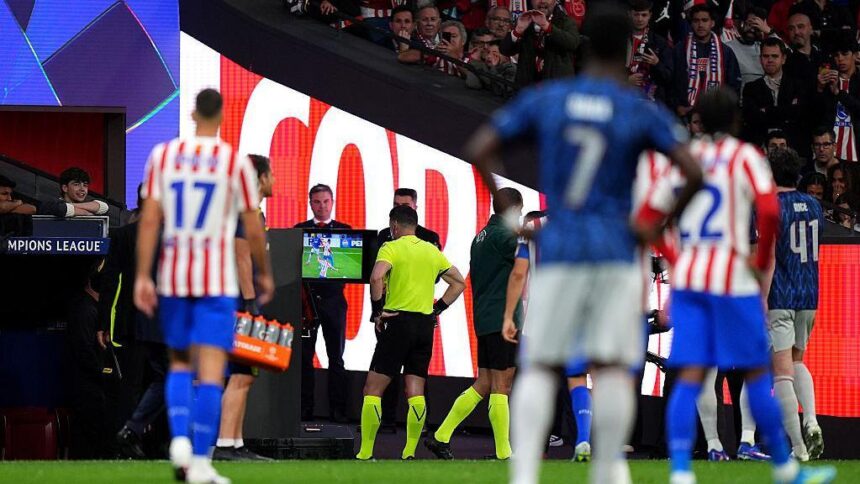
- The VAR check: After a prolonged review, the video assistant recommended an on-field review. Vinčić then watched the replay on the pitchside monitor and reversed his original decision.
- The outcome: A free kick to Atletico, much to the fury of the Arsenal bench and home crowd.
Speaking on the BBC Radio 5 Live Euro Leagues podcast, French football journalist Julien Laurens offered a blunt assessment. “If I’m being honest, I really didn’t see much contact,” Laurens said. “I understand the frustration from an Arsenal point of view because it was given first, but was it really the right call? These are the situations we want VAR to make the right call in and I’m not sure a penalty would’ve been the right call, if it had stood. For me, they were right to overturn it. I didn’t see much contact, I can’t lie.”
Laurens’s comments have added fuel to an already raging fire. While some pundits argue that the referee’s initial instinct should have been trusted, others side with the VAR, insisting that technology corrected a clear error. The key question remains: did Hancko actually do enough to bring Eze down, or did the Arsenal substitute simply lose his footing?
Expert Analysis: Was the Contact Enough for a Penalty?
To understand the controversy, we must examine the physics of the challenge. Replays show Hancko sliding in with his trailing leg. The Atletico defender’s right foot does make contact with Eze’s left ankle—but the degree of force is debatable. Slow-motion footage often exaggerates contact, making it look more significant than it is in real time. However, the VAR protocol requires clear and obvious evidence of a mistake to overturn a penalty call.
Here is what the data and expert eyes tell us:
- Contact point: Hancko’s studs graze the top of Eze’s boot. There is no clear bending of the ankle or leg.
- Eze’s movement: The Arsenal man is already falling forward before contact is made, suggesting he may have been off balance.
- Historical precedent: In similar situations this season, UEFA has instructed referees to only award penalties for “significant” contact that clearly impedes a player.
Former Premier League referee Mark Clattenburg, speaking on a separate broadcast, noted that the overturn was “consistent with UEFA’s current directives.” He added: “If the contact is minimal and the player is already going down, VAR is correct to step in. The referee’s original decision was a penalty, but the technology showed it was a soft one. In the Champions League, they want clear, definitive fouls.”
Yet Arsenal supporters point to a similar incident earlier in the game where Atletico’s Antoine Griezmann went down under minimal contact and no penalty was given. The inconsistency, they argue, is the real problem. “If you give one, you have to give the other,” said former Arsenal striker Ian Wright on social media. “The standard has to be the same for both boxes.”
Predictions: How Will This Decision Shape the Second Leg?
The overturned penalty has massive implications for the tie. Arsenal now travel to the Metropolitano Stadium in Madrid with a slender 2-1 lead. Had Eze scored from the spot, the Gunners would have had a two-goal cushion and a potentially decisive away goal advantage. Instead, Atletico remain very much alive, knowing that a 1-0 win would send them to the final.
Looking ahead, here are three key predictions for the second leg:
- Atletico will target Arsenal’s mental fragility: Diego Simeone’s side thrives on controversy. They will use the VAR decision as a rallying cry, claiming the football gods are on their side.
- Arsenal must avoid a high line: Without a second penalty, Mikel Arteta’s team cannot afford to be reckless. Atletico’s counter-attacks, led by João Félix, will punish any defensive lapses.
- VAR will be under even more scrutiny: UEFA will likely issue a statement clarifying the protocol. Expect a more conservative approach from officials, with fewer overturned calls in the second leg.
The psychological impact on Eze himself cannot be ignored. The England international was visibly distraught after the decision was reversed. He missed a golden chance minutes later, firing wide from a tight angle. Arteta will need to manage his player’s confidence carefully. “It’s a tough one to take,” Arteta said in the post-match press conference. “But we have to move on. The tie is still in our hands.”
Strong Conclusion: The VAR Debate Rages On
In the end, the Arsenal penalty controversy is a microcosm of the ongoing battle between technology and human instinct in football. The BBC Radio 5 Live Euro Leagues podcast panel, led by Julien Laurens, has made a compelling case that the overturn was correct—that VAR did its job by correcting a “soft” penalty. But for every expert who agrees, there is a fan or pundit who insists that the referee’s initial view should carry more weight.
What is clear is that this decision will be dissected for years as a defining moment in Champions League history. It has reignited calls for semi-automated offside technology and clearer guidelines on what constitutes a “clear and obvious error.” Until then, the debate will continue to divide opinion. One thing is certain: the second leg in Madrid will be played under an intense microscope, with every tackle, every fall, and every VAR check carrying the weight of a semi-final tie.
For Arsenal, the message is simple: score more goals, and take the human element out of the equation. For the rest of us, we can only watch, argue, and hope that the next big VAR call brings more clarity than confusion. As Laurens put it: “We want VAR to get the big calls right. In this case, I think they did. But the process? That still needs work.”
Source: Based on news from Yahoo Sports.