Venus Williams Makes Unwanted History: The Weight of a 10-Match Losing Streak
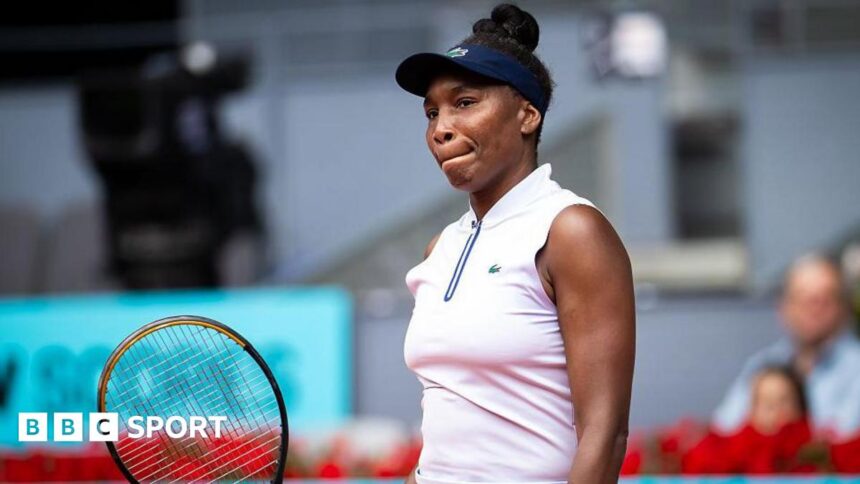
The roar of the Madrid Open crowd is a familiar sound to Venus Williams. For over a quarter-century, she has stepped onto the sport’s grandest stages, her power and grace defining an era. Yet, on a recent afternoon at La Caja Mágica, the applause carried a different tone—one of profound respect tinged with palpable concern. A 6-2, 6-4 defeat to 18-year-old qualifier Kaitlin Quevedo was, on paper, a first-round loss at a prestigious tournament. In the broader narrative of a legendary career, it was a historic, heartbreaking milestone. With that loss, Venus Williams, the former world number one and seven-time Grand Slam champion, etched her name into a record no athlete desires: the first former top-ranked player in WTA history to lose ten consecutive singles matches.
A Streak That Defies Legacy
To contextualize this streak is to grapple with the sheer improbability of it. Venus Williams is not just any former champion. She is a foundational pillar of modern tennis, a player whose record 95 Grand Slam appearances speak to a longevity and resilience unmatched in the sport’s history. The last time she tasted victory was nearly a year ago, in July 2023, against Peyton Stearns in Washington. Since then, the circuit has been a relentless gauntlet of losses, each one amplifying the questions surrounding her future.
The WTA rankings were first published in 1975, creating a definitive historical ledger. In the nearly 50 years since, legends have risen, dominated, and eventually declined. Yet, none who once sat atop the mountain had experienced a slide of ten consecutive defeats until now. This statistic is less an indictment of Williams’s current form and more a stark illustration of the unprecedented territory she occupies. She is competing not only against opponents decades her junior but against the immutable march of time itself.
- Historic Milestone: First former WTA No. 1 to lose 10 straight matches in the Open Era.
- Time Since Last Win: Victory over Peyton Stearns in Washington, July 2023.
- Age Defying Context: At 45, Williams is competing in a sport where the average age of the top 100 is 26.
Between the Lines: Analyzing the On-Court Reality
Watching Williams’s recent matches, the analysis requires a nuanced lens. The powerful serve and flat, penetrating groundstrokes that once overwhelmed opponents are still present in flashes. Against Quevedo, she struck several winners that echoed her prime. However, the consistency and match sharpness are elusive. Unforced errors creep in at critical moments, often stemming from a slight hesitation or a mistimed step. The explosive movement to cover the wide ball, a hallmark of her game, has diminished, leaving her vulnerable to angles and drop shots.
Furthermore, the psychological weight of the streak is undeniable. Tennis is a sport of fine margins and amplified pressure. Each missed opportunity, each set that slips away, adds another layer of mental burden. For a competitor of Williams’s caliber, who built a career on closing out matches with icy resolve, the frustration is visible. She is now facing opponents who grew up idolizing her, players like Quevedo, who are unburdened by history and play with nothing-to-lose freedom. This dynamic creates a unique and challenging competitive environment.
It’s crucial to separate current results from eternal legacy. Five Wimbledon titles and two US Open crowns are immutable facts. Her influence, alongside sister Serena, in revolutionizing the women’s game with power and athleticism, is a permanent chapter in tennis history. This difficult period does not rewrite those accomplishments but exists in a separate, more complex volume about the end of a career.
The Unanswerable Question: What Comes Next?
This is the most delicate and speculative part of the Venus Williams story. Predictions are fraught with emotion. Several paths lie before her, each with its own rationale.
The Case for Continuation: Venus has always marched to the beat of her own drum. She has repeatedly stated she will play tennis as long as she loves the competition. The fire to simply *compete*, to solve the puzzle of her own game against new challenges, may be enough to keep her on tour. Her protected ranking and legendary status guarantee her entry into tournaments, offering her the autonomy to choose her schedule, likely focusing on Grand Slams and events she cherishes.
The Case for a Shift: The physical demands of the WTA tour are brutal. An alternative path could see a graceful pivot away from the weekly grind of singles. A focused farewell tour, perhaps culminating at the US Open, would allow global fans to celebrate her properly. Additionally, a dedicated run in women’s doubles, where the physical toll is different and she has enjoyed great success (14 major doubles titles), could satisfy the competitive itch while partnering with new generations of players.
Ultimately, the decision will be Venus’s alone, made on her own terms—a principle that has guided her entire career. The sporting world often struggles with allowing its icons to define their own exits, but if anyone has earned that right, it is Venus Williams.
Beyond the Scoreboard: A Legacy of Unmatched Substance
To frame Venus Williams’s current journey solely through wins and losses is to miss the point of her existence in the sport entirely. Her legacy was never contingent on being the last player standing at age 45. It was built much earlier, and with much more substance.
She is a trailblazer for equality and activism. Her successful fight for equal prize money at Wimbledon changed the financial landscape for every woman who followed. She has been a vocal advocate for social justice and a successful entrepreneur with her fashion line, EleVen. On the court, she brought a combination of raw power, elegance, and sportsmanship that redefined what was possible in women’s tennis.
The sight of her battling through this streak, facing pointed questions with characteristic grace, and continuing to put in the work is, in its own way, a powerful testament to her character. It is a display of resilience that has nothing to do with trophies. She is showing what it looks like to face profound professional difficulty with public dignity, to love something enough to endure its hardest lessons.
The final chapter of Venus Williams’s singles career is being written in a script no one predicted. The ten-match losing streak is a stark, statistical reality. Yet, it exists within a career that is a monument to triumph, resilience, and transformative impact. When the last match is finally played, whether in weeks or years, the numbers on the scoreboard will fade into a footnote. What will remain is the image of a champion who changed her sport forever, who fought for what was right, and who, even in the twilight of her playing days, taught us about perseverance and grace under a unique kind of pressure. The applause in Madrid, and everywhere she goes, is not for the victory she couldn’t find, but for the legendary journey she is still brave enough to continue.
Source: Based on news from BBC Sport.