Vikings Legend and Ring of Honor Member Joey Browner Dies at 65
The Minnesota Vikings family and the broader NFL community are mourning the loss of a defensive titan. The team announced on Sunday that Ring of Honor member Joey Browner, a fearsome safety who defined an era of Vikings football, has passed away at the age of 65. Browner’s death marks the end of a storied life and career, leaving behind a legacy of hard-hitting excellence and leadership that resonated far beyond the Metrodome’s walls.
- A Legacy Forged in Purple: The On-Field Dominance of Joey Browner
- More Than a Player: The Browner Family Dynasty and Lasting Impact
- Expert Analysis: Why Browner’s Canton Case Deserves Renewed Scrutiny
- Predictions: How Browner’s Legacy Will Influence Future Generations
- A Final Whistle: Remembering a Minnesota Icon
Selected in the first round of the 1983 NFL Draft from the University of Southern California, Browner spent nine dominant seasons in Minnesota, forging a reputation as one of the most versatile and intimidating defensive backs of his generation. His passing is not just the loss of a great player, but of a cornerstone figure who helped bridge the franchise’s “Purple People Eaters” legacy to its modern identity. In an era where safeties were often specialists, Browner was a revolutionary force, a prototype for the hybrid defender we see today.
A Legacy Forged in Purple: The On-Field Dominance of Joey Browner
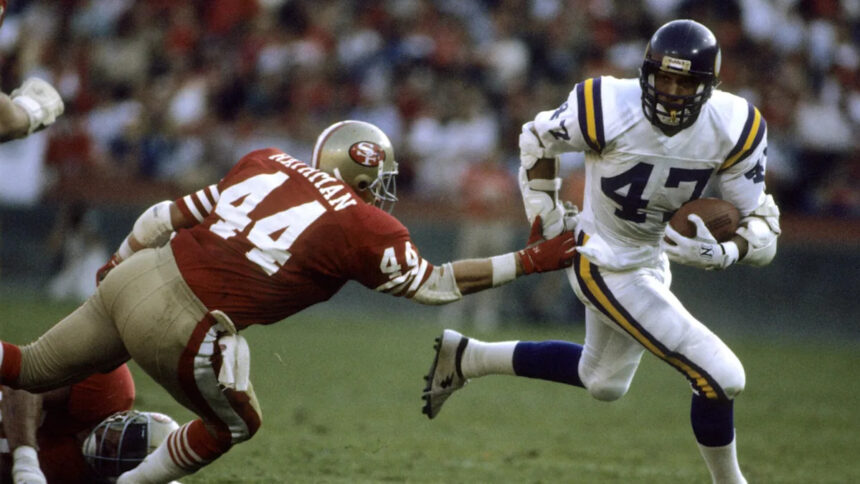
To understand Joey Browner’s impact, one must look beyond traditional statistics. While his 37 career interceptions and 1,098 tackles are impressive, they only tell part of the story. Browner was a 6-foot-2, 220-pound avalanche in the secondary, a rare physical specimen whose size and speed allowed him to erase tight ends, punish ball carriers, and patrol the deep middle with equal authority. He was a defensive coordinator’s chess piece, deployed to disrupt an offense’s best-laid plans.
His accolades solidify his place among the NFL’s all-time greats at the safety position:
- Three-time First-Team All-Pro (1988, 1989, 1990)
- Six consecutive Pro Bowl selections (1985-1990)
- Named to the NFL’s All-Decade Team for the 1980s
- Key leader of the 1987 Vikings team that reached the NFC Championship Game
Browner’s style was a blend of artistry and violence. He didn’t just make tackles; he delivered statements. His ability to separate a receiver from the football was legendary, and his presence in the box was akin to adding an extra linebacker. In many ways, he was ahead of his time—a forerunner to players like Troy Polamalu and Kam Chancellor, who would later redefine the safety position with a similar blend of instinct, intelligence, and sheer physicality.
More Than a Player: The Browner Family Dynasty and Lasting Impact
Joey Browner’s story is also a remarkable chapter in one of football’s most prolific families. He was one of four Browner brothers to play in the NFL, an astonishing feat that underscores the athletic pedigree and competitive fire that ran in the family. Alongside brothers Ross, Jim, and Keith, the Browner name became synonymous with NFL toughness throughout the 1970s and 80s.
This familial legacy adds a profound layer to Joey’s accomplishments. Competing at the highest level is one thing; doing so while your brothers are also achieving greatness creates a unique and powerful dynamic. It speaks to a shared drive and a standard of excellence that was nurtured from a young age. Joey, often considered the most decorated of the brothers, carried that banner with a quiet pride, representing not just the Vikings, but the entire Browner lineage every time he took the field.
His impact on the Vikings organization is permanent. Inducted into the Vikings Ring of Honor in 2013, his name hangs alongside franchise icons like Fran Tarkenton, Alan Page, and Cris Carter. For current players and fans, he remained a visible and respected symbol of what Vikings football should embody: relentless, physical, and fundamentally sound defense.
Expert Analysis: Why Browner’s Canton Case Deserves Renewed Scrutiny
Joey Browner’s passing inevitably reignites a longstanding debate among historians and analysts: is he a Hall of Famer? A close examination of his resume and his contemporaries suggests his absence from Canton is a significant oversight.
When placed alongside other safeties of his era and those inducted since, Browner’s credentials are compelling. His three First-Team All-Pro nods match or exceed those of several enshrined defensive backs. His inclusion on the NFL’s 1980s All-Decade Team is a formal recognition that he was considered one of the two best safeties in football for an entire ten-year period—a golden era for the NFL. Furthermore, his versatility was unmatched. He was not a system player; he was the system. Defensive coordinators built schemes around his unique ability to impact both the run and pass at an elite level.
The argument against him often points to team success—the lack of a Super Bowl ring. Yet, this ignores his central role in the Vikings’ competitive teams of the late 80s, culminating in that 1987 NFC Championship run. His individual excellence was a constant. In the modern era, where the Hall of Fame has increasingly recognized the importance of transformative players at all positions, Joey Browner’s case should be revisited. He wasn’t just a great safety; he helped evolve the position itself.
Predictions: How Browner’s Legacy Will Influence Future Generations
While the football world grieves, Joey Browner’s legacy is firmly cemented and will continue to influence the game in tangible ways.
First, his style of play is now the blueprint for the modern NFL safety. Scouts actively seek “big safeties” who can match up in coverage and support the run—the very prototype Browner embodied forty years ago. Players like Kyle Hamilton of the Baltimore Ravens are direct descendants of Browner’s mold, celebrated for their size and positional flexibility.
Second, expect the Vikings organization to further immortalize his contributions. Beyond the Ring of Honor, his number may receive honorary recognition, and his story will be told to new generations of players during team orientations. He represents the very soul of the franchise’s defensive tradition.
Finally, his passing may serve as a catalyst for a renewed push for his Hall of Fame enshrinement, potentially through the Seniors Committee. As the historical record is re-evaluated, Browner’s stature as a dominant, decade-defining player becomes clearer. His legacy is not one of nostalgia, but of a standard that continues to be chased.
A Final Whistle: Remembering a Minnesota Icon
The news of Joey Browner’s passing at 65 leaves a void in the heart of Vikings Nation. He was more than a collection of highlights and accolades; he was the embodiment of a punishing, prideful brand of football that fans adored. From his thunderous hits to his quiet leadership, he commanded respect.
In remembering Browner, we remember a player who gave the Vikings an identity during a competitive period in the NFC. We remember a brother from a royal football family who upheld its name with distinction. And we remember a talent so unique that it forced the league to reconsider what was possible from a man playing safety.
His journey from USC star to first-round pick, to six-time Pro Bowler, to Ring of Honor member is the story of a football life fully realized. While the final whistle has blown on that life, the echoes of his impact—the jarring tackles, the game-changing interceptions, the unwavering intensity—will resonate forever in Minnesota. Joey Browner wasn’t just in the play; he was the play. And for that, he will never be forgotten.
Source: Based on news from Yahoo Sports.