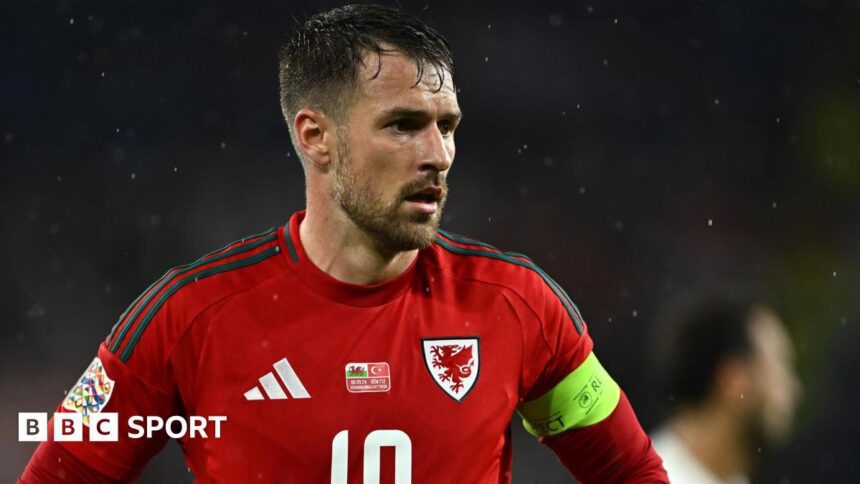
Aaron Ramsey: The Quiet Conductor of a Golden Era Bows Out
The news arrived not with a fanfare, but with the quiet, considered dignity that characterised his finest moments on the pitch. Aaron Ramsey, the captain of Wales and architect of so many of its modern dreams, has retired from professional football. At 35, and without a club since his stint with Pumas UNAM in Mexico, the former Arsenal midfielder has chosen to close one illustrious chapter, undoubtedly to begin another. His departure marks not just the end of a playing career, but the definitive full-time on a transformative epoch for Welsh football—an era he did more than most to define.
From Prodigy to Pillar: The Making of a Welsh Legend
It is easy to forget just how young Aaron Ramsey was when the weight of a nation’s hopes first settled on his shoulders. His senior Wales debut came in November 2008, a 17-year-old with a mature gaze and an even more mature touch, stepping onto the field against Denmark. He was a prodigy in a country yearning for a hero. His club move to Arsenal that same summer cemented his status as the great Welsh hope. The journey, however, was never linear. A horrific double-leg fracture in 2010, inflicted by a reckless challenge, threatened to derail everything. His comeback was a testament to a resilience often overlooked in discussions of his elegant style.
Ramsey’s international career is a story of quantifiable impact and intangible influence. His 86 caps and 21 goals for Wales place him among the nation’s all-time greats, but the numbers only tell half the story. He was the metronome in midfield, the player who could dictate tempo, arrive with devastating late runs into the box, and produce moments of sublime quality when they were needed most. He wore the armband with a calm authority, leading not with booming rhetoric, but with relentless example.
The Euro 2016 Symphony: A Peak Performance for the Ages
To understand Aaron Ramsey’s legacy, one must rewind to the summer of 2016. Wales, absent from major tournaments for 58 years, arrived at the European Championships in France as curious outsiders. They left as immortalised heroes, and at the heart of their unforgettable run to the semi-finals was Ramsey in the form of his life. His performance was a masterclass in box-to-box midfield play.
- Creative Force: He provided four assists in the tournament, a joint-high, weaving passes that sliced open defences.
- Clinical Edge: He scored a crucial goal in the historic 3-1 last-16 victory over Belgium, a perfectly timed header.
- Tactical Intelligence: His understanding with Joe Allen and Joe Ledley gave Wales a dynamic and cohesive midfield unit.
His suspension for the semi-final, earned through a yellow card, was a heartbreaking blow for player and nation alike. Many Welsh fans still ponder what might have been had their conductor been on the pitch. His inclusion in UEFA’s Team of the Tournament was a deserved accolade, placing him officially among Europe’s elite that summer. That campaign was Ramsey’s magnum opus—the definitive proof of his world-class ability.
Club Career: North London Glory and a Footballing Odyssey
While his Welsh exploits brought him immortality at home, Ramsey’s club journey was a compelling saga of its own. At Arsenal, he became a symbol of a new generation, eventually scoring two FA Cup-winning goals in 2014 and 2017. The latter, a sumptuous, flowing team move finished with typical Ramsey precision against Chelsea, is etched in Gunners’ folklore. He embodied a certain kind of Arsenal player: technically gifted, intelligent, and capable of moments of pure artistry.
His subsequent moves to Juventus, a return to Rangers on loan, and a final playing chapter in Cardiff and Mexico painted the picture of a footballer in search of a perfect fit after his prime Arsenal years. Yet, through every stop, his class and professionalism never dimmed. The fact he was without a club upon retirement feels incongruous with his talent, a stark reminder of the modern game’s often unforgiving nature towards players entering their mid-thirties.
The Next Chapter: From Midfield Maestro to Sideline Strategist?
With retirement confirmed, the immediate question turns to what comes next. Ramsey has indicated an expected pursuit of a career in coaching. For those who have followed his intelligent playing style, this transition seems not just logical, but inevitable. Ramsey was a player who always seemed to understand the geometry of the game, the spaces between the lines, and the tactical demands of different moments.
We can predict his coaching pathway will mirror his playing style: thoughtful, dedicated, and without excessive ego. He possesses a wealth of experience from the pinnacles of the Premier League, Serie A, and international football. More importantly, he has lived through the entire cycle of Wales’ rise—from hopeful youngster to inspirational captain at World Cups and European Championships. This unique perspective is an invaluable asset. Don’t be surprised to see him initially involved with the Wales national team setup, perhaps guiding the next generation of midfield talents who grew up idolising him.
A Legacy of Grace and Gravitas
Aaron Ramsey’s retirement closes the book on one of the most important careers in Welsh sporting history. He was not the loudest voice, but his was the most respected. He was not always the flashiest player, but he was often the most decisive. In an era where Welsh football shook off its inferiority complex and danced on the world stage, Ramsey was its quiet conductor.
He retires as a Wales great, a man who carried the hopes of a nation with a quiet steel and delivered some of its most joyous moments. His legacy is secure in the memories of that red wall in Lille and Toulouse in 2016, in the crunching tackles he overcame, and in the elegant goals he provided. The conductor has left the podium, but the symphony he helped compose for Wales will resonate for generations to come. The football world now awaits his next move, off the pitch, with keen interest.
Source: Based on news from BBC Sport.