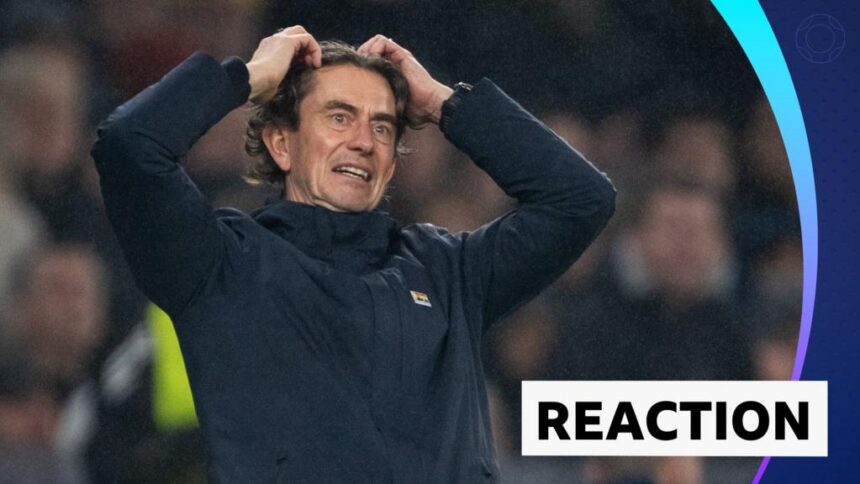
Watch Thomas Frank’s Final Interview as Tottenham Boss: The End of an Era
The digital silence was deafening for fans across the globe. A simple, frustrating message: “This content is not available in your location.” For supporters desperate for closure, the inability to watch Thomas Frank’s final interview as Tottenham Hotspur manager felt like a cruel metaphor for his abruptly terminated project. The Danish coach’s reign, a mere eight-month whirlwind of fleeting promise and profound disappointment, officially concluded in the wake of a dismal 2-1 home defeat to Newcastle United on Tuesday. While the official video may be geo-blocked, the story it tells—of a vision cut short and a club at a crossroads—resonates loudly across North London and the Premier League.
A Farewell Forced by Familiar Failings
Thomas Frank’s final post-match duties were carried out under the heavy shadow of inevitability. The loss to Newcastle was not an anomaly but a浓缩 of his troubled tenure. Spurs’ defensive fragility, a problem Frank never solved, was exposed yet again. The lack of a coherent attacking identity beyond hopeful crosses was plain for all to see. The atmosphere at the Tottenham Hotspur Stadium had turned from optimistic to apathetic, a poison for any ambitious club.
In what would be his last address to the Spurs media, Frank likely faced questions he’d grown weary of answering. While the full video remains inaccessible to many, the themes were undoubtedly clear:
- Accountability: Did he take responsibility for the team’s consistent underperformance?
- Tactical Explanation: How did he justify the repeated tactical setups that failed to yield results?
- Player Application: Was the issue his philosophy, or the players’ execution of it?
- The Final Word: A chance to thank the fans and perhaps hint at the internal challenges faced.
This interview wasn’t just a post-match debrief; it was an unintentional post-mortem for a failed project. Every answer, every weary expression, would be analyzed as the closing chapter of a book that never found its compelling plot.
Expert Analysis: Why the Frank Experiment Failed
From a tactical standpoint, Frank’s appointment always carried an element of risk. His success at Brentford was built on a clear, data-driven model, intense pressing, and a cohesive unit that exceeded the sum of its parts. At Tottenham, he inherited a squad with a different profile—higher individual talent but plagued by psychological scars from years of instability and a glaring lack of balance.
Critical missteps defined his short stay. His insistence on a high defensive line without the personnel suited to it led to catastrophic errors. The midfield often looked disconnected, neither protecting the back four nor effectively supplying the attack. Key players, like the prolific striker he was brought in to maximize, saw their form dip alarmingly. Frank’s attempts to implement his system appeared rigid, lacking the in-game adaptability required at the elite level.
Beyond tactics, the cultural fit never materialized. Spurs, a club craving a return to glamorous, attacking football, watched a team become predictable and brittle. The famous “Spurs Way” became a distant memory under Frank’s pragmatic, yet ineffective, stewardship. The board’s decision to sack him after eight months indicates they saw a trajectory pointing not just away from European football, but potentially toward a more serious scrap for survival.
The Domino Effect: What’s Next for Tottenham?
Thomas Frank’s departure triggers yet another critical—and expensive—rebuild for Daniel Levy and the Tottenham hierarchy. The club now faces a series of monumental decisions that will define its medium-term future.
Immediate priorities for the interim leadership and eventual new manager include:
- Stabilizing a fractured dressing room: Player morale is at a low ebb. Restoring belief is job one.
- Addressing the defensive crisis: The center-back and defensive midfield positions require urgent attention, possibly in January.
- Rediscovering an attacking spark: Unlocking the potential of the forward line is non-negotiable for fan engagement and results.
The managerial search will be under a microscope. Will Spurs return to a progressive, attack-minded coach, or seek a pragmatic firefighter? Names will swirl, but the club must learn from recent history. The new appointment must be a strategic fit, backed with appropriate transfer market support, and given the time to build—a commodity rarely afforded at the Tottenham Hotspur Stadium.
Furthermore, this sacking raises serious questions about the club’s sporting director structure and long-term planning. The cycle of hire-and-fire is debilitating and costly. The next appointment must be part of a visible, coherent project, or risk repeating the same mistakes.
Final Whistle: A Cautionary Tale for Club and Coach
The unavailability of Thomas Frank’s final interview in many regions is ironically fitting. His tenure at Tottenham will largely be remembered for what it failed to deliver, for the potential that remained frustratingly out of reach. For fans, it’s another period of transition and disappointment. For Frank, it’s a brutal lesson in the scale and scrutiny of a “Big Six” club compared to the more measured project at Brentford.
As Spurs dust themselves off and begin the search for their fourth permanent manager in as many years, the club stands at a familiar precipice. Sacking a manager provides a short-term jolt, a semblance of action. But without a foundational strategy, it is merely a postponement of the underlying issues. The next manager will watch that final Frank interview closely, looking for clues about the challenges of the role—the pressure, the expectations, the need for immediate results in a environment yearning for stability.
The true legacy of the Thomas Frank era may not be found in a geo-blocked video, but in the stark warning it represents: in modern football, a clear vision and patience are as important as any tactical plan. For Tottenham Hotspur, finding both remains the ultimate, unfulfilled challenge.
Source: Based on news from BBC Sport.