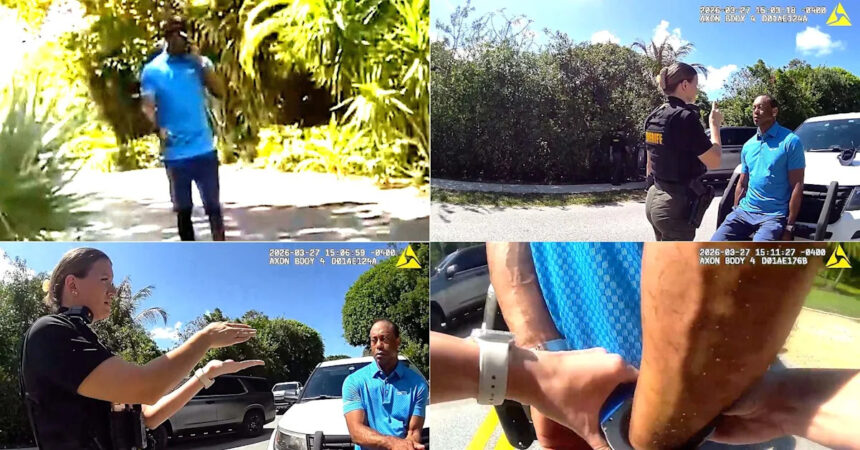
WATCH: Tiger Woods’ DUI Arrest Bodycam Reveals Bizarre Trump Brag and Unfiltered Moments
The myth of Tiger Woods has always been one of controlled, superhuman focus—a man who built an empire on steely nerves and preternatural calm under the brightest spotlights. But newly released, extended bodycam footage from his 2017 DUI arrest shatters that veneer, presenting a disoriented, vulnerable, and startlingly candid figure. In nearly thirty minutes of unfiltered interaction with Jupiter Police, the golf legend’s attempts to navigate the crisis include a jarring, name-dropping reference to the most powerful man in the world. This isn’t just a police procedural; it’s a raw, human document that contrasts starkly with the Tiger the public knows.
A Night of Confusion: The Arrest and The Aftermath
In the early hours of May 29, 2017, Tiger Woods’ black Range Rover was found crashed, with minor damage, on the side of Military Trail in Jupiter, Florida. The engine was running, the blinkers were flashing, and Woods was asleep at the wheel. What followed was a slow-motion, often painful interaction that led to a DUI charge (later pleaded down to reckless driving). Officers noted his glassy eyes and slurred speech. While no alcohol was found in his system, toxicology reports later revealed a cocktail of prescription medications, including Vicodin, Xanax, and Ambien. In his pocket, officers found two loose hydrocodone pills, a stark symbol of the physical toll and pain management defining his life post-surgeries.
The world saw a brief clip then: a woozy Woods failing field sobriety tests. But the full footage, released this week, provides profound context. This was not a belligerent celebrity but a man profoundly medicated and confused, caught in a humiliating spiral. His legendary coordination was gone; his famous mind, fogged. The incident became a public reckoning, forcing a conversation about his health and dependencies far removed from the fairways.
The Trump Card: A Surreal Moment of Name-Dropping
Amidst the mumbling and the struggle to follow basic instructions, one moment stands out for its sheer surreal disconnect. As officers attempt to ascertain what happened, a disheveled Woods, leaning against his SUV, offers an explanation that seems pulled from a different reality. He slurs, “I was just talking with the president…” before trailing off. When an officer asks, “The president of?” Woods clarifies, “The United States. Trump.”
This bizarre brag to cops is a fascinating psychological snapshot. Experts in crisis communication and image management see it as a reflexive, if impaired, attempt to reassert status and control.
- An Anchor to Identity: In a moment where he was stripped of all dignity and control, invoking a connection to the President was a desperate grasp at his own significance, a reminder that he was “Tiger Woods,” not just another incapacitated driver.
- A Shield of Importance: It functioned as a potential soft-power play, perhaps subconsciously intended to signal, “I am a person of consequence, handle me differently.”
- The Surreal Juxtaposition: The contrast between the gritty, blue police lights of a Florida roadside and the implied opulence of a chat with the leader of the free world could not be more stark. It highlights the dizzying fall from his usual environs of private jets and clubhouse lounges.
The mention, confirmed to be true—he and Trump had played golf recently—adds a layer of tragicomedy. It was a non-sequitur that underscored his complete disorientation from the gravity of his legal situation.
Wildest Moments from the Extended Bodycam Footage
Beyond the Trump brag, the extended bodycam footage is a cascade of cringe-worthy and concerning moments that paint a full picture of the ordeal.
The Struggle to Follow Simple Commands: Woods is repeatedly told to put out his hands for a finger-to-nose test. Instead, he brings his nose to his finger, a childlike misinterpretation that frustrates the officer. He sways dangerously during a balance test, his athleticism utterly absent.
The Mumbling and Confusion: His speech is thick and slow. He seems unaware of where he is coming from or how he got there. At one point, he asks if he can drive his damaged car home, displaying a profound lack of awareness of his condition.
The Medical Emergency Question: The officers, to their credit, spend significant time trying to determine if this is a medical emergency or purely impairment. They ask about his back surgeries and medications, showing concern for the man behind the celebrity. This tension—between law enforcement and paramedic—runs through the tape.
The Raw Humanity: Stripped of his entourage and control, we see a man who is scared, embarrassed, and physically broken. The invincible competitor is gone, replaced by someone painfully human and flawed. It’s a side of Tiger Woods the public was never meant to see, and its release adds a complex chapter to his legacy.
Analysis and Legacy: What This Means for the Tiger Woods Story
This footage, though six years old, is not a relic. It is a crucial inflection point in the Tiger Woods narrative. It came after years of debilitating back injuries and multiple surgeries that left him reliant on powerful painkillers. The arrest forced a public intervention. Woods would later enter a clinic for help managing his medications, citing the unexpected effects of mixing prescriptions.
In many ways, this humiliating night was the necessary rock bottom that preceded one of sports’ greatest comebacks. His victory at the 2019 Masters, built on a surgically fused back and a clear mind, is narratively inseparable from the man in the bodycam footage. That triumph was about more than golf; it was about personal redemption and physical reclamation.
Predictions for the Narrative: This footage will now be permanently woven into the tapestry of his biography. Future documentaries will use it as the dark-night-of-the-soul moment. It serves as a permanent, cautionary footnote about the price of physical pain and the perils of self-medication, even for the wealthy and famous. However, its release now likely strengthens, rather than diminishes, his current image as a survivor. It provides a stark “before” picture to contrast with the determined, albeit limited, competitor he is today.
Conclusion: More Than a Traffic Stop
The extended DUI bodycam footage of Tiger Woods is a difficult but important watch. It transcends tabloid gossip or political name-dropping. The moment he bragged to cops about talking to Trump is a bizarre headline, but the deeper story is one of human frailty. It captures the moment a global icon was laid bare, vulnerable to the world in a way he never was on the 18th green at Augusta. This footage is the unedited prologue to his comeback saga—a reminder that before the green jacket could be won again, it had to be nearly lost entirely on the side of a Florida road. It forever complicates the legend of Tiger Woods, adding a necessary layer of humanity to a figure often viewed as something more, or less, than human.
Source: Based on news from Yahoo Sports.