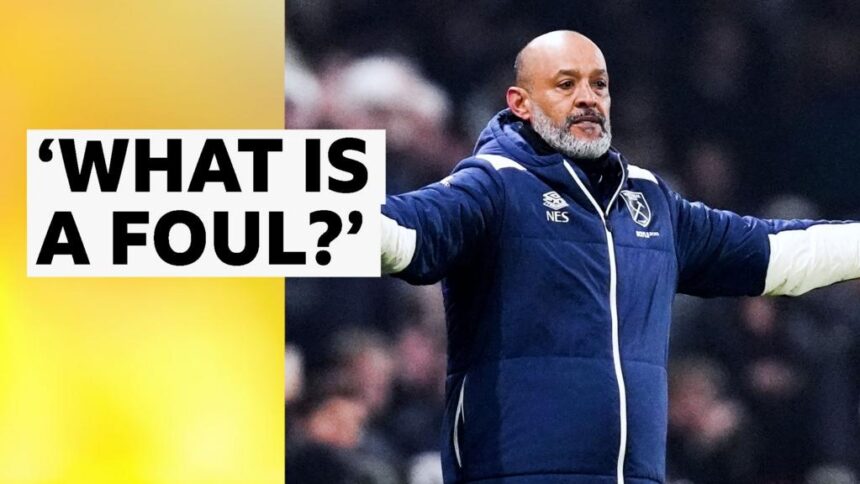
Nuno’s Clarion Call: In the Set-Piece Chaos, What *Is* a Foul Anymore?
The Premier League is a spectacle of power, pace, and precision. Yet, amidst the weekly drama, a persistent, grinding controversy threatens to overshadow the artistry: the anarchic state of set-piece defending. As goals from corners and free-kicks rise, so does the grappling, the shirt-pulling, and the outright wrestling in the penalty area. Now, West Ham United head coach Nuno Espirito Santo has given voice to the simmering frustration of managers, players, and fans alike, issuing a stark admission that cuts to the heart of the issue: “We don’t know what is a foul.” This is not just a complaint; it’s a cry for clarity that demands a systemic review.
The Set-Piece Tangle: A League-Wide Epidemic of Uncertainty
Nuno’s comments, following a period of intense scrutiny on decisions in his own team’s box and at the opposite end, reflect a league-wide confusion. The Premier League’s directive to crack down on holding and blocking at set-pieces has been inconsistently applied, leading to a lottery of decisions. One week, a slight tug is penalized with a penalty. The next, a defender can seemingly bear-hug an attacker to the ground with impunity. This inconsistency creates a impossible environment for coaches. How can you drill defensive set-piece routines when the rules seem to change from official to official, or even from minute to minute within the same game?
The problem is twofold. Firstly, the interpretation of “normal contact” has become hopelessly blurred. Football is a physical game, and jostling for position is expected. But the line between competitive positioning and illegal impeding has vanished. Secondly, the use of VAR has complicated, not clarified, the situation. The forensic examination of every corner, searching for any infringement, often leads to decisions that feel disproportionate to the footballing action, undermining the flow and physical contest fans cherish.
- Managerial Minefield: Coaches are left instructing players in a grey area, often leading to avoidable penalties.
- Player Confusion: Defenders and attackers are both second-guessing their actions, leading to hesitant play and more errors.
- Fan Disillusionment: The joy of a goal is increasingly tempered by the long wait for a VAR check, turning celebration into anxiety.
Beyond the Whistle: The Need for Transparent Dialogue
Nuno’s solution is not necessarily revolutionary, but it is essential: open dialogue between officials and clubs. He isn’t asking for special treatment; he’s pleading for a coherent, communicated standard. The Professional Game Match Officials Limited (PGMOL) occasionally releases videos explaining decisions, but Nuno’s call is for a more proactive, educational approach. What specific actions are now deemed punishable? How is the “line” determined? Can managers receive clear, pre-season briefings with visual examples that are then adhered to consistently?
This transparency would serve everyone. Officials, often maligned and working under immense pressure, would have a clearer, publicly understood framework to apply. Clubs could adapt their training accordingly. The current opacity breeds only suspicion and conspiracy theories. A set-piece review, led by a panel including former players, coaches, and referees, could establish a new, durable protocol. The goal should not be to sanitize the game, but to restore consistency and fairness to one of its most exciting and contentious phases.
We’ve seen this work in other areas. The clarification of the handball rule, while still debated, followed a similar path of attempted standardization. The offside rule benefits from technological precision. The chaotic maelstrom of the six-yard box now deserves the same focused attention to reclaim its status as a battle of athleticism and timing, rather than clandestine fouls.
The Ripple Effect: Tactics, Transfers, and the Title Race
The implications of this uncertainty stretch far beyond a single penalty award. It is actively shaping the Premier League landscape. Tactically, teams with prowess at set-pieces gain an even greater, and somewhat unfairly variable, advantage. The risk-reward calculation of committing defenders forward for a corner becomes skewed by the fear of an unpredictable, game-changing call against you.
This influences the transfer market. The value of a towering, physical center-back who can dominate in the air is now intertwined with his risk of conceding penalties in the current climate. Similarly, cunning forwards who are experts at “winning” contact are at a premium. Clubs are not just recruiting for skill, but for a player’s ability to navigate the arbitrary enforcement of the rules.
Most critically, it could influence the title race, European qualification, and relegation battles. A contentious, inconsistently awarded penalty in a key match in May could decide the fate of millions in prize money and prestige. The integrity of the competition is paramount, and its foundation is a set of rules applied consistently for all 20 clubs, from August to May. Right now, that foundation, at least for set-pieces, looks worryingly unstable.
The Path Forward: Prediction and Precedent
So, what happens next? Nuno’s public stance will resonate in boardrooms and referees’ meetings. The pressure from several high-profile managers will likely force the Premier League and PGMOL to act. We predict a summer of focused review, culminating in a new, stricter directive for the 2024/25 season. This may initially lead to a spike in penalties as players and officials adjust, much like the early season crackdowns on tactical fouls and time-wasting.
The ideal outcome is a new normal: a standard where clear, obvious holding and blocking are penalized, while the robust, shoulder-to-shoulder combat for space is allowed. This requires brave officiating, but more importantly, it requires a clear and unified definition of what constitutes a foul. The technology for micro-analysis exists; now the footballing authorities must provide the philosophical framework.
The Premier League sells itself on pure, unscripted emotion. But that emotion must be rooted in fair contest. Nuno Espirito Santo has thrown a spotlight on a crack in the competition’s veneer. His words are a challenge to the powers that be: clarify the rules, communicate them transparently, and apply them consistently. Until then, every corner and free-kick will be accompanied not just by the roar of the crowd, but by a shared, nagging doubt—a waiting for the whistle that may or may not come, for an offense no one can reliably define. The beautiful game deserves better than this set-piece lottery.
Source: Based on news from BBC Sport.