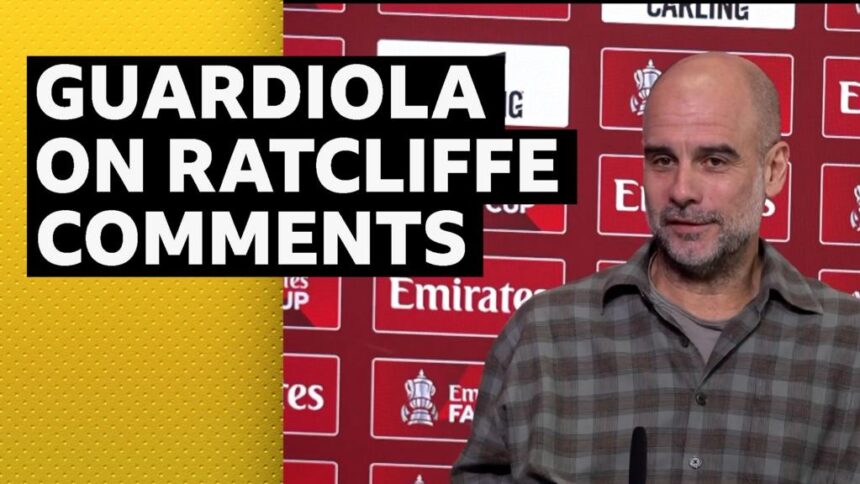
Guardiola’s Global Vision: A Footballing Philosopher Responds to Ratcliffe’s Remarks
In the rarefied air of elite football management, where press conferences are often minefields of tactical evasion and injury updates, Pep Guardiola occasionally transforms into something more: a philosopher-statesman. This week, the Manchester City boss provided a masterclass in measured, principled leadership, responding to controversial comments from across the Manchester divide with a message of inclusivity that transcended sport. His words, “we have a lot of work to do,” served as both a gentle rebuke and a hopeful blueprint for a better society.
The Spark: Ratcliffe’s Remarks and a Swift Apology
The catalyst was an interview given by Sir Jim Ratcliffe, the nascent co-owner of Manchester United, with the Telegraph. Discussing his chemical company INEOS’s approach to hiring, Ratcliffe stated he believed the UK had been “colonised by immigrants,” a phrase that ignited immediate controversy. He later apologised, clarifying his comments were “not my finest hour” and that his intention was to highlight a need for improved training for domestic workers. However, the initial remark had already entered the public discourse, landing on the desk of a manager renowned for his cosmopolitan outlook.
Guardiola, who has built dynasties in Spain, Germany, and England with players from every corner of the globe, was asked for his perspective. His response was not a fiery condemnation, but a thoughtful exposition of his lived reality. He sidestepped personal criticism of Ratcliffe, instead pivoting to the universal principle at stake. This approach elevated the discussion from a petty club rivalry to a societal one, showcasing the Catalan’s acute political acumen.
Guardiola’s Creed: Football as a Microcosm of a Better Society
For Pep Guardiola, the football dressing room is not just a tactical workshop; it is a proven model for successful integration. His career is a testament to the power of diverse talent unified by a common purpose.
- At Barcelona, he melded La Masia graduates with international stars, winning a Champions League final with a starting eleven featuring seven homegrown players—a feat of cultural and sporting identity.
- At Bayern Munich, he integrated global talents into a bastion of German footballing tradition.
- At Manchester City, his current squad is a United Nations of talent, with figures like the Algerian Riyad Mahrez, the Norwegian Erling Haaland, the Brazilian Ederson, and the Portuguese Bernardo Silva all pivotal to their historic successes.
“We have a better society if we embrace other cultures,” Guardiola stated. This isn’t just a platitude for him; it’s a operational blueprint. His footballing philosophy—positional play—requires intelligence, adaptability, and a shared understanding that transcends language or origin. It is, in essence, a system where diverse parts create a more beautiful and effective whole. His success proves the model works on the pitch. His argument is that its principles are desperately needed off it.
A Stark Contrast: The Football Manager as a De Facto Diplomat
The episode inadvertently highlights a fascinating role reversal in modern football. While club owners, particularly those from private equity and multinational conglomerates, often speak in the language of pure business and market forces, it is the managers who frequently emerge as the custodians of broader human values. Guardiola, Jurgen Klopp, and others have repeatedly used their platforms to address social issues, from migration to inequality.
Ratcliffe’s original comments, even if clumsily phrased, stemmed from a discussion on economic protectionism and workforce development. Guardiola’s rebuttal came from a place of human potential and collective growth. This clash of paradigms—the industrialist versus the humanist—is stark. In today’s game, the manager’s role extends far beyond the training ground; they are the emotional and ethical compass for the club, often needing to navigate complex societal issues that their employers inadvertently trigger.
Guardiola’s deft handling also underscores the global branding of Manchester City. As part of the City Football Group, the club’s identity is deliberately globalist. Guardiola’s message reinforces that brand as open, progressive, and forward-thinking—a subtle but powerful piece of reputation management that resonates with a worldwide fanbase.
The Road Ahead: Predictions for a Lingering Discourse
This incident will not be an isolated one. As football clubs become geopolitical entities and their owners increasingly powerful public figures, the tension between insular nationalism and globalist ambition will continue to flare. We can predict several consequences:
- Increased Scrutiny on Owner Communications: Boards will likely impose stricter media training and messaging protocols on principal owners, especially those new to the intense spotlight of the Premier League.
- Managers as Moral Anchors: The trend of managers being asked to comment on socio-political issues will intensify. Their ability to speak with empathy and intelligence will become an unofficial but critical part of the job description.
- A Litmus Test for Player Recruitment: Guardiola’s stance reinforces that top talent, which is inherently global, will be drawn to environments perceived as welcoming and inclusive. Clubs seen as fostering a less welcoming culture may find themselves at a competitive disadvantage in the transfer market.
Ultimately, Guardiola’s “lot of work to do” is a call for continuous effort. It acknowledges progress while rejecting complacency. It’s a message that true strength—in a team or a society—comes from synthesis, not separation.
Conclusion: More Than a Game, A Guiding Philosophy
Pep Guardiola did not merely defend immigration this week; he championed the very idea that human exchange is the engine of improvement. His career is a living argument that the best teams, and by extension the best societies, are built on meritocracy fused with mutual respect. While Sir Jim Ratcliffe’s comments reflected a narrow, transactional view of human capital, Guardiola offered a vision of shared destiny.
In the heated theatre of Manchester football, where rivalry is usually measured in goals and points, this was a different kind of victory. It was a victory of perspective. By framing the embrace of other cultures as a pathway to a “better society,” Guardiola reminded us that the beautiful game’s most enduring legacy might not be the trophies it fills, but the bridges it builds. The work, as he says, is far from over. But in his cosmopolitan dugout, we have a compelling model for how to do it.
Source: Based on news from BBC Sport.