McCullum’s Shield: Why England’s ‘Bazball’ Era Demands a New Kind of Player Protection
The roar of the crowd has faded, the stump microphones are off, and the relentless glare of the international spotlight has, for a moment, shifted. But in the quiet aftermath of a gruelling winter, England’s red-ball revolution faces one of its most nuanced challenges yet: not a technical flaw, but the human element. At the centre of this stands Harry Brook, the prodigiously talented batter, and his fiercely protective head coach, Brendon McCullum. The message from the camp is unequivocal: the player is not the problem; the modern ecosystem is.
The Unseen Battle: Pressure, Scrutiny, and the Need for a ‘Bubble’
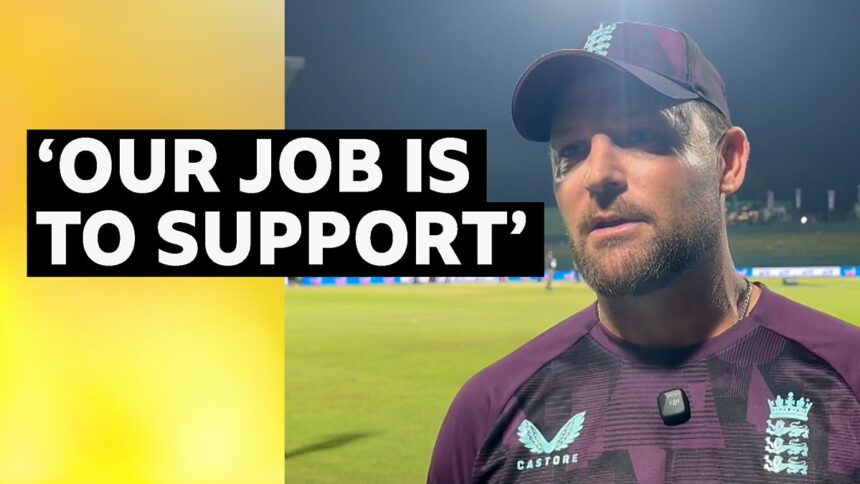
Brendon McCullum’s defence of Harry Brook was not a mere dismissal of criticism. It was a strategic, philosophical statement about how England intends to nurture talent in the ‘Bazball’ age. Brook, lauded as an ‘outstanding’ talent by his coach, faced scrutiny not just for his on-field returns during the tours of New Zealand and Australia, but for off-field behaviour perceived by some as indicative of a player out of sync. McCullum’s response cut to the heart of a modern dilemma.
“We’ve dealt with it,” McCullum stated, a phrase that carries the weight of private conversations and a unified front. His call to ‘protect’ Brook is a recognition that the mental and emotional demands on players in this hyper-aggressive, constantly analysed environment are unprecedented. This isn’t about excusing poor form; it’s about understanding that the fuel for England’s fearless cricket is a fragile confidence that must be sheltered from external noise. Ben Stokes’ parallel call for support for players in ‘tough’ times reinforces that this is a leadership mantra, not an isolated opinion.
- Psychological Armour: The ‘Bazball’ methodology requires players to take extraordinary risks. To foster that, the management must provide an unshakeable safety net off the field.
- Beyond the Boundary: Criticism now follows players onto social media and into private life, creating a 24/7 pressure cooker. Protection means managing this entire environment.
- Long-Term Investment: Brook is seen as a cornerstone for the next decade. McCullum’s approach is a strategic investment in his long-term mental capital, not just his short-term runs.
The Glue and the Spark: Balancing Youth and Experience
While the focus is on protecting emerging talent like Brook, the architecture of the England Test side relies heavily on a core of experienced stability. This is where Michael Vaughan’s recent observation that Joe Root ‘is the glue’ for England’s success becomes profoundly relevant. Root’s sublime, consistent run-scoring provides the foundational security that allows the strokemakers around him to play with such liberated aggression.
This dynamic is crucial. McCullum can afford to insulate a Brook or a Ben Duckett precisely because he has the adhesive qualities of Root and the inspirational leadership of Stokes. The ‘glue’ allows the more volatile, explosive elements to bond into a winning compound. Vaughan’s analysis underscores that ‘Bazball’ is not a blanket policy of recklessness; it is a carefully calibrated team structure where roles are clearly defined. The experienced heads are the shock absorbers, allowing the young guns to fire without the fear of systemic collapse.
A Lesson from the Past: The Human Behind the Hero
In a poignant parallel, the cricketing world recently reflected on a player of a different era with the tribute to Robin Smith. Chief cricket reporter Stephan Shemilt’s recollection that ‘He was a cool cricketer’ reminds us of the personalities that define sport. Smith faced the fearsome West Indian pace batteries with legendary courage, but his career also had its struggles and eventual conclusion.
This look back is a timely reminder. Every player celebrated for their aura and toughness is also human, susceptible to form, fatigue, and the pressures of the spotlight. The current management’s approach to Brook suggests a more holistic understanding of this than perhaps some previous regimes. They are not just managing a cricketing asset; they are stewarding a young man’s career through its inevitable peaks and troughs, hoping to preserve the very ‘cool’ talent that makes him special.
The Road Ahead: Predictions for a Protected Prodigy
So, what does this mean for Harry Brook and England’s summer? The prediction here is not about a specific average, but about an environment.
First, expect Brook to return to the middle order with the full, public backing of the dressing room. Any technical tweaks will be made away from the spotlight. Second, the narrative around him will be aggressively managed by the team; missteps will be framed as learning, not failure. Finally, and most importantly, this episode sets a precedent. Player welfare in the ‘Bazball’ context is being redefined as psychological empowerment. We will see this applied not just to Brook, but to any player who buys into the ethos and encounters a rough patch.
The ultimate test will be whether this protection translates to performance. Can a shielded Brook play with the same devastating freedom that announced him on the world stage? The England management is betting everything that he can.
Conclusion: Redefining Toughness in Modern Cricket
Brendon McCullum, the architect of cricket’s most thrilling revolution, has revealed his next strategic layer. It’s not a new batting stance or a novel field setting. It’s a cultural deep dive into what it takes to sustain high-risk, high-reward cricket. Defending and protecting Harry Brook is a symbolic act. It declares that in this England set-up, toughness isn’t just about facing a 90mph bowler; it’s about having the resilience to weather public storm, and the team’s role is to provide the shelter for that resilience to grow.
This is a long game. By treating Brook not as a problem to be solved but as a talent to be safeguarded, McCullum and Stokes are investing in the soul of their project. They understand that the ‘glue’ of Root and the fearlessness of youth are not opposing forces, but complementary ones. And as the tribute to Robin Smith reminds us, the legacy of a ‘cool cricketer’ is defined not just by the battles they win, but by how they are supported through the wars. England’s new war is a psychological one, and they are drawing a very clear line in the sand around their most precious troops.
Source: Based on news from BBC Sport.