


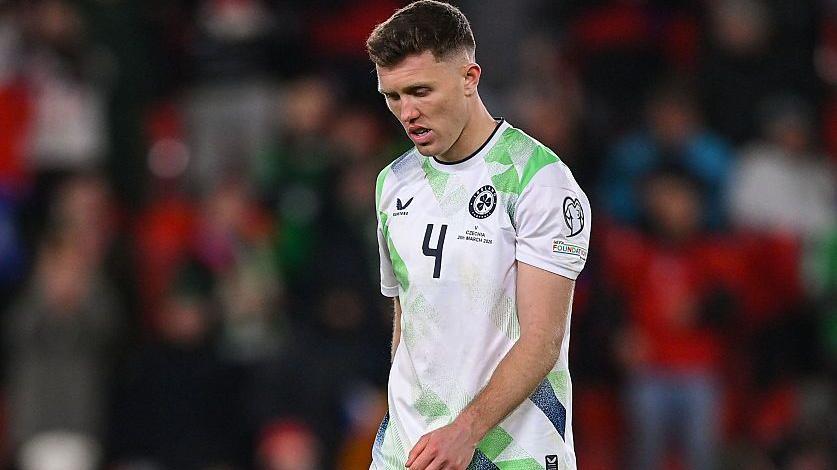
‘We’ve Had Closure’: Dara O’Shea Urges Ireland to Park Prague Pain and Build for the Future
The dust has settled over the Fortuna Arena, but the sting of a dream deferred lingers in the air. For the Republic of Ireland, the manner of their World Cup exit—a penalty shootout collapse after surrendering a two-goal lead in Prague—was a brutal lesson in football’s cruelest twists. Yet, as the squad regroups for Tuesday’s friendly against North Macedonia, a new narrative is being forged not from despair, but from a determined resolve to look forward. At its heart is defender Dara O’Shea, whose message is clear: closure has been found, and the building must begin anew.
The Prague Agony: A Collapse That Stunned a Nation
Last Thursday’s play-off semi-final in the Czech capital was a microcosm of an entire campaign compressed into 120 agonising minutes. Heimir Hallgrimsson’s side, organised and opportunistic, seized a commanding position, only to see it evaporate under late pressure. The subsequent penalty shootout defeat was a final, gut-wrenching blow, ending the World Cup dream and extending Ireland’s major tournament exile. For players and fans alike, it felt like a unique form of heartbreak—a failure snatched from the jaws of success.
“It’s a tough one to take, there’s no hiding from that,” O’Shea reflected, articulating the mood of a nation. The nature of the loss, squandering a lead that seemed unassailable, invites a period of painful introspection. Yet, dwelling on the ‘what-ifs’ is a luxury international football’s relentless calendar does not afford. The immediate challenge is a dead rubber friendly at the Aviva Stadium, a fixture that risks being played in the shadow of Thursday’s trauma. O’Shea, however, is adamant the page must be turned.
Finding Closure and Forging a Professional Path Forward
The concept of ‘closure’ in sport is often elusive, a platitude offered in the immediate aftermath of defeat. But O’Shea’s insistence suggests a deliberate, collective process within the camp. “We’ve had closure, now we have to look forward to the next game, we can’t keep dwelling on that because nothing can change. What’s done is done,” stated the Burnley defender. This isn’t about forgetting, but about compartmentalising. It is the essential professional mindset required to survive at the highest level.
His words underscore a critical transition for this Irish squad under Hallgrimsson. The Icelandic coach has instilled a clearer identity and tangible progress, with the Czech game—for all its painful ending—demonstrating a capacity to compete and execute a game plan in high-stakes away fixtures. To let one result, however devastating, unravel that growing confidence would be a second defeat. O’Shea’s focus is on protecting the foundations laid.
- Immediate Focus: A proud, solid performance against North Macedonia to maintain momentum.
- Squad Ethos: Reinforcing the collective spirit and tactical understanding built in recent months.
- Future Vision: Using the pain of Prague as fuel for the next qualifying cycle, not an anchor.
“We’re professionals so you have to move onto the next game,” O’Shea emphasised, highlighting the non-negotiable attitude required. Tuesday night becomes a test of character, a measure of the squad’s resilience and its ability to park the pain for the greater good.
Euro 2028: The Shining Light on the Horizon
If the road to the 2026 World Cup now runs through the perilous terrain of a Nations League play-off, there is a colossal beacon on the horizon: Euro 2028. Co-hosted by Ireland and the United Kingdom, the tournament represents a guaranteed place at football’s top table and a generational opportunity. O’Shea directly linked the present moment to that future. The mission now is to ensure the team arriving at that tournament is a battle-hardened, cohesive unit capable of making history on home soil.
This long-term vision fundamentally changes the context of the coming years. Every friendly, every Nations League game, becomes a vital brick in the construction of that 2028 squad. The experience of Prague—the high-pressure environment, the tactical battle, the psychological toll of a shootout—is invaluable data. For a relatively young squad, learning to absorb such a blow and channel it positively is a rite of passage. The focus shifts from the single goal of qualification to the holistic process of team development and growth.
Hallgrimsson’s project is now unequivocally geared towards this destiny. The style of play, the integration of emerging talents like Evan Ferguson, and the cultivation of mental fortitude all serve the ultimate aim of being competitive and ready when the eyes of the world fall upon Dublin in 2028. The Czech loss is not the end of a story, but a pivotal, painful chapter in a longer saga.
Analysis: Why O’Shea’s Leadership is Pivotal for the Rebuild
At 25, Dara O’Shea represents a bridge between the experienced core and the new generation. His calm, authoritative presence on and off the pitch makes him a natural leader, and his public messaging is strategically important. By openly discussing closure and future goals, he is helping to steer the narrative and, by extension, the squad’s psychology. This is a key component of modern international management: players as standard-bearers for the collective mindset.
From a tactical perspective, the coming years demand evolution. Hallgrimsson has solidified the defence and improved structure, but unlocking greater creativity and a more consistent attacking threat is the next frontier. The development of players like Ferguson, Sammie Szmodics, and others who will emerge will be crucial. The friendly against North Macedonia offers a first chance to experiment or reinforce principles without the suffocating pressure of qualification, a rarity in the international game.
Expert predictions for Ireland’s trajectory are cautiously optimistic. The consensus is that the team is on an upward curve, but the Prague collapse exposed enduring frailties in game management. The true test of progress will be how they respond in the next competitive fixtures. Will they retreat, or will they play with the fearless confidence that built their two-goal lead? O’Shea’s comments suggest the latter is the intended path.
Conclusion: From the Ashes of Prague, a New Resolve
The Republic of Ireland’s World Cup dream ended in the most harrowing fashion imaginable. Yet, in the raw aftermath, the seeds of a determined future are being sown. Dara O’Shea’s declaration of closure and forward focus is not mere rhetoric; it is a necessary manifesto for a squad at a crossroads. The friendly against North Macedonia is no longer a dead rubber, but a vital first step in a new journey—a public demonstration of the squad’s resilience and professionalism.
The road to Euro 2028 begins now, in the Aviva Stadium, with a performance of pride and purpose. The pain of Prague will forever be part of this group’s story, but under Hallgrimsson’s guidance and with leaders like O’Shea setting the tone, it need not define them. Instead, it can be the forge in which a tougher, smarter, and more capable Irish team is tempered. The closure is not an end, but a new beginning. The building has started.
Source: Based on news from Yahoo Sports.


