What’s Gone Wrong for British Short Track Speed Skating? A Post-Milan Post-Mortem
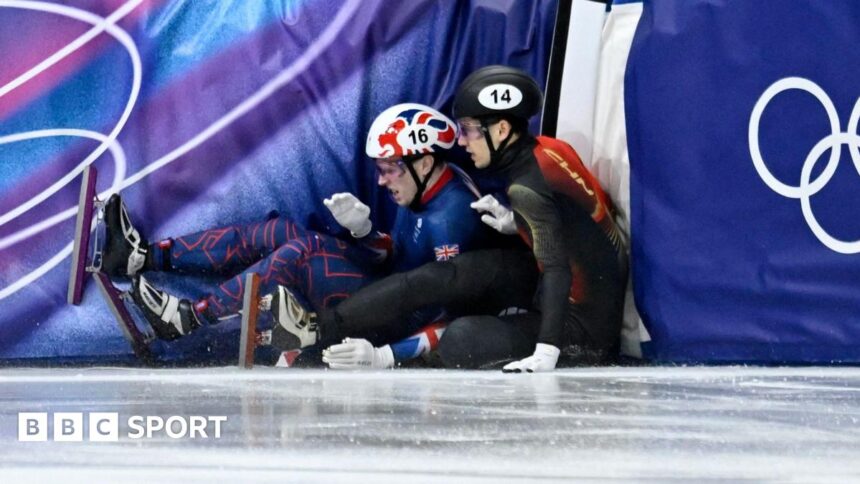
The roar of the crowd fades, the ice chips settle, and for British short track speed skating, the silence is deafening. As Niall Treacy skidded out of the men’s 500m heats in Milan, it marked not just an individual exit, but the final, faltering step of a disastrous Winter Olympic cycle for the entire program. In a Games where Team GB celebrated a historic “Super Sunday,” the short track squad was left out in the cold, failing to register a single top-ten finish. This wasn’t just a bad week; it was the culmination of a systemic decline. So, what has gone so profoundly wrong for a discipline that once delivered British Winter Olympic glory?
From Turin Highs to Milan Lows: A Legacy Unfulfilled
To understand the depth of the current crisis, one must recall past success. Short track is the source of Britain’s only individual Winter Olympic gold on ice, courtesy of Elise Christie’s historic triple world championship wins in 2017. Before her, Jon Eley and Sarah Lindsay were consistent finalists. The program had pedigree. Today, that legacy feels like a distant memory. In Milan, Britain qualified just one skater across all events—Niall Treacy—a stark reduction from the teams of three and four sent to previous Games. This quantitative decline points directly to a collapse in competitive depth within the national system. Where once there was a pipeline, now there appears to be a cul-de-sac, leaving solitary skaters like Treacy carrying an impossible weight of expectation without the day-to-day, high-level domestic competition needed to thrive.
Dissecting the Milan Misfortune: More Than Just Bad Luck
Niall Treacy’s experience in Milan reads like a cruel catalogue of short track’s inherent perils. A crash, a fall, a penalty—he endured them all across the 500m, 1,000m, and 1,500m. While bad luck is part of the sport’s fabric, consistent misfortune across multiple distances suggests deeper issues. Analysts point to several critical factors:
- Lack of Race Density: Short track is as much about tactical nous as raw speed. Without regularly competing in packed, high-stakes finals, British skaters lose the instinct for the split-second decisions—when to overtake, when to hold position—that define the sport.
- The Training Gap: World leaders like South Korea, China, and the Netherlands train in large, elite groups where every session mimics an Olympic final. British skaters often train in smaller, less competitive environments or must travel extensively for quality competition, a significant logistical and financial hurdle.
- The Psychological Burden: Being the sole representative transforms every race from a sporting contest into a national trial. This immense pressure, coupled with the knowledge that one error ends the entire nation’s campaign, is a unique and stifling mental challenge.
As one former Olympian noted anonymously, “You can’t simulate the chaos of a World Cup final in training if you only have two or three skaters. You learn by being in the mix, getting bumped, and understanding limits. Right now, our skaters are entering that chaos cold.”
Systemic Shortfalls: Funding, Infrastructure, and the Pathway
The on-ice struggles are merely symptoms of a chronic, off-ice condition. British short track operates in the long shadow of its more successful sliding sports, which have dedicated facilities and historically consistent funding. Key systemic issues include:
- An Ice Crisis: The UK has a severe shortage of suitable, full-sized short track ovals. The primary national training base has faced uncertainty, disrupting consistent, high-level training.
- The Funding Vortex: UK Sport funding is ruthlessly medal-targeted. Failure to hit performance targets leads to budget cuts, which in turn makes hitting future targets harder—a vicious cycle that has gripped short track since Elise Christie’s injury-hit PyeongChang 2018 campaign.
- A Broken Talent Pathway: The journey from a local ice rink to the Olympic team is fragmented. Unlike in speed skating powerhouses, where children are scouted and nurtured in a coherent system, British talent identification and development remain inconsistent, often relying on individual perseverance over systemic support.
This perfect storm of infrastructural neglect and performance-based financial withdrawal has left the sport on life support at the elite level.
The Road to Recovery: Is There a Path Back to the Podium?
Rebuilding British short track is a marathon, not a 500m sprint. It requires a fundamental strategic shift. Firstly, there must be an acceptance that immediate Olympic medals are not a realistic goal for 2026. The focus must shift to a long-term development strategy, potentially safeguarded by a core “progression funding” model from UK Sport that values building a team, not just chasing a podium. Concrete steps must include:
- Securing and investing in a permanent, world-class training facility as a non-negotiable hub.
- Establishing a clear national competition structure to build race sharpness and identify talent.
- Forming strategic alliances with top-tier nations for training camps and athlete exchanges to immerse British skaters in a winning culture.
- Launching a concerted grassroots campaign to increase participation, capitalizing on any residual visibility from the Olympics.
The prediction is stark: without these foundational changes, the Milan scenario will repeat. The nation may continue to send one or two brave qualifiers, who will face near-insurmountable odds. With investment and a decade-long vision, a new generation could emerge, perhaps ready to challenge by the 2030s.
Conclusion: A Crossroads on Thin Ice
The story of British short track speed skating is currently one of unfulfilled promise and alarming decline. The grim reality of the Milan Games is not an aberration but a verdict. It highlights the consequences of a high-performance system that, when applied to a sport requiring specific infrastructure and depth, can amplify weakness rather than build strength. Niall Treacy’s falls were not his failure; they were the symptom of a system that has stumbled for years. The question now is whether the relevant bodies will pick the sport up, dust off the blueprints for a sustainable future, and commit to the long and difficult journey back. Or, will they leave it lying on the ice, a casualty of the relentless pursuit of medals elsewhere? For the sake of a sport with proud British history, one hopes it’s the former. The recovery starts not with a starting pistol, but with a policy paper and a check—the will to build, not just to win.
Source: Based on news from BBC Sport.