UEFA’s Racism Protocol Under the Microscope: Does It Protect Players or Perpetuate Inaction?
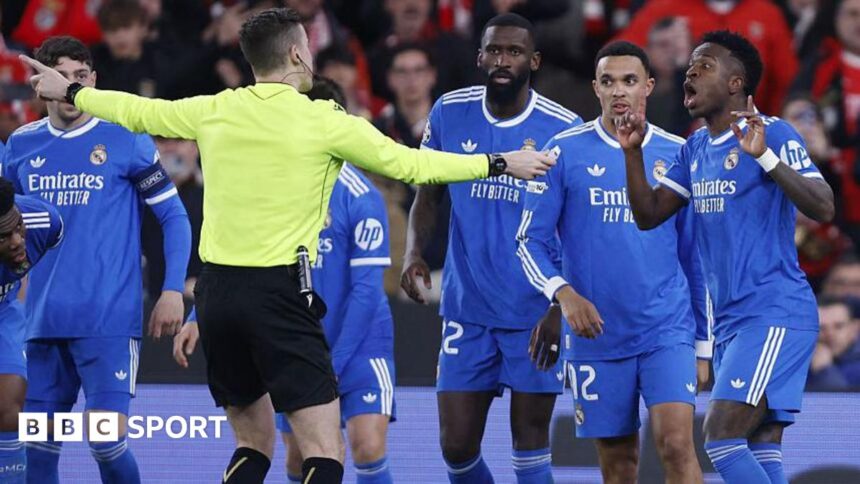
The image was stark, surreal, and spoke volumes. Vinicius Jr., having just scored a breathtaking, world-class goal for Real Madrid against Benfica, sat isolated in the dugout. As coaches and players argued furiously on the touchline, the Brazilian sipped water, a moment of eerie calm at the eye of a storm. The Champions League match was halted for nine minutes after Vinicius alleged he was racially abused by Benfica’s Gianluca Prestianni, who denies the claim. The referee’s immediate response—stopping play and making the crossed-arm gesture—was textbook UEFA protocol. But the scene that unfolded begs the critical question: In the high-stakes theatre of European football, is UEFA’s much-vaunted racism protocol a robust shield for players, or a procedural fig leaf masking systemic failure?
Decoding the Three-Step Protocol: Theory vs. Pitch Reality
UEFA’s three-step protocol for racist incidents is designed to provide a clear, escalating response. Its activation in Lisbon was a visible acknowledgment that something serious had occurred. But understanding its steps reveals both its intent and its potential shortcomings.
The protocol mandates:
- Step 1: The referee stops the match and requests a stadium announcement demanding the unacceptable behavior cease.
- Step 2: If abuse continues, the referee can suspend the match for a “reasonable period” (often 5-10 minutes) and send players to the dressing room, with another warning issued.
- Step 3: As a final measure, if abuse persists, the referee can abandon the match entirely.
In the Benfica case, the game moved directly to a Step 2-style suspension, though players remained pitchside. The protocol was technically followed. Yet, this is where the disconnect begins. The process is reactive, focused on managing an incident in progress. It places the burden of proof and initiation on the victim—the player abused—in the heat of competition. As we saw with Vinicius, it also creates a perverse dynamic where the victim, having just performed a moment of athletic brilliance, becomes the center of a controversy, often facing scrutiny and hostility from opposing fans and players denying the claim.
The Vinicius Litmus Test: A Pattern of Systemic Failure
Vinicius Jr. is, tragically, the most high-profile test subject for UEFA’s and football’s anti-racism measures. The incident in Portugal is not an isolated event for him; it’s a recurring chapter. This context is crucial. Each activation of the protocol for the same player points to a failure of prevention and deterrence.
The protocol handled the symptom—the alleged abuse in that moment—but does nothing to address the disease. The opposing player accused was able to deny the allegation on-field, leading to the chaotic touchline arguments. The match resumed, and Real Madrid secured their 1-0 win. The footballing consequence was a nine-minute pause. For Vinicius, the human consequence was yet another public ordeal, another layer of trauma. This highlights a core flaw: the protocol is an in-match procedure, not a holistic justice system. Its success is measured in whether a game finishes, not whether justice is served or the victim feels supported. The post-match investigation becomes a slow, bureaucratic follow-up, often lost in a fog of “insufficient evidence” due to the chaotic nature of stadium environments.
Expert Analysis: Gaps in the Armor
Sports sociologists and anti-racism advocates identify several critical gaps in the current approach. “The protocol is a necessary first-aid kit,” notes Dr. Lise Møller, a researcher in sport and discrimination, “but it is being asked to perform surgery on a deep-seated infection. It outsources the initial emotional labor and confrontation to the victimized player and the match official, neither of whom are trained crisis counselors.”
The key weaknesses are evident:
- Player-Dependent Activation: The system relies on a player hearing abuse, having the emotional fortitude to report it mid-game, and convincing the referee to act. Many players, especially younger ones, may not.
- Lack of Immediate Accountability: There is no mechanism for immediate identification or ejection of specific offenders from large crowds, diluting the deterrent effect.
- Sporting Incentives Clash: Teams winning a match, as Real Madrid was, have little incentive to push for an abandonment (Step 3). The protocol’s ultimate sanction is thus almost theoretical.
- Post-Match Ambiguity: Denials, like Prestianni’s, create a “he said/he said” stalemate that investigations often fail to resolve, leaving the allegation in a damaging limbo.
The protocol, therefore, risks becoming a performative gesture—a visible show of “doing something” that allows the game to continue while the underlying issue festers.
The Future of the Fight: Predictions and Necessary Evolution
Looking ahead, the pressure on UEFA will only intensify. Predictably, we will see more stoppages, not fewer, as players like Vinicius become increasingly empowered to speak out. The protocol’s frequent use will itself become an indictment of football’s racism problem. To move from theatre to tangible change, several evolutions are non-negotiable.
First, independent match observers with the power to trigger the protocol must be introduced, removing the burden from players. Second, rapid-deployment forensic audio technology needs to be trialed to identify specific perpetrators in real-time, leading to immediate arrests and lifetime bans. Third, and most importantly, sporting sanctions must be automatic and severe. Points deductions, closed-door matches, and immediate forfeits for clubs where systemic abuse is proven are the only language that football governance understands.
The future of the protocol must also include wrap-around victim support, with dedicated counselors available from the moment an allegation is made. The sight of Vinicius alone on the bench should be the last of its kind.
Conclusion: Beyond the Gesture, Towards Justice
The nine-minute pause at the Estadio da Luz was a testament that UEFA’s protocol exists, but the isolated figure of Vinicius Jr. was a louder testament to its inadequacy. The system worked procedurally, yet it failed humanely. It managed the event but did not protect the individual. For the protocol to be deemed truly “working,” its success metrics must shift. It cannot be judged on games completed, but on incidents prevented, perpetrators held accountable, and players feeling genuinely protected and believed.
Until the consequences for racist abuse are as immediate, severe, and career-defining as they are for the victims, the crossed-arms gesture will remain just that—a gesture. Football needs less protocol and more justice. The beautiful game’s integrity depends on it.
Source: Based on news from BBC Sport.