The Long Wait: When Was the Last Time Iowa Men’s Basketball Played in a Final Four?
The question echoes through Carver-Hawkeye Arena every March, whispered by hopeful fans and pondered by a new generation of players: When was the last time Iowa men’s basketball played in a Final Four? The answer is a time capsule, a journey back to an era of analog simplicity and seismic cultural shifts. The year was 1980. To understand just how long ago that was, consider this: the last time the Hawkeyes danced on college basketball’s grandest stage, Pac-Man had yet to chomp his first dot, CNN was an unlaunched idea, Mount St. Helens was a peaceful peak, and Ronald Reagan was still campaigning for the presidency. For Iowa basketball, the Final Four is not a recent memory but a legendary chapter, a destination last reached over four decades ago.
1980: A Final Four Season Frozen in Time
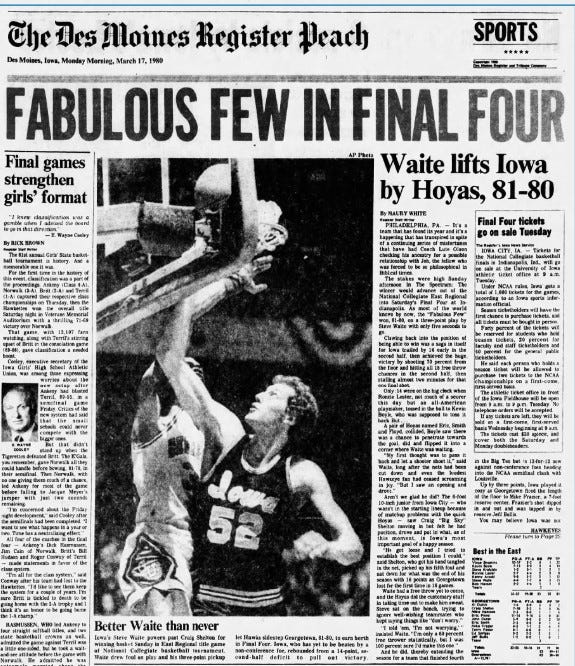
The 1979-80 Iowa Hawkeyes, under the steady hand of the legendary Coach Lute Olson, were a powerhouse. They were led by the electric guard Ronnie Lester, whose season was tragically cut short by a knee injury during the NCAA Tournament. Yet, this team embodied resilience. With Lester sidelined, players like Kenny Arnold, Steve Krafcisin, and Kevin Boyle elevated their games. Their journey to the Final Four was a nail-biter, culminating in an Elite Eight classic against Georgetown. With the score tied at 80 and mere seconds remaining, it was not a star, but a role player who etched his name into Hawkeye lore.
Forward Steve Waite took a pass, drove the baseline, and scored while being fouled with just five ticks left on the clock. He sank the ensuing free throw, sealing an 81-80 victory and sending Iowa to its first Final Four since 1956. The celebration was short-lived, however, as the injury-depleted Hawkeyes fell to eventual national champion Louisville in the national semifinals. Despite the anticlimactic finish, the 1980 team secured its place as the last Iowa squad to reach the sport’s promised land.
The Anatomy of a Four-Decade Drought
Reaching a Final Four is a monumental achievement, a confluence of talent, coaching, health, and fortune. Iowa’s prolonged absence since 1980 prompts a deep analysis. The program has certainly had its share of brilliance in the intervening years. The era of B.J. Armstrong and Roy Marble under Dr. Tom Davis brought thrilling, high-scoring teams and deep tournament runs, including an Elite Eight appearance in 1987. The Hawkeyes have produced NBA talent, All-Americans, and memorable moments. Yet, the final step has remained elusive. Several factors contribute to this extended drought:
- The Tournament’s Unforgiving Nature: A single off-shooting night, a key injury, or a matchup nightmare can end a season. Iowa has faced heartbreaking, narrow losses in the Sweet 16 and Elite Eight that could have swung the other way.
- Evolving Competitive Landscape: The rise of one-and-done talent at traditional blue-bloods, the transfer portal’s recent volatility, and the increased parity in college basketball have made the path more crowded and unpredictable.
- Defensive Consistency: While often boasting elite offenses, Iowa has occasionally struggled to string together the consistent defensive stops required to win four or five high-stakes games in a row against top competition.
It’s crucial to note that this is not a story of failure, but one of the immense difficulty of the task. Many storied programs have endured similar, or even longer, waits between Final Four appearances.
Fran McCaffery’s Era and the Path Back
Under long-tenured coach Fran McCaffery, Iowa has experienced a renaissance. The program has returned to a near-perennial NCAA Tournament presence, won Big Ten Tournament titles, and developed transcendent stars like Luka Garza, the 2021 National Player of the Year, and sharpshooter Keegan Murray. The Hawkeyes have been knocking on the door, boasting teams with the offensive firepower to beat anyone. The question is no longer about making the tournament, but about making the deep, historic run.
The modern formula for breaking the Final Four curse likely involves a blend of McCaffery’s offensive genius with a veteran-led roster that peaks at the right time. The transfer portal now offers a potential accelerant, allowing teams to plug specific experience gaps. For Iowa, the key will be constructing a roster that not only scores in bunches but possesses the switchable defenders and tournament-tested poise to win multiple, diverse styles of games in a pressurized environment. The foundation is firmly in place; the next step is the hardest one.
Predictions: Is the Drought Nearing Its End?
As a seasoned observer of college basketball, predicting a Final Four is a fool’s errand—the madness of March defies logic. However, we can assess probability and trajectory. Iowa is closer now than it has been in decades. The program’s stability, its ability to develop elite professional talent, and its potent offensive system create a high ceiling for any given season.
The prediction here is not for a specific year, but for a coming era. Within the next five to seven years, it is more likely than not that an Iowa team will break through. It will require the usual staples of a Final Four run: a top-10 offense, a defense that climbs into the top 40, a favorable bracket draw, and, inevitably, a lucky bounce or two. When it happens, it will be a cathartic release for a fanbase that has remained fiercely loyal through the long wait. The shadow of 1980 will finally be replaced by the bright lights of a new millennium Final Four.
Conclusion: The Legacy of 1980 and the Hope for Tomorrow
The 1980 Iowa Hawkeyes are not just a trivia answer; they are a benchmark of ultimate success. They remind us that Iowa basketball has stood on the mountain top, even if that peak was scaled a generation ago. The stories of Ronnie Lester’s brilliance, Steve Waite’s clutch play, and Lute Olson’s leadership are the foundational myths that fuel current aspirations.
The long wait since the last Iowa men’s basketball Final Four is a testament to the challenge, but also to the enduring hunger of the program. It is a narrative of near-misses and “what-ifs” that makes the pursuit all the more compelling. For Hawkeye faithful, the passage of time since 1980 isn’t just measured in years, but in tournament brackets, buzzer-beaters, and the unwavering belief that the next great team could be the one to end the drought. The final chapter of this story has yet to be written, and that is what makes the journey, and the answer to that persistent question, so powerfully compelling.
Source: Based on news from Yahoo Sports.