Why Arsenal Have Fallen Short in the WSL and Champions League This Season
The Emirates Stadium has become accustomed to nights of high drama, but even Stina Blackstenius’ 93rd-minute winner against Everton in their penultimate Women’s Super League (WSL) match of the season did little to change the bigger picture. That goal, a flash of pure desperation and quality, was a microcosm of Arsenal’s entire campaign: brilliant in bursts, but ultimately too little, too late.
This season hasn’t gone to plan for Arsenal. While the Gunners lifted the inaugural Champions Cup, they failed to retain their Women’s Champions League title and also exited the FA Cup at the quarter-final stage and the League Cup in the semi-finals. The narrative of a “transitional season” has worn thin. The reality is a squad laden with international talent has underperformed across every major domestic and European competition.
With Manchester City already crowned champions, Arsenal’s wait for a first WSL title since 2019 continues. The question every Gooner is asking is simple: why? Let’s dissect the tactical, psychological, and structural cracks that have left the Gunners in the dust.
The Russo Paradox: Goals Without Glory
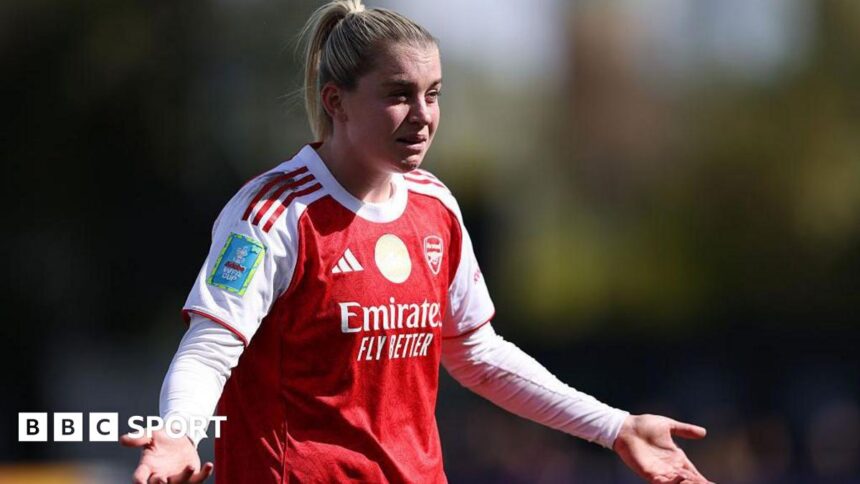
Individually, Alessia Russo has scored 11 goals in the Women’s Super League this season. On paper, that is a respectable return for a striker who arrived with a £500,000 price tag and the weight of a nation’s expectations. Yet the numbers tell a deceptive story.
Russo’s goals have often come in clusters—hat-tricks against lower-table sides or crucial strikes in games already under control. Where she has fallen short is in the defining moments:
- Against top-four rivals (Chelsea, Manchester City, Manchester United), Russo has managed just two goals from open play.
- Her conversion rate from “big chances” (as defined by Opta) sits at 38%, a figure that places her outside the top five in the WSL.
- In the Champions League knockout stages, she failed to score in either leg against Paris FC or the eventual winners, Lyon.
The problem is not Russo’s talent—it’s the system. Arsenal’s midfield, led by the aging Kim Little and the inconsistent Frida Maanum, has lacked the vertical penetration required to feed a striker who thrives on service. Too often, Russo has been forced to drop deep, vacating the penalty area and leaving Arsenal without a focal point.
Key metric: Arsenal’s expected goals (xG) per game has dropped from 2.1 last season to 1.6 this term. The creativity has dried up, and Russo has been left to forage alone.
Defensive Fragility: The Achilles’ Heel
If the attack has been inconsistent, the defense has been a full-blown crisis. Arsenal have conceded 18 goals in the WSL this season—more than in any campaign since 2018. In the Champions League, they shipped five goals in two legs against Lyon, a team they beat convincingly in last year’s group stage.
The root cause is a structural imbalance in the backline:
- Injury to Leah Williamson: The England captain’s ACL injury last April left a leadership void that has never been filled. Lotte Wubben-Moy is talented but lacks the commanding presence to organize a high line.
- Full-back vulnerability: Katie McCabe is world-class going forward but has been exposed defensively, particularly in transition. On the opposite flank, the experiment with Steph Catley as an inverted full-back has confused the defensive shape.
- Goalkeeper uncertainty: The rotation between Manuela Zinsberger and Sabrina D’Angelo has created a lack of continuity. Zinsberger’s error against Chelsea in the League Cup semi-final was a turning point in that competition.
Statistical evidence: Arsenal have conceded the highest number of goals from set-pieces (7) in the top five of the WSL. This is a damning indictment of their organization and aerial dominance—areas that were once their strength under former manager Jonas Eidevall.
The defensive fragility has forced the midfield to drop deeper, creating a disconnect between the lines. This is why Arsenal have struggled to control games against elite opposition.
Champions League Collapse: The European Dream Dies
Arsenal’s Champions League campaign was supposed to be a statement. They reached the semi-finals last season and had the squad depth to challenge Lyon and Barcelona. Instead, they crashed out in the quarter-finals to Paris FC—a team with a fraction of Arsenal’s budget.
The 2-1 defeat at home in the first leg was catastrophic. Arsenal dominated possession (67%) but managed only three shots on target. This is a recurring theme: possession without penetration. In the second leg, a 1-0 win was not enough to overturn the deficit, exposing a lack of tactical flexibility.
Key reasons for European failure:
- Poor recruitment in January: The loan signing of Emily Fox from North Carolina Courage was a reactive move, not a proactive one. She has struggled to adapt to the physicality of European football.
- Over-reliance on Beth Mead: After her ACL return, Mead has shown flashes of her 2022 form but lacks the explosive pace needed to unlock elite defenses. Opponents have doubled up on her, knowing the threat from the right side is limited.
- Lack of a plan B: When the passing game breaks down (as it did against Lyon’s press), Arsenal have no alternative. They cannot go long effectively, and they lack a target man who can hold up play.
The Champions League exit was not a fluke. It was the logical endpoint of a season where Arsenal’s squad depth was exposed as thin, and their tactical identity was confused.
What Next? Predictions for the Summer Window
Arsenal’s hierarchy has a massive rebuild ahead. The WSL title is no longer a realistic short-term target—Manchester City and Chelsea have pulled away. Here is my expert analysis on what the club must do to close the gap:
Priority 1: A world-class defensive midfielder – Lia Wälti is excellent but injury-prone. Arsenal need a destroyer in the mold of Keira Walsh (Barcelona) or Lena Oberdorf (Wolfsburg). Someone who can protect the back four and transition the ball quickly.
Priority 2: A clinical striker to complement Russo – Russo cannot do it alone. The club should target a player like Ewa Pajor (Wolfsburg) or Tabitha Chawinga (PSG) who offers pace and direct running in behind.
Priority 3: A commanding center-back – Williamson’s return will help, but she needs a partner who is dominant in the air and vocal. The free agency pool includes Wendie Renard (if she leaves Lyon) or Amanda Ilestedt, who has underperformed this season.
Prediction for 2024/25: Arsenal will finish third in the WSL again, but will win the League Cup as a consolation. They will reach the Champions League semi-finals, only to be knocked out by Barcelona. The gap is too large to bridge in one window.
Conclusion: A Season of Missed Opportunities
This season hasn’t gone to plan for Arsenal. The numbers don’t lie: one trophy (the Champions Cup, a pre-season competition) out of four possible, a third-place finish in the WSL, and a quarter-final exit in Europe. For a club with the resources, fanbase, and history of Arsenal, that is a failure.
The Stina Blackstenius winner against Everton was a beautiful moment, but it masked a deeper malaise. Arsenal are no longer a team that strikes fear into opponents. They are a team that relies on individual brilliance to paper over tactical cracks.
The board must act decisively. The summer transfer window is not just about adding talent—it is about building an identity. If Arsenal continue to sign players without a clear system, they will remain in the shadow of Manchester City and Chelsea.
Final thought: The WSL is evolving. The days of Arsenal dominating through sheer history are over. To win the title, they must become a team that is ruthless, resilient, and tactically flexible. Right now, they are none of those things. The clock is ticking.
Source: Based on news from BBC Sport.