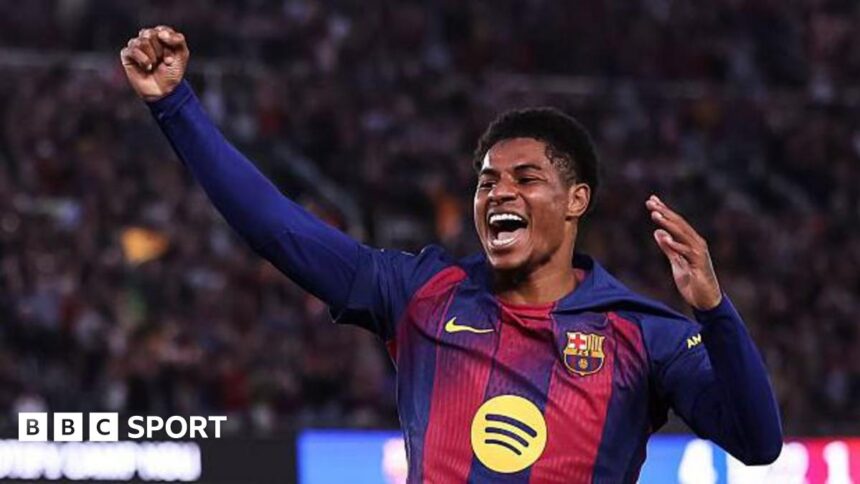
Why Rashford Must Be Patient Over Barcelona Future
There is a moment in every transfer saga that the people writing the stories never see. It does not happen in a press room, a boardroom, or even on the training pitch. It happens at a kitchen table, or during a phone call late at night, or in the silence after someone reads something on their phone and puts it down without saying a word. It is the moment a footballer’s family find out what is being said about the player. With Marcus Rashford, it has been happening a lot recently.
Stories suggesting Barcelona do not really want him. That he is expendable. That a club which signed him on loan last summer and played him regularly is now looking to move him on. These narratives are not just noise. They are real, cutting, and deeply personal. For a player of Rashford’s stature—a homegrown Manchester United legend who made a brave, emotional move to Catalonia—this feels like a betrayal of trust. But here is the hard truth that his camp must hear: patience is not weakness. It is the only path to redemption at the Camp Nou.
The Barcelona Loan: A Story of Promise and Pressure
Let’s rewind to last August. Rashford’s move to Barcelona was hailed as a masterstroke. After a turbulent final season at Old Trafford, where he was frozen out by Erik ten Hag and later marginalized by Ruben Amorim, the switch to La Liga offered a fresh start. Barcelona needed a wide forward with pace, directness, and a proven goal-scoring record. Rashford needed a club that believed in him. For the first few months, it worked. He started regularly, showed flashes of his 2022-23 form, and looked comfortable in Xavi’s system.
But football is a brutal business. By January, the whispers began. Barcelona’s financial struggles meant they could not afford to trigger his permanent transfer clause—rumored to be around €40 million. Then came the tactical tweaks. Xavi started rotating more. Rashford was substituted early in key games. And then, the killer blow: reports emerged that Barcelona were exploring options to terminate the loan early or send him back to Manchester United in the summer.
For Rashford, this must feel like a personal slight. He left everything behind—his boyhood club, his city, his comfort zone—to prove he could still be elite. Hearing that the club that took that gamble is now looking for an exit is devastating. But here is the reality: Barcelona are a club in crisis. They are operating under strict financial fair play restrictions. Every signing, every loan, every contract extension is a political calculation.
Why Barcelona’s Cold Feet Is Not Personal
It is easy for Rashford to interpret these stories as a verdict on his ability. That is the danger of the modern transfer rumor mill. But the truth is far less dramatic and far more structural. Barcelona do not have a Rashford problem; they have a money problem. The club is still digging itself out of a €1.3 billion debt hole. They cannot afford to make a permanent commitment to a player earning £250,000 a week unless they offload several high earners first.
Furthermore, the emergence of Lamine Yamal and Raphinha’s resurgence has shifted the pecking order. Yamal is untouchable. Raphinha, who was also linked with a move away, has become one of Barcelona’s most consistent performers. That leaves Rashford competing for minutes on the left wing—his natural position—against a 17-year-old prodigy and a Brazilian who finally found his rhythm.
But here is the key point: competition is not rejection. Xavi has publicly praised Rashford’s professionalism and work rate. He has started him in 18 of 24 league appearances. Those are not the numbers of a player being frozen out. They are the numbers of a player who is valued but not yet indispensable. The stories about Barcelona wanting to move him on are likely trial balloons—leaked by agents or club officials to test the market, or to put pressure on Manchester United to lower a potential permanent fee.
- Financial reality: Barcelona cannot commit to a big transfer fee this summer.
- Squad depth: Yamal and Raphinha are ahead, but injuries and fixture congestion guarantee minutes.
- Market leverage: Leaks are often used to negotiate better terms, not to dump a player.
The Danger of Rashford Reacting Emotionally
This is where the kitchen table moment becomes critical. Rashford’s family, his advisors, and his inner circle have heard these stories. The natural instinct is to fight back. To demand clarity. To push for a move elsewhere—back to the Premier League, perhaps, or to a club like Paris Saint-Germain that would offer him a starring role. But reacting emotionally would be a catastrophic mistake.
Consider the alternatives. A return to Manchester United is not realistic. The club is in transition under Sir Jim Ratcliffe’s new sporting structure, and the fanbase is still divided over his departure. A move to another Premier League side—say, Arsenal or Chelsea—would mean starting from scratch again, adapting to a new league, a new manager, and new expectations. And it would come with the stigma of being a player who could not make it at Barcelona.
Patience, on the other hand, offers a different path. If Rashford stays, works hard, and waits for the market to shift, he could become a key figure in Barcelona’s long-term rebuild. The club’s financial situation is not permanent. By 2025, the Camp Nou renovation will be complete, bringing in new revenue streams. The debt will be restructured. And by then, Rashford will be 27—entering his prime—with a year of La Liga experience under his belt.
Furthermore, Xavi’s future is uncertain. If the manager leaves or changes his system, Rashford could find himself back in the starting XI. Football moves fast. A few weeks of good form, a couple of injuries to teammates, and the narrative flips entirely. The worst thing Rashford can do is burn bridges based on rumors.
Expert Analysis: What Rashford Should Do Next
As a journalist who has covered dozens of transfer sagas, I can tell you that the players who succeed in these situations are the ones who separate emotion from strategy. Rashford needs to do three things:
First, ignore the noise. The stories about Barcelona not wanting him are being written by people who have never spoken to him, his agent, or anyone inside the club. They are based on inference, not fact. He should stop reading them. His family should stop feeding them. The only opinion that matters is Xavi’s and the sporting director’s.
Second, double down on his performance. Rashford has the talent to be Barcelona’s best forward. He showed it in the first half of the season. He needs to recapture that form—not for the media, not for the fans, but for himself. If he plays well, the club will find a way to keep him. Goals and assists are the ultimate negotiation tool.
Third, communicate directly with the club. Behind closed doors, Rashford should ask for a clear, honest conversation about his future. Does Barcelona see him as a long-term asset? If so, what are the conditions? If not, he deserves to know early so he can plan accordingly. But he must approach that conversation with professionalism, not desperation.
Prediction: Rashford Will Stay—And Thrive
Here is my bold prediction: Marcus Rashford will be a Barcelona player next season. The loan will be extended, or a permanent deal will be structured with add-ons and deferred payments. The reason is simple: Barcelona cannot afford to lose him for nothing, and Rashford cannot afford to leave without proving himself.
The club’s financial constraints mean they will not find a better player for the same price. Rashford’s market value has dropped, but his ceiling is still elite. If he stays patient, works through the noise, and delivers in the final stretch of this season, he will earn the right to stay. The stories will stop. The kitchen table conversations will shift from worry to celebration.
But if he panics—if he demands a transfer, if he sulks, if he lets the rumors define him—he will become exactly what the headlines say he is: a player who could not handle the pressure of Barcelona. That is a legacy no player wants.
Conclusion: The Courage to Wait
Patience is not passive. It is an active, deliberate choice to trust the process. For Marcus Rashford, the next six months will define the next six years of his career. He has already shown immense courage by leaving Manchester United. Now he must show an even greater courage: the courage to wait.
The transfer saga is not over. The stories will keep coming. But the moment that matters most is not the one written in the press. It is the one that happens in the quiet of a kitchen table, when a footballer’s family looks at him and asks, “What do you want to do?” The answer should be simple: I want to stay. I want to fight. I want to be a Barcelona legend.
And if he does that, the club will have no choice but to keep him.
Source: Based on news from BBC Sport.