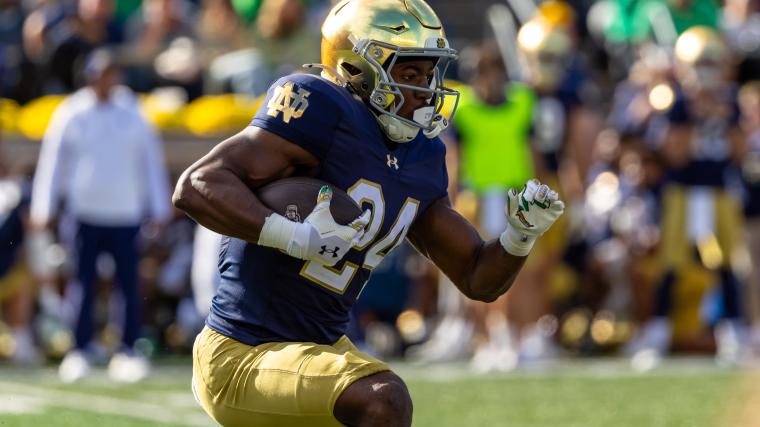
Why Seahawks selected Notre Dame RB Jadarian Price at No. 32 instead of trading down
Why Seahawks selected Notre Dame RB Jadarian Price at No. 32 instead of trading down originally appeared on The Sporting News. Add The Sporting News as a Preferred Source by clicking here.
- The Seahawks’ Draft Capital Crisis: Why Trading Down Seemed Inevitable
- Jadarian Price: The “Complete Package” That Forced Seattle’s Hand
- The Silent Trade Market: Why Seattle Couldn’t Find a Partner
- Expert Analysis: How Price Fits Seattle’s Long-Term Plan
- The Fallout: What This Means for the Rest of the Draft
- Conclusion: A Risky but Calculated Gamble
The Seattle Seahawks entered the 2026 NFL Draft with a glaring problem: they owned just four selections, the fewest of any team in the league. Conventional wisdom screamed for a trade-down scenario. General manager John Schneider is known for his wheeling and dealing, often accumulating picks like a fantasy football manager hoarding waiver wire claims. Yet, when the clock struck for the No. 32 overall pick—the final selection of the first round—Seattle stood pat. And with that pick, they selected Notre Dame running back Jadarian Price.
The move raised eyebrows across the league. Running back was a need, yes, but taking one at the end of the first round when you desperately need depth across multiple positions? It felt like a luxury the Seahawks couldn’t afford. So, what happened? Why didn’t Schneider trade down? Let’s break down the logic, the player, and the long-term strategy behind this surprising selection.
The Seahawks’ Draft Capital Crisis: Why Trading Down Seemed Inevitable
To understand the shock of the Price pick, you have to first understand the context of Seattle’s draft board. Coming into the 2026 draft, the Seahawks held only four total picks. In a draft class that was widely considered deep at offensive line, defensive back, and wide receiver, having four picks was a recipe for disaster. The team had glaring needs at guard, linebacker, and cornerback—positions that typically require multiple swings of the bat to find a starter.
According to NFL insider Jordan Schultz, the Seahawks received multiple calls from teams looking to move up. Several teams in front of Seattle had already traded their picks, creating a frenzy of movement in the mid-to-late first round. The market was hot. The Seahawks could have easily dropped back 10-15 spots, picked up an extra third-rounder, and still landed a quality running back like Price or another prospect.
Instead, Seattle held firm. The decision was not made lightly. Sources within the building suggested that the team’s draft board had a massive tier break after the first 31 picks. In their eyes, Jadarian Price was the last player in that elite tier. The front office believed that if they traded down, they would be forced to select from a group of players they rated significantly lower—a gamble they were not willing to take.
Jadarian Price: The “Complete Package” That Forced Seattle’s Hand
So, who is Jadarian Price, and why did he command such a high selection? The Notre Dame product is not your typical one-dimensional power back. At 5-foot-11 and 215 pounds, Price possesses a rare blend of explosive burst, vision, and receiving ability that made him the top-rated running back on Seattle’s board.
During his final season with the Fighting Irish, Price rushed for 1,342 yards and 14 touchdowns, while also hauling in 38 receptions for 412 yards and 3 scores. His ability to be a three-down back in the NFL is what separated him from other prospects like Ohio State’s Quinshon Judkins or Georgia’s Trevor Etienne.
- Elite Acceleration: Price’s 10-yard split at the NFL Combine (1.51 seconds) was the fastest among all running backs. He hits the hole with zero hesitation.
- Pass Protection: This is where Price truly won over the Seahawks’ coaching staff. He allowed zero sacks on 97 pass-blocking snaps in 2025. For a team that struggled to protect Geno Smith, this is a massive plus.
- Home Run Threat: Price averaged 6.8 yards per carry over his college career. He has the speed to take any handoff to the house.
The Seahawks’ running back room was already solid with Kenneth Walker III and Zach Charbonnet. But Walker has struggled with injuries, and Charbonnet is more of a grinder. Price offers a dynamic, explosive change-of-pace option that fits offensive coordinator Ryan Grubb’s zone-running scheme perfectly. This wasn’t a reach for a need; it was a value pick for a player they viewed as a top-25 talent.
The Silent Trade Market: Why Seattle Couldn’t Find a Partner
While the narrative suggests the Seahawks “refused” to trade down, the reality is more nuanced. According to team sources, the offers Seattle received were not as lucrative as the public might assume. In the 2026 draft, the value of picks in the late first round had depreciated. Teams were aggressively moving up for quarterbacks and pass rushers in the top 20, but the market for the No. 32 pick was surprisingly soft.
Seattle reportedly sought a package that included a 2026 third-round pick and a 2027 second-round pick. No team was willing to pay that price. The offers that came in were for a future fourth-rounder or a swap of late-round picks—deals that Schneider felt were not worth dropping out of the first round for.
“We had a number on what it would take to move back,” Schneider said in a post-draft press conference. “When the phone rang, the offers didn’t meet that threshold. We had a player we loved at a position of need. We took him.”
This is a critical point. The Seahawks were not being stubborn. They were being disciplined. In a draft where they had the fewest picks, trading down for a marginal return would have been a strategic error. By staying at No. 32, they secured a player with a fifth-year option—a valuable asset for a running back who will be 22 years old for his entire rookie contract.
Expert Analysis: How Price Fits Seattle’s Long-Term Plan
Let’s look at this from a roster construction perspective. The Seahawks have a decision looming on quarterback Geno Smith and his future. Whether they extend him or draft a successor in 2027, running the ball effectively will be paramount. A three-headed monster of Walker, Charbonnet, and Price gives Seattle arguably the deepest backfield in the NFC West.
Furthermore, the move signals a shift in philosophy. Under new defensive-minded head coach Mike Macdonald, the Seahawks want to control the clock and play complementary football. A powerful, versatile running game is the engine of that strategy. Price is not just a runner; he is a weapon in the screen game and a reliable check-down option for the quarterback. His presence will force defenses to stay honest, opening up play-action opportunities for Seattle’s talented wide receivers, DK Metcalf and Jaxon Smith-Njigba.
Prediction: Don’t be surprised if Price leads all rookie running backs in total yards from scrimmage in 2026. He will not be the primary starter immediately, but by mid-season, his role in the passing game will make him a fantasy football darling and a crucial piece of Seattle’s offense. His ability to break a 60-yard run on any touch gives the Seahawks a dimension they lacked last year.
The Fallout: What This Means for the Rest of the Draft
By taking Price at No. 32, the Seahawks essentially bet that they can find starting-caliber offensive linemen and defensive backs in the later rounds. This is a high-risk, high-reward strategy. With only three picks remaining (a third, a fifth, and a seventh), Seattle must hit on every single selection.
The pressure is now on the scouting department to find gems. Look for Seattle to target interior offensive linemen on Day 2, specifically guards who can pull and block in space. They also need a nickel cornerback who can cover slot receivers in Macdonald’s aggressive scheme.
If the Seahawks nail those picks, the Price selection will be remembered as a masterstroke—a team that refused to settle for mediocre trade offers and instead secured a blue-chip talent at a premium position. If they miss, however, this will be viewed as the moment John Schneider let his ego get in the way of a necessary rebuild.
Conclusion: A Risky but Calculated Gamble
The Seattle Seahawks’ decision to select Jadarian Price at No. 32 instead of trading down was not a mistake. It was a calculated gamble rooted in player evaluation and market dynamics. The team identified a player they believe is a top-tier talent, and they refused to trade that player away for pennies on the dollar.
In a league where running backs are often devalued, Seattle has decided to zig while others zag. They are building a physical, explosive offense that can win games in the fourth quarter. Jadarian Price is the key to that vision. Whether this move pays off will depend on the health of the roster and the success of their remaining picks. But one thing is clear: the Seahawks are not playing it safe. They are playing to win, and they believe Jadarian Price is the man to help them do it.
For complete coverage of the 2026 NFL Draft, including live tracker updates, pick-by-pick grades, and analysis of the best players still available, stay locked to The Sporting News.
Source: Based on news from Yahoo Sports.