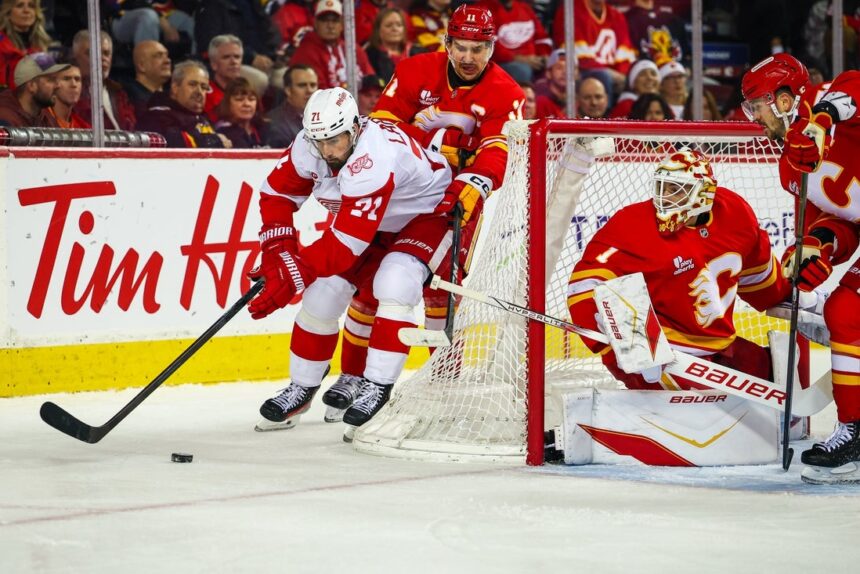
Red Wings Weather Flames’ Fury, Cling to Atlantic Division Lead with Gritty Win
In the NHL, a four-goal lead is supposed to be a comfortable cruise to the finish line. For the Detroit Red Wings on Wednesday night in Calgary, it became a white-knuckle flight through turbulence. Building a seemingly insurmountable advantage through two periods, the Wings were forced to summon every ounce of resilience to repel a furious Flames comeback, ultimately securing a critical 4-3 victory that propelled them back to the top of the Atlantic Division standings.
Detroit’s Dynamic Start: DeBrincat Drives the Offense
The Red Wings came out with the urgency of a team aware of the standings implications. From the opening puck drop, their speed and precision passing carved through the Flames’ defense. The catalyst, as he has been so often this season, was Alex DeBrincat. The sniper opened the scoring with a trademark quick-release wrister, then later added a crucial power-play goal to notch his second multi-goal game in a week. His three-point night was the engine of Detroit’s early dominance.
He wasn’t alone. Dylan Larkin, the captain, continued his strong two-way play, contributing a goal and acting as a pivot in all situations. Perhaps most encouraging for the future was the first NHL goal from top defensive prospect Axel Sandin-Pellikka, whose seeing-eye shot from the point showcased the offensive skill that makes him a cornerstone piece. With Patrick Kane and Andrew Copp each chipping in two assists, Detroit’s offensive layers were on full display, building a 4-0 lead that felt unassailable.
- Alex DeBrincat’s dual threat: Scoring at even strength and on the power play.
- Youth and veteran synergy: Sandin-Pellikka’s first goal assisted by seasoned vets.
- Commanding the neutral zone: Detroit’s transition game stifled Calgary early.
The Flames’ Furious Rally and Gibson’s Great Wall
Hockey games, however, are sixty minutes long. Acknowledging their playoff hopes were slipping away, the Flames emerged for the third period with a desperate, chaotic energy. They tilted the ice, outshooting Detroit 17-4 in the final frame. Joel Farabee broke the seal, Matt Coronato followed, and when MacKenzie Weegar’s point blast found twine with over five minutes remaining, the Scotiabank Saddledome erupted, and the Wings’ cushion was suddenly a single, precarious goal.
This is where the Red Wings’ recent maturation was tested, and where goaltender John Gibson proved his immense value. Acquired for stability, Gibson was spectacular under siege in the third. He made 34 saves total, many of the high-danger variety during the Calgary onslaught. His calm, positional goaltending prevented the Flames from ever finding the true equalizer. “Gibson was our best penalty killer and our best player in the last ten minutes,” Coach Derek Lalonde noted post-game. This victory was a testament to the Red Wings’ resilience, a quality they’ve honed during their current 4-0-2 point streak.
Standings Implications and the Road Ahead
This wasn’t just another regular-season win. The two points earned in Calgary have significant weight. By jumping back into first place in the Atlantic Division, the Red Wings send a message about their legitimacy in a hyper-competitive race. Furthermore, extending their winning streak over the Flames to seven games demonstrates a psychological edge in the matchup.
For Calgary, the single point lost stings. Ending a three-game winning streak and a successful homestand on a note of near-comeback provides lessons but no consolation in the tight Western Conference wild card chase. The failure to solve Detroit’s structure for forty minutes ultimately doomed them.
- Atlantic Division dogfight: Every point is premium in the top-heavy Atlantic.
- Mental fortitude: Winning close games builds crucial playoff mentality.
- Calgary’s uphill battle: The rally shows fight, but slow starts are costly.
Expert Analysis: What This Win Reveals About Detroit
This game was a microcosm of the modern Red Wings. The first two periods highlighted their explosive, skilled offense—arguably one of the deepest forward groups in the Eastern Conference. The third period, however, revealed the ongoing growing pains of a young team learning to close out elite opponents. The tendency to sit back and defend a lead is a common trap.
The positive takeaway is that they survived. Last season’s model might have folded under that pressure. This year’s squad, bolstered by Gibson’s steadiness and the poise of veterans like Kane and Copp, found a way. It’s a hallmark of a playoff-caliber team: winning when you’re not at your absolute best. The Red Wings’ defensive structure, while bent, did not completely break, and they made critical shot blocks and clears in the final frantic minutes.
Looking ahead, the challenge is consistency. Can they harness the dominant form they showed in the first 40 minutes for full games against top contenders? The answer to that question will define their ceiling.
Conclusion: A Character-Building Victory
The Detroit Red Wings’ 4-3 victory over the Calgary Flames will be logged in the standings as a regulation win. But within the locker room, it will be valued as much more: a character win. They demonstrated their high-octane offensive capability, survived a self-inflicted crisis, and leaned on their goaltender in the clutch. While the method was nerve-wracking, the result—first place in the Atlantic Division—is all that matters. As the season grinds toward the playoffs, lessons in closing out games are invaluable. In Calgary, the Red Wings learned they could weather a storm, even one largely of their own making, and emerge on top. That resilience, more than the four-goal lead, might be the most important takeaway from a night that proved this team is for real.
Source: Based on news from Deadspin.