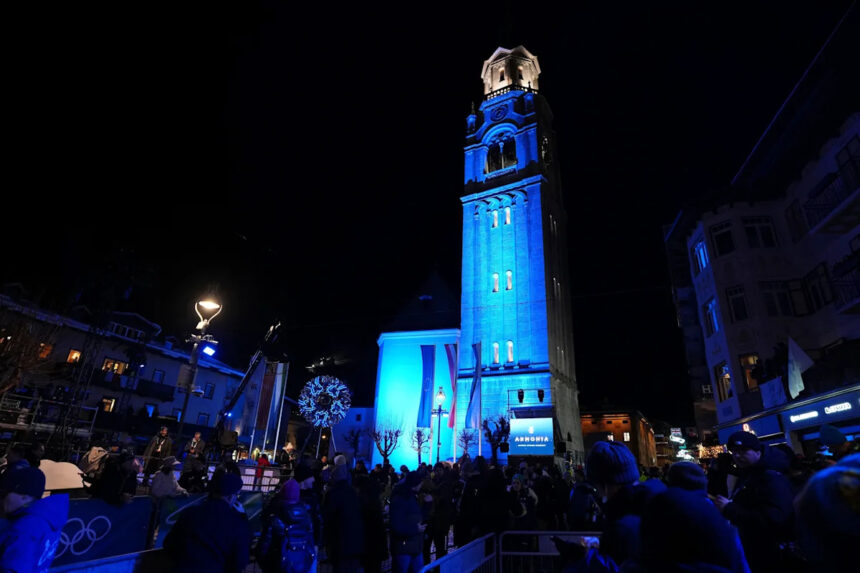
Cortina’s Cosmic Return: A Dual-Flame Opening Ignites the 2026 Winter Olympics
The crisp, alpine air in Cortina d’Ampezzo carried a unique blend of sound on Friday evening: the thumping bass from vibrant bars, the clinking of wine glasses in celebration, and the palpable buzz of history being made. Seventy years after it first hosted the Winter Games, the “Queen of the Dolomites” once again welcomed the Olympic flame, not with a solitary roar, but as part of a revolutionary, dual-hearted opening for the 2026 Milano-Cortina Games. This was not a simple ceremony; it was a decentralized spectacle, a bold reimagining of tradition that stretched across Italy’s majestic north, binding cities and mountain valleys together in a single, luminous knot of sport.
- A Parade Through Living History: Cortina’s Corso Italia Reclaims the Spotlight
- The Dual Flame: A Nod to da Vinci and a New Olympic Blueprint
- Expert Analysis: The “Distributed Games” Model and Its Legacy
- Predictions: The Cortina Effect on Competition and Culture
- Conclusion: A Knot That Binds Past, Present, and Future
A Parade Through Living History: Cortina’s Corso Italia Reclaims the Spotlight
While the world’s eyes were divided between multiple venues, the scene along Cortina’s famed Corso Italia was one of intimate grandeur. Spectators, draped in national colors and designer winter wear from the avenue’s luxury boutiques, created a human river of anticipation. Here, the athlete parade was not a distant spectacle in a massive stadium, but a close-up, communal celebration. Athletes competing in the events destined for Cortina’s legendary slopes and tracks—women’s Alpine skiing, bobsled, luge, skeleton, biathlon, and curling—marched with a palpable sense of connection to the town itself.
Their journey culminated at a profound symbolic installation: an illuminated circle acting as a portal. This design, a deliberate contrast to the vertical drama of the surrounding Dolomites, served as a “point of orientation.” It was a moment of pause and transition, where the energy of the parade was focused before flowing into the ceremony’s climax. This choice reflected a core theme of these Games: human-scale celebration amidst epic natural beauty.
The Dual Flame: A Nod to da Vinci and a New Olympic Blueprint
The most groundbreaking innovation of the night was the lighting of not one, but two Olympic cauldrons. As flames leapt to life simultaneously in Milan’s San Siro Stadium and here in Cortina, they wrote a new chapter in Olympic history. The cauldrons themselves were masterpieces of design, their intertwined structures a direct homage to Leonardo da Vinci’s intricate knots, symbolizing unity, infinity, and the interconnectedness of all things.
This was far more than a clever visual. It was a strategic and philosophical statement. The dual cauldron concept achieved several firsts:
- Geographic Unity: It physically tied the metropolitan hub of Milan to the alpine soul of Cortina, validating the “distributed” model of these Games.
- Logistical Mastery: It allowed athletes based in distant competition clusters like Livigno and Predazzo to have their own meaningful opening moments without exhausting travel.
- Symbolic Power: The enduring glow of both flames for the duration of the Games represents a permanent bond between Italy’s diverse cultural and sporting landscapes.
While Milan’s ceremony, with headliner Mariah Carey and vast, complex choreography, captured global headlines for its scale, Cortina’s offering was arguably richer in sentimental weight. It provided a participatory experience for athletes who might otherwise have missed a traditional opening due to training schedules, ensuring every competitor had their moment in the Olympic light.
Expert Analysis: The “Distributed Games” Model and Its Legacy
As a sports journalist who has witnessed decades of Olympic evolution, the 2026 opening ceremony feels like a pivotal turn. The International Olympic Committee has long grappled with the soaring costs and “white elephant” stadiums of single-city Games. The Milano-Cortina model, amplified by this multi-site opening, presents a compelling alternative.
This approach leverages existing world-class venues across a region, from Cortina’s historic Olympia delle Tofane slopes to Milan’s modern arenas. It spreads economic benefits, reduces environmental impact through shorter intra-Games travel, and offers a more authentic tourist experience. The risk, of course, is a diluted sense of unity. Yet, the ingenious symbolism of the twin da Vinci cauldrons and the synchronized ceremonies effectively mitigated that, creating a shared, simultaneous ignition point for the entire event.
The success of this model here will be closely watched by future host cities. It could very well set a new precedent for sustainable, regionally integrated mega-events.
Predictions: The Cortina Effect on Competition and Culture
Beyond the ceremony, the return to Cortina’s hallowed ground will infuse the competitions with a unique aura. The legendary Olympia delle Tofane downhill course will test a new generation of ski racers with its storied terrain. The intimate, electric atmosphere of the Curling Centre will contrast with the sheer velocity of the sliding track. Expect the following:
- Historic Performances: Athletes will be acutely aware they are competing on the same mountains as legends like Toni Sailer (1956). This could inspire record-breaking performances in Alpine skiing and sliding sports.
- Italian Alpine Surge: The home nation, fueled by the energy of a home crowd in a ski-mad region, is poised for a potential medal haul in Alpine, cross-country, and ski jumping events.
- A Fashion-Forward Games: Cortina’s chic ambiance and designer presence will likely influence the off-slope style narrative, merging high-performance gear with high-fashion apres-ski looks.
The true legacy of these Games may be this seamless blend of high-octane sport and dolce vita lifestyle, all set against a breathtaking UNESCO World Heritage landscape.
Conclusion: A Knot That Binds Past, Present, and Future
Seventy years ago, Cortina’s Games were a post-war celebration of revival. Today, its return as co-host marks a celebration of innovation and unity. The 2026 Winter Olympics opening ceremony was a beautiful paradox: it was both fragmented and profoundly connected, intimate yet globally broadcast, steeped in history while boldly futuristic.
The image that will endure is that of the twin flames, shaped like da Vinci’s knots, burning brightly over Milan and Cortina. They are more than just cauldrons; they are a promise. A promise that the Olympic spirit can adapt, can honor its past while embracing a smarter, more inclusive future. As the competitions begin, these flames stand as a testament to an opening night that didn’t just start the Games, but potentially reinvented the blueprint for how they begin. The knot is tied, the portal is open, and the next chapter of winter sport is now being written on the slopes of Cortina once more.
Source: Based on news from Yahoo Sports.