Gary Woodland’s Masters Mission: A Champion’s Battle with PTSD and the Unseen Security Detail
When the morning mist lifts from Amen Corner and the world’s best golfers step into the cathedral of Augusta National, their pre-shot routines are sacred and personal. For Gary Woodland, that ritual now includes a scan of the Georgia pines not for wind direction, but for a different kind of anchor. As he prepares for his opening drive at the 2024 Masters, his eyes will be subtly tracing the perimeter, seeking the reassuring presence of a security team. This is not a measure of vanity, but one of vulnerability and survival. The 2019 U.S. Open champion is walking the hallowed fairways while openly managing post-traumatic stress disorder (PTSD), a profound testament to the invisible battles athletes face long after the roar of the crowd fades.
- The Diagnosis: From Brain Surgery to a Mental Health Revelation
- The Unconventional Caddie: “You’re Safe” as the Ultimate Pre-Shot Routine
- The Security Detail: A Tangible Shield for an Intangible Fear
- Expert Analysis: Redefining Resilience in Professional Sports
- Predictions and Legacy: Beyond the Score at Augusta
- Conclusion: A Drive Toward Greater Awareness
The Diagnosis: From Brain Surgery to a Mental Health Revelation
Gary Woodland’s journey to this point is a stark narrative of physical triumph followed by a hidden psychological struggle. In September 2023, the golfer known for his powerful, athletic swing underwent surgery to remove a lesion that was pressing on his brain. The operation was a success, a medical victory. However, the aftermath ushered in a different kind of challenge. Last month, Woodland revealed he had been diagnosed with PTSD approximately a year ago, a condition directly linked to the trauma of his brain surgery and the pervasive fear it seeded.
For an elite athlete whose profession demands razor-sharp focus, unwavering confidence, and a sense of control, the symptoms of PTSD are uniquely debilitating. The condition can manifest as hypervigilance, anxiety, intrusive thoughts, and a heightened state of alert—a nervous system constantly prepared for a threat that has already passed. On a golf course, a arena of quiet tension and explosive pressure, these symptoms can be overwhelming. “The anxiety and stress that playing golf can cause him since the surgery,” as noted, became a formidable new opponent. His victory at the Houston Open in late March, his first win in nearly seven years, was not just a comeback; it was a monumental act of defiance against this internal adversary.
The Unconventional Caddie: “You’re Safe” as the Ultimate Pre-Shot Routine
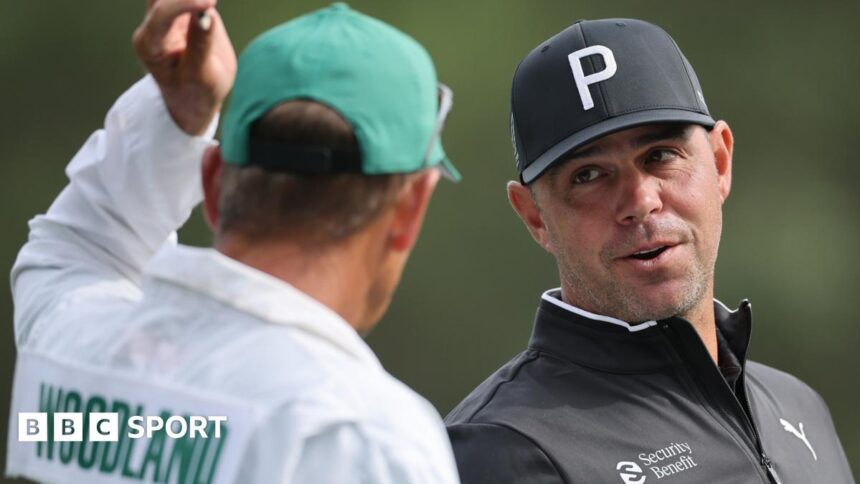
In golf, the player-caddie relationship is a fortress of trust. For Woodland and his longtime caddie, Brennan Little, that dynamic has expanded into a lifeline. Little’s role has transcended yardage books and club selection; he has become a crucial pillar of emotional and psychological support. Woodland has explicitly credited Little’s constant, grounding reminders: simple affirmations that he is safe.
This practice is a direct, on-course application of therapeutic techniques used to manage PTSD and anxiety. The verbal cue acts as a cognitive anchor, pulling Woodland’s mind away from intrusive fear and back to the present, safe reality of the golf course. Imagine the scene: amidst the crushing silence before a crucial shot at Augusta, while other players focus solely on the shot shape, Little’s steady voice provides a different kind of alignment. This partnership highlights a critical evolution in sports:
- The caddie as a holistic performance partner, managing mental health as diligently as green reading.
- The normalization of verbal affirmations for safety and stability in high-stakes environments.
- A powerful model for how trusted allies can be integrated into a treatment plan, turning a workplace into a space for healing.
The Security Detail: A Tangible Shield for an Intangible Fear
Woodland’s most visible and discussed adaptation is his decision to organize extra security at tournaments. This is a profound step that speaks volumes about the nature of his anxiety. For someone experiencing PTSD, environments that feel unpredictable or exposed can trigger the fight-or-flight response. A massive gallery, while supportive, can become a sea of potential unpredictability.
By arranging for a known, professional security presence, Woodland is creating a controlled perimeter—a tangible, visual symbol of safety. Checking where the security is stationed allows him to map his safety in real-time, providing a psychological comfort zone from which he can then execute his golf shots. This isn’t about celebrity; it’s about creating a necessary condition for performance. It allows him to conserve the mental energy typically spent on subconscious scanning and redirect it entirely to the task of competing at the highest level. This innovative approach demonstrates a radical form of self-advocacy, where a golfer proactively architects his environment to suit his mental health needs.
Expert Analysis: Redefining Resilience in Professional Sports
Woodland’s openness is a seismic moment in the often-stoic world of professional golf. Sports psychologists see this as a watershed event. “For decades, ‘mental toughness’ was misconstrued as the suppression of fear and vulnerability,” says Dr. Elena Torres, a leading performance psychologist. “What Gary is doing is redefining that term. True toughness is acknowledging the injury—in this case, a psychological one—and implementing a detailed, practical game plan to manage it. His security detail is no different than a knee brace; it’s an adaptive tool that facilitates performance under altered conditions.”
His victory in Houston proved the efficacy of his plan. He didn’t win in spite of his management strategies; he won because of them. The win validates that addressing mental health with concrete, personalized tools isn’t a weakness—it’s a competitive advantage. It sends a clear message to athletes at all levels: seeking help and creating accommodations is a path back to winning, not a retreat from it.
Predictions and Legacy: Beyond the Score at Augusta
At Augusta National, the score Gary Woodland posts is almost secondary to the statement he is making by simply teeing it up with his full truth visible. The predictions for his week should be framed through this lens:
- His performance will be a direct reflection of his comfort level, more so than his swing mechanics. Look for his results to correlate with his reported state of mind.
- Win or miss the cut, his legacy this week is already secure: he is championing a new conversation about trauma and recovery in sport.
- Expect his story to inspire other athletes, both professional and amateur, to seek diagnosis and develop their own “game plans” for mental health.
The golf world will watch, hoping for birdies. But the world beyond will watch, learning a deeper lesson about courage.
Conclusion: A Drive Toward Greater Awareness
Gary Woodland’s walk at Augusta National this year is unlike any other in the tournament’s storied history. With each step, he carries the weight of a major championship pedigree and the profound responsibility of a pioneer. By relying on the dual shields of his caddie’s words and a security team’s presence, he is not hiding from his PTSD; he is confronting it on the grandest stage. His story moves the conversation far beyond the rough and the greens. It’s a powerful narrative about the aftermath of medical trauma, the innovative paths to management, and the undeniable fact that mental health is integral to peak performance. When he looks into the Georgia pines this week, he’s seeking more than a clear line to the fairway. He’s securing his foundation, reminding us all that before a champion can swing, he must first feel safe to stand.
Source: Based on news from BBC Sport.