Tiger Woods Declines 2027 Ryder Cup Captaincy, Marking a Pivotal Moment for US Team
The landscape of American Ryder Cup leadership has shifted dramatically. Tiger Woods, the singular figure many believed was destined to guide the United States team at Bethpage Black in 2027, has officially informed the PGA of America that he will not accept the captaincy. This decision, stemming from his continued focus on recovery and a scaled-back competitive schedule following his 2021 car accident, sends a seismic wave through the golf world and forces a strategic recalibration for the US side as they look to defend home soil.
The Decision: Prioritizing Health and Competitive Fire
While the news may stun fans who envisioned Woods leading a charged-up team onto the raucous Black Course, insiders suggest the decision is a testament to Woods’s meticulous approach to his legacy and current reality. The 2027 Ryder Cup captaincy is not a ceremonial role; it is an all-consuming, multi-year commitment of diplomacy, strategy, and intense travel. For Woods, whose physical regimen is carefully crafted around his ability to play sporadic tournaments, taking on such a demanding off-course role was deemed incompatible with his primary goals.
“My focus is on my game, my body, and my family,” a source close to Woods indicated. “The captaincy requires a 100% dedication he cannot give right now, and he respects the role too much to do it halfway.” This isn’t a rejection of the Ryder Cup; it’s a prioritization. Woods’s legendary competitive drive remains, but it is now channeled into the painstaking process of preparing his body for the rigors of major championships, not the logistical marathon of a captaincy.
Analyzing the Void: What the US Team Loses (and Gains)
Woods’s absence as captain leaves a profound void. His aura alone would have been a weapon. The intimidation factor of “Captain Tiger” on home turf, in New York of all places, was a tangible asset now forfeited. His unparalleled understanding of pressure, course management, and team dynamics—forged through eight Ryder Cup appearances as a player—would have been invaluable.
Expert analysis from former captains and players, however, suggests a potential silver lining. Woods’s intense, sometimes insular, focus on excellence can be a double-edged sword in a team setting. The modern, successful US model—evidenced under Steve Stricker and Zach Johnson—has emphasized a more collaborative, data-driven, and player-friendly environment.
- Loss of Intimidation Factor: No captain would command more respect from both teams.
- Loss of In-Game Tactical Genius: Woods’s golf IQ is arguably the highest in history.
- Potential for a More Unified Locker Room: A less omnipresent figure might foster a different, perhaps more relaxed, team cohesion.
- Opportunity for a Bridge-Builder: The next captain can focus solely on the team dynamic without the overwhelming “Tiger Spotlight.”
The Contender Pool: Who Will Steer the Ship at Bethpage?
With Woods removing himself from consideration, the PGA of America’s task is clear: identify a leader who can harness the unique, boisterous energy of a New York crowd and mold a team to win on a brutal Bethpage layout. The Ryder Cup captain selection process now turns to a deep bench of qualified candidates.
Stewart Cink emerges as an immediate frontrunner. A respected major champion, a thoughtful communicator, and someone with recent winning experience on the PGA Tour, Cink embodies the modern player-coach dynamic. Davis Love III, who captained winning teams in 2012 and 2016, could be considered for a rare third stint, offering proven stability and experience.
Other compelling names include Matt Kuchar, known for his steady demeanor and popularity among peers, and Zach Johnson, who despite the 2023 loss in Rome, remains deeply respected within the PGA of America framework. A wildcard candidate is Fred Couples, whose effortless cool and player admiration could be perfect for managing personalities in a high-pressure environment. Do not rule out a younger, recent-playing captain like a Phil Mickelson, though his involvement with LIV Golf complicates that path.
Predictions and The Long Shadow of Tiger
This decision likely reshapes Woods’s Ryder Cup future entirely. The Bethpage Black captaincy was seen as his perfect swan song in the event. It is now plausible he transitions into a behind-the-scenes role—a vice-captain or special advisor—where his insights can be leveraged without the burdens of leadership. Alternatively, he may step back from the Cup arena altogether to conserve energy for his playing pursuits.
For the US team, the immediate future of American golf leadership looks toward a figure who can be a full-time CEO of the team for the next three years. The prediction here is that the PGA of America will opt for a fresh, yet deeply connected, voice. Stewart Cink represents that ideal blend: a contemporary of Woods who operates with a different, perhaps more accessible, leadership style. The mission will be to build on the successful framework of recent years, not to replicate a “Tiger Era” that was never meant to be.
Conclusion: A Turning Point, Not an Endpoint
Tiger Woods’s decision to decline the 2027 Ryder Cup captaincy is a landmark moment, but it is not a catastrophe for American hopes. It is a sober acknowledgment of his physical reality and a respectful nod to the immense demands of the job. While the dream of Captain Tiger rallying the troops before a frenzied New York crowd is now extinguished, it clears the way for a new chapter in US Ryder Cup leadership.
The US Ryder Cup team at Bethpage will now be forged under a different guiding hand. The core of young superstars—the Morikawas, Schefflers, and Cantlays—will still form the backbone of the team. The task for the new captain is to unite them, strategize for a punishing course, and weaponize the home crowd’s energy. Tiger Woods’s shadow will always loom over American golf, but at the 2027 Ryder Cup, the spotlight will finally, and fully, shine on whoever steps forward to take the helm. The quest for a new leader begins now.
Source: Based on news from Sky Sports.
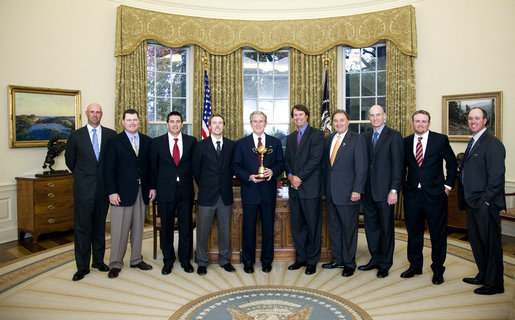
Image: CC licensed via georgewbush-whitehouse.archives.gov