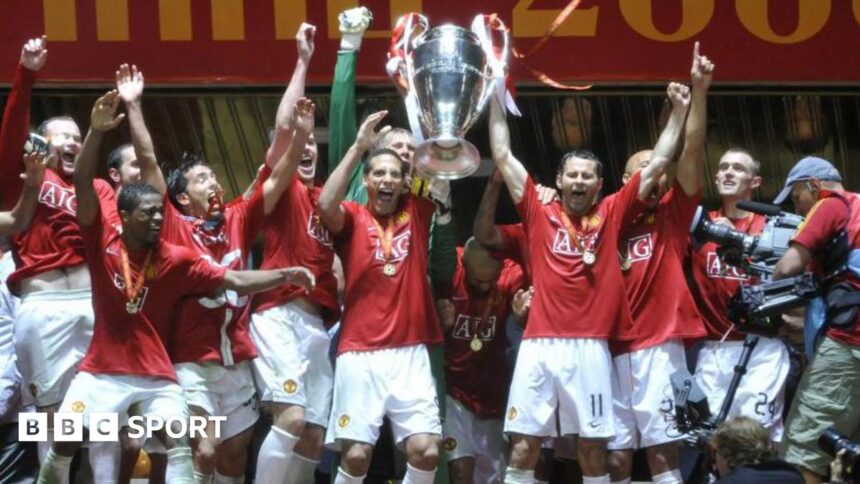
Would Man Utd’s 2008 Treble-Winners Really ‘Batter’ Arsenal’s 2026 Contenders?
The eternal, intoxicating debate of eras colliding on a football pitch has been reignited with a spark of pure, unscripted bravado. The setting was the Overlap fan debate, the protagonists were former England teammates, and the claim was seismic. Theo Walcott, discussing Mikel Arteta’s burgeoning Arsenal project, seemingly pondered if the current side could be challenged by the legendary Manchester United team of 2008. Wayne Rooney’s response was instantaneous, dripping with the trademark bullish certainty of his playing days: “Yeah, we’d batter them.” The statement hangs in the air, a tantalizing ‘what if’ that transcends mere banter. But beyond the headline, could Sir Alex Ferguson’s European champions truly dismantle a modern Arsenal machine built for 2026?
The Immovable Object: Deconstructing the Man Utd 2008 Juggernaut
To understand Rooney’s confidence, one must first appreciate the sheer, multifaceted dominance of that United side. The 2007-08 squad was not just a collection of stars; it was a perfect fusion of peak-age experience, youthful explosiveness, and the iron will of Sir Alex Ferguson. They secured a Premier League and Champions League double, playing a brand of football that was both ruthless and exhilarating.
Their tactical blueprint was versatile, often a 4-4-2 or 4-3-3 that could morph in-game. It was built on a bedrock of Rio Ferdinand and Nemanja Vidic, arguably the greatest defensive partnership in Premier League history. Ahead of them, the engine room combined Paul Scholes’s metronomic passing, Owen Hargreaves’s tenacity, and Michael Carrick’s intelligence. The attack was a nightmare for any defense: the telepathic understanding of Rooney and Carlos Tevez, with the ballistic, world-beating genius of Cristiano Ronaldo soaring above it all.
- Defensive Fortress: Ferdinand’s elegance and Vidic’s brutality conceded just 22 league goals.
- Midfield Mastery: Scholes controlled tempo, while the work rate of Park Ji-sung in big games was legendary.
- Attacking Firepower: Ronaldo (42 goals), Rooney, and Tevez provided a blend of power, skill, and relentless pressing from the front.
- The Ferguson Factor: The psychological edge and in-game management were immeasurable assets.
This was a team that knew how to win every type of match: they could outplay you, outfight you, or snatch victory in stoppage time. Their mentality, as Rooney alluded to, was “We’re going to score more than you.”
The Modern Force: Arsenal 2026’s Projected Peak
Assessing Arsenal in 2026 requires projection. Under Mikel Arteta, the club has meticulously built a young, athletic, and tactically sophisticated squad designed for sustained dominance. By 2026, the current core—Bukayo Saka, William Saliba, Martin Ødegaard, Declan Rice—would be at their absolute peak, supplemented by further strategic acquisitions.
Arteta’s system is a high-precision, possession-based machine with intense gegenpressing triggers. It demands technical perfection, physical endurance, and tactical discipline. The 2026 iteration would likely be even more refined, with players completely ingrained in its complexities.
- Technical & Physical Prowess: Modern players are faster, stronger, and trained in complex tactical systems from a young age.
- Tactical Complexity: Arsenal’s structured build-up and coordinated press could disrupt any era’s rhythm.
- Youthful Peak: A squad entering its collective prime, with immense big-game experience.
- The Arteta Blueprint: A manager whose obsessive detail rivals the greats, potentially closing the “Ferguson gap.”
The key question is whether their technical and tactical advancements could overcome the raw, winning brutality and individual genius of the 2008 United side.
Tactical Crossroads: Where the Eras Would Collide
This fantasy clash would be a battle of philosophies. United’s 2008 side excelled in transition, using direct, vertical passing to unleash their ferocious front three. Arsenal 2026 would seek to control the ball, suffocate United’s midfield space, and isolate the Ferdinand-Vidic partnership by moving them with intricate passing patterns.
The key battles would be mesmerizing. Declan Rice and Martin Ødegaard trying to navigate the press of Tevez, Rooney, and a young, hungry Ronaldo. Scholes attempting to pick passes through Arsenal’s high defensive line. How would Saliba and Gabriel handle the combined physicality and movement of Rooney and Tevez? Could the legendary United backline cope with the inverted runs of Saka and a Martinelli-type winger, a movement pattern less common in 2008?
Set-pieces would be a critical arena. United, with Ronaldo, Vidic, and Ferdinand, were monstrous. Modern Arsenal, however, employs set-piece specialists with scientifically designed routines, representing a clear evolution in that department. This one area might see the 2026 side hold a distinct, quantifiable advantage.
The Verdict: Could a ‘Battering’ Really Happen?
Wayne Rooney’s “batter” is the language of a competitor, a psychological assertion of his team’s superiority. In reality, a one-off match would likely be fiercely contested, decided by moments of individual brilliance or a tactical tweak.
United’s biggest advantages are their proven mentality in the biggest moments and the presence of Cristiano Ronaldo—a player capable of deciding any game, in any era, single-handedly. The combined streetwise aggression and game intelligence of that United squad in a cup final scenario is an intangible that is hard to quantify but impossible to dismiss.
Arsenal’s strongest case lies in the evolution of the sport. The overall athleticism, tactical preparation, and depth of the modern elite player is superior. Their system could frustrate United and control large periods. However, the 2008 United side was uniquely equipped to punish any mistake with devastating efficiency.
Would it be a battering? Almost certainly not. This would be a epic, razor-tight clash. United’s sheer concentration of world-class talent in their prime—particularly Ronaldo—might give them a narrow edge in a one-off final. They had a unique knack for finding a way to win. But the idea that Arteta’s Arsenal, at its projected 2026 peak, would be overwhelmed is a disservice to the modern game’s sophistication. They would not be battered; they would be challenged in a way no current Premier League side could replicate.
Conclusion: The Unanswerable, Essential Debate
Ultimately, Walcott’s question and Rooney’s retort celebrate what makes football fandom eternal. We compare, we argue, and we lionize the heroes of our time. The Manchester United of 2008 remain a benchmark of holistic excellence and sheer winning power. The Arsenal of 2026 represents the cutting edge of football’s future—a system-built, technically sublime project.
While the science of sport marches on, the heart of the game resides in characters like Rooney, Ronaldo, and Keane, and the indomitable spirit Ferguson instilled. In a hypothetical clash, that spirit might just shade it. But to suggest a battering is the nostalgia-fueled boast of a legendary warrior, defending the honor of his band of brothers. The truth, as always, is lost in time, leaving us with only the glorious, unprovable debate—and football is all the richer for it.
Source: Based on news from BBC Sport.